[Ateneo Press Review Crew] The Measure of a Woman, the Making of a Nation Through Carmen Guerrero Nakpil’s Essays
01 Dec 2025 | Arienne Therese Guinto



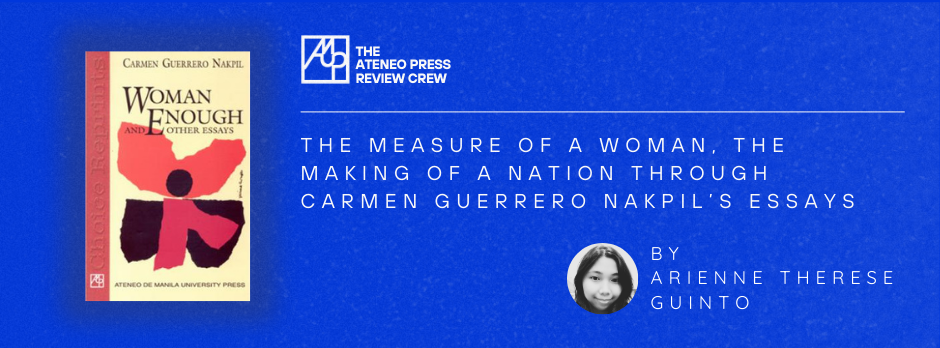
What does it mean to be enough—for a woman, for a writer, for a nation still learning its name?
I first opened Carmen Guerrero Nakpil’s Woman Enough: and Other Essays out of curiosity. The title alone felt like a provocation. It carried the weight of a question that has never stopped haunting Filipino women: enough for whom?
The collection gathers her post-war essays, originally written between the 1950s and 1960s, where she dissects everything from history and politics to beauty, love, and myth. At first glance, the pieces appear genteel—short, polished, conversational—but there’s a charge beneath the surface. Her voice is precise and deliberate, as if testing how much truth she can slip past the expectations of her time.
I didn’t read the book all at once. Some days I would read just one essay and then sit with it for a while. The experience wasn’t difficult, but it wasn’t something you could rush through either. Nakpil’s language feels deceptively simple; her arguments, anything but.
If I could, I would talk about every essay. But a few in particular stayed with me.
In Woman, the book’s opening piece, Nakpil describes the Filipina as carrying “a long, unburied, polychromatic past.” It’s a striking image. She doesn’t begin with oppression or suffering but with memory; layered, persistent, alive. She imagines the Filipina not as a passive inheritor of colonial wounds but as someone who predates them, whose story begins long before colonizers arrived. It’s a gentle but radical reframing: a reminder that identity doesn’t have to start with victimhood.
Then in Myth and Reality, she turns her attention to the idea of womanhood itself. On the surface, it’s a critique of the Maria Clara archetype. But it’s more than that. Nakpil peels away the layers of myth that shape how we imagine both women and the nation. The “ideal woman”—pure, self-sacrificing, silent—is a convenient fiction, she implies, just as the “ideal nation” often is. Both demand submission in exchange for belonging. Reading this now, when our politics still romanticizes suffering as a form of virtue, it’s hard not to see the relevance.
In Maria Clara, she revisits the same figure but with more intimacy. She doesn’t condemn Maria Clara outright; instead, she wonders what might happen if we allowed her to speak. What stories would she tell if freed from the pens of men who made her a symbol? It’s a different, subtle form of rebellion through Nakpil’s way of reclaiming narrative power without announcing it. You sense her frustration between the lines, but also her tenderness for the women she’s trying to recover.
Even Guide to Filipino Politics, which sounds like a detour into humor, carries an undercurrent of critique. Beneath her witty commentary about governance lies a moral insight: that civic virtue, the kind that sustains nations, is rooted in care—the same ethic long confined to the private, domestic sphere. She turns the notion of “women’s work” inside out, suggesting that the discipline of empathy and responsibility is exactly what public life lacks.
What struck me most about this book was not just Nakpil’s intellect. It was her restraint that you can observe throughout the collection. She writes like someone aware of the limits placed on her voice, yet refuses to be defined by them. There’s no anger on the page, but you can sense the urgency in the spaces between her sentences. She mastered the art of saying enough to be understood, and leaving enough unsaid to stay free.
And that, I think, is what makes the book enduring. Nakpil wrote in an era when the language of feminism didn’t yet exist in mainstream discourse, but her work anticipates it. She interrogates the myths that tie womanhood to martyrdom, and by doing so, exposes how the same myths keep the nation tethered to colonial ideals of virtue and obedience. Her essays remind us that decolonization is not only political, but also personal, embodied, lived through the everyday.
There’s something distinct about Philippine non-fiction—it rarely distances itself from life. Even when it turns critical, it stays rooted in lived experience, carrying the warmth and tension of memory. Nakpil writes this way too; her essays think aloud, unafraid to contradict themselves, to show uncertainty as part of the work of becoming. That’s what makes reading her both humbling and unsettling.
With that, Woman Enough: and Other Essays feels less like a book you finish and more like one that finishes with you because it lingers, unsettles, and makes you trace your own boundaries. Long after, you start catching echoes of her words in the quiet moments you question your own place in things.
So what does it mean to be enough? Nakpil doesn’t offer an answer. She leaves the question with us instead—with every woman who has been told to shrink her voice, and with every citizen who wonders if love for country must mean silence.
Keep the question alive. Get your copy here: Website | Shopee and Lazada
Arienne Therese Guinto is a people's researcher at the Institute for Nationalist Studies, with a background in Human Ecology. She critically engages with public policy, disaster resilience, feminist thought, grassroots organizing, and nationalist movements, emphasizing the intersections of power, resistance, and social transformation. In her capacity as a reviewer, she seeks to interrogate dominant narratives, foreground marginalized perspectives, and contribute to a more critical and emancipatory discourse in literature and scholarship.
Recent News
You may also like these articles
[Hot Off the Press] Arkipelago
New book from the Ateneo Press Arkipelago provides a fascinating and fantastical twist on Philippine politics and history Our country is an archipelago of stories
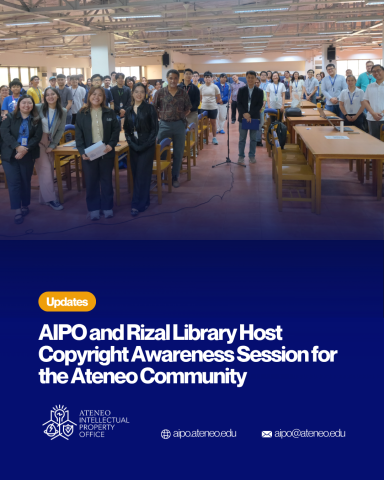
Protecting Creativity: AIPO and Rizal Library Host Copyright Awareness Session for the Ateneo Community
On March 18, 2026, the Ateneo Intellectual Property Office (AIPO), in collaboration with the Rizal Library, successfully conducted a Copyright Awareness Session held on the
Holy Week 2026 Holidays (Memo # UHR2526-038)
Memo # UHR2526-038 31 March 2026 TO: All Employees FROM: [Sgd] Maria Victoria T Cortez, PhD Vice President for University Human Resources SUBJECT: Holy Week
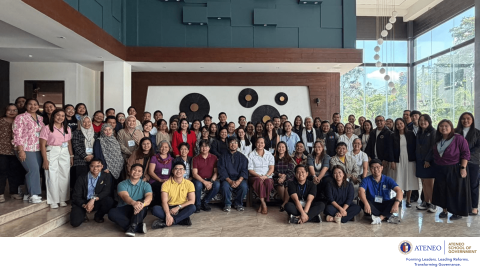
ASOG’s Tobacco Control initiatives spotlighted in DOH National Technical Working Group for Tobacco Prevention and Control
On March 10 to 12, 2026, the Ateneo School of Government (ASOG), through its research and public policy unit, the Ateneo Policy Center, participated in
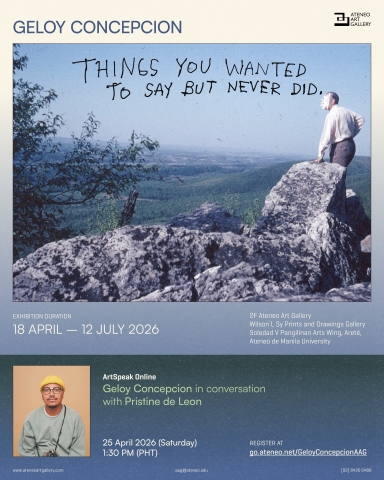
Things You Wanted to Say But Never Did: Geloy Concepcion’s six-year project makes Its exhibition debut at the Ateneo Art Gallery
Geloy Concepcion’s Things You Wanted To Say But Never Did comes to the Ateneo Art Gallery this 18 April 2026. After receiving almost 300,000 messages
[Hot Off the Press] Love If I'm Pretty
New YA Release from the Ateneo Press Love If I’m Pretty tackles the nuances of growing up through complex characters and straightforward prose What do