[Ateneo Press Review Crew] The Essay Is Brechtian Theater in Martin Villanueva’s “A Pig Was Once Killed In Our Garage”
22 Jan 2026 | Ashley Martelino

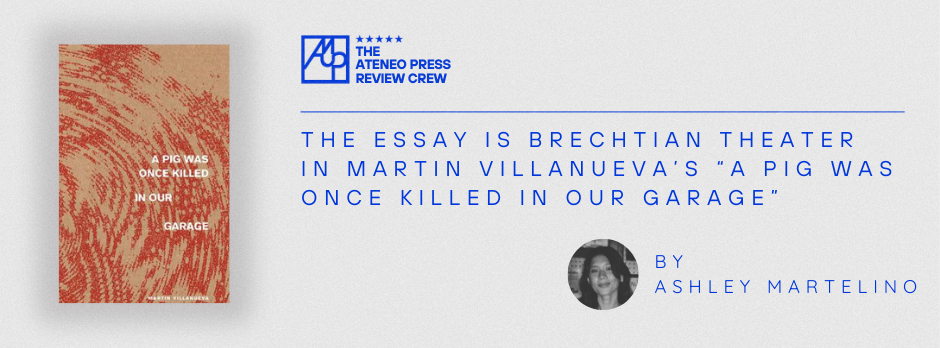
Pay attention to how Martin Villanueva writes an essay. In A Pig Was Once Killed In Our Garage, he points a finger at his own process. In many ways, the collection is all about the construction of nonfiction, but not necessarily a love letter to it. Villanueva here is suspicious of the essay and of his own inclination to create it. The writer, or at least the narrator that stands in his place, is unsympathetic of those who use the genre as a means of self expression or coping mechanism, where the writing is a “mere conduit to opening up and holding hands.” His project here is not the subject matter or the wisdom it might produce, but the practice of writing it down—the performance of putting it on paper.
A patchwork portrait of events from Villanueva’s life, A Pig Was Once Killed In Our Garage revolves around the author’s family, his past romantic relationships, his career as a writer and educator, and the cancer that plagued his body. Despite the personal subject matter, the writing often keeps the reader at arm’s length, encasing anecdotes in a purposeful nonchalance. Many of the most stereotypically emotional moments are presented as matter-of-fact, surgical, detached, indirect, betraying a general aversion to the “touchy feely.” The narrator is self-conscious, as if politely sparing his readers the most unpleasant details. Where other writers would aim for catharsis or didacticism, Villanueva reveals only anti-climax.
The collection begins with a meditation on lists as Umberto Eco described them—that is, as both a tool for containment, and an implication of boundlessness. It’s no coincidence that the entire collection is structured like a list where each essay is numbered—made more apparent by the fact that only six of the 20 entries are titled. That said, the organizing structure here is relatively loose. Some essays list their years of origin (though they’re not laid out in chronological order), others don’t. Many entries are straightforward essays, others written (again) as lists, or even lists within lists; one a pseudo-academic paper, complete with footnotes. The narrator shifts in and out of chronology, sometimes distracting the reader with long tangents or breaks in thought. It is a manufactured randomness—refusing a theme, an order of events, often even the imposition of titles.
For Villanueva, the focus is not life itself or the events that defined it, but rather the process by which those events are narrated, remembered, recorded, framed. He is interested not in the heart of a particular memory, but more so on how it is transformed into the written word—the tricks it plays, the subjects it is selling out, the personal material it is exploiting. If the collection can be said to have a center, it is the writer—not the autobiographical figure experiencing these moments in time, but the writer who is recounting them.
Consider the fifth entry in the collection (one of the untitled ones), where Villanueva describes conducting an interview for an article, then later recalls a difficult conversation with his father. He foregrounds both instances with the same line: “I hold onto this,” he says, conscious that he is mining both his life and the interviewee’s for material. The entry ends with a note from Villanueva’s then-editor: “Don’t get distracted by the histories and personal stories of your interviewees. They’re NOT the subjects of your article.” Narrativizing, then, becomes a dehumanizing exercise, an effacement of the subject in favor of its poetic value.
Again and again, Villanueva reminds us that this is the process he is employing. As the writer, he cannot resist it. As readers, we must contend with it. Perhaps he illustrates it best in his 11th entry, After Sagada—an essay that takes place entirely in Sagada, but whose title implies its existence is an act of remembrance. In it, he recalls two past relationships. “We wouldn’t last the year,” he declares of one. And for the other: “We would last two years.”
Later, in the collection’s 10th entry, he recalls breaking up with a former partner, then trying (and failing) to win her back. “I can be the type to want a stranglehold of the narrative,” he says before recounting the experience that ultimately “went off script” from what he had planned. As the entry comes to a close, he decides, “The story always outlives the memory,” which might be another way of saying that “history is written by the victors.” The writer is a propagandist. His power over the narrative is absolute. He has no choice in the matter.
And since this authoritarian impulse cannot meaningfully be resisted, Villanueva settles for a look behind the curtain—a Brechtian performance of nonfiction writing where thought process is exposed in place of staging mechanics, alienating the reader from the hallucinatory narrative image. Characters and events are revealed discontiguously, asymptotically; diverging just before they can piece together and synthesize meaning. “I’m writing this now,” he says in countless instances throughout the collection, almost childlike in his fourth-wall breaks—a reminder that even his version of the story is a fabrication. Often, it feels like Villanueva is attempting to teach his reader: Notice this. Pay attention to this. Can you see how the sausage is made?
This is why “Poetics,” one of the longest works in the collection, is perhaps its best entry, which is to say, its most skilled performance. Here, Villanueva reckons directly with the nature of creative nonfiction, defining, redefining, and problematizing it several times over. “The genre deemed most honest and true was actually that which should be viewed as most meta, most concerned with construction, most self-conscious,” he says, citing John D’Agata. Drawing from Phillip Lopate, he says, “The story then in the tradition of the personal essay is not the events that take place in one’s life, but how the mind attempts to come to an understanding of occurrences, ideas, and images.” Ironically, this is where Villanueva is most vulnerable. Every new argument is a shattering of the glass, an unsuspension of disbelief, an interrogation of the self.
In the collection’s penultimate essay, Villanueva describes “the angered thrill of nailing things, especially the most ugly, on the head, squarely,” shortly before declaring with clarity and bite: “My mother is a loser.” For Villanueva, there is a dread that comes with finally putting something into words, an inconvenience in constructing meaning so conclusively. But this is the writer’s begrudging mission, his only passage to some form of honesty. Despite his resistance, he must take part in the process. He concedes: “Perhaps I’m most true when I’m bothered enough to write about it.” The show must go on.
Get your copy in paperback: Website | Shopee and Lazada
Ashley Martelino is a writer and editor based in Metro Manila. Her work has been featured on various local publications. She graduated from Ateneo de Manila University with a degree in English Literature.
Recent News
You may also like these articles
[Hot Off the Press] Arkipelago
New book from the Ateneo Press Arkipelago provides a fascinating and fantastical twist on Philippine politics and history Our country is an archipelago of stories
Protecting Creativity: AIPO and Rizal Library Host Copyright Awareness Session for the Ateneo Community
On March 18, 2026, the Ateneo Intellectual Property Office (AIPO), in collaboration with the Rizal Library, successfully conducted a Copyright Awareness Session held on the
Holy Week 2026 Holidays (Memo # UHR2526-038)
Memo # UHR2526-038 31 March 2026 TO: All Employees FROM: [Sgd] Maria Victoria T Cortez, PhD Vice President for University Human Resources SUBJECT: Holy Week
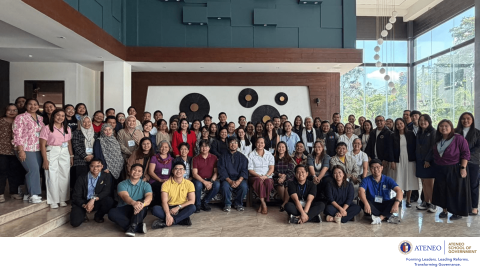
ASOG’s Tobacco Control initiatives spotlighted in DOH National Technical Working Group for Tobacco Prevention and Control
On March 10 to 12, 2026, the Ateneo School of Government (ASOG), through its research and public policy unit, the Ateneo Policy Center, participated in
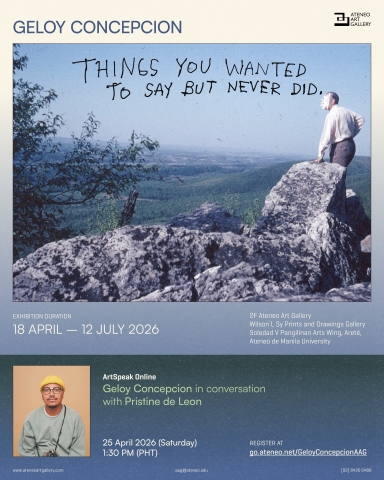
Things You Wanted to Say But Never Did: Geloy Concepcion’s six-year project makes Its exhibition debut at the Ateneo Art Gallery
Geloy Concepcion’s Things You Wanted To Say But Never Did comes to the Ateneo Art Gallery this 18 April 2026. After receiving almost 300,000 messages
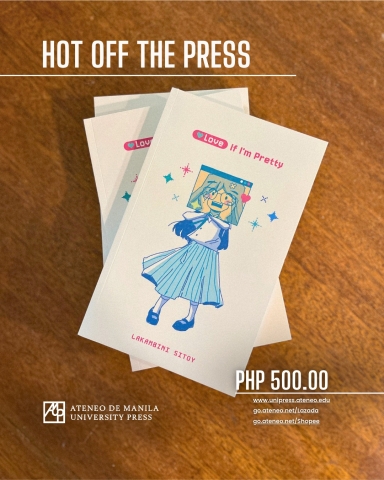
[Hot Off the Press] Love If I'm Pretty
New YA Release from the Ateneo Press Love If I’m Pretty tackles the nuances of growing up through complex characters and straightforward prose What do