[Tinig] Confessions & Reflections of a Once Deactivated Voter
01 Dec 2021 | Marnie D. Racaza
On September 21, 2021, the 49th anniversary of the declaration of Martial Law, I lined up at the COMELEC from 5:00 a.m. until 12:00 noon to reactivate my registration. Of the 54 million registered voters recorded by the Commission on Elections (COMELEC) for the 2016 national and local elections, more than 44 million Filipinos exercised their right to vote. I was one of those who did not.
I have been a registered voter in Cebu since 2009, but the last election I participated in was when the country had its first automated election in 2010. During the highly contentious 2016 election, I was in Baguio City. I deliberately chose not to vote because it was costly to go home to the province. I also did not make an effort to inform myself about the provision of transferring my voter’s registration. I justified my actions by thinking that my vote would not make a difference and that the same set of trapo politicians would eventually win. Perhaps in 2016, there were more than 10 million of us who had this kind of political cynicism. However, the 263,473-vote-difference between Vice President Leni Robredo and Bongbong Marcos and the repercussions of giving power to tyrannical politicians debunk the statement “my vote does not matter.” Because it really matters.
Mea culpa, mea culpa. We know that there is more to political participation than voting during election time. Nevertheless, it is imperative that we take part in it. I came across social media posts, editorials, and random remarks blaming the 16.6 million Filipinos who voted for Rodrigo Duterte for the country’s current socio-political climate, one marred by impunity, blatant disregard for human rights, and a culture of violence. But honestly, I feel ashamed and guilty for being one of those who did not exercise a social responsibility. Mea culpa, mea culpa.
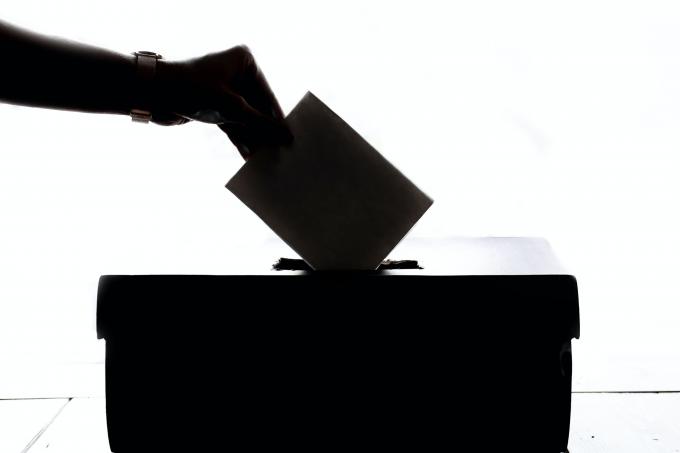
Vatican II’s Pastoral Constitution on the Church in the Modern World or Gaudium et Spes particularly stresses the necessity of free and active participation in the establishment of the juridical foundations of the political community, of fixing the terms of reference of the various public bodies, and of electing political leaders. All citizens then must be mindful of their right and duty to use their free vote to further the common good (GS 75). Political participation by exercising conscientiously the right to vote is an act of social charity. In his most recent social encyclical Fratelli Tutti, Pope Francis emphasizes the value of political love in which he describes it as a “commanded” love that galvanizes people and communities to create more sound institutions, more just regulations, and more supportive structures (FT 186).
Manifesting political love in the exercise of the right to vote entails not only registering and showing up on election day. What the electorate does during the election and campaign periods is equally important. Examining the candidates and their platforms carefully and engaging in dialogue with the community are part of the whole process. I remember that six months before the 2016 national elections, I unfollowed some of my acquaintances and friends whose political stance I did not agree with. But proactive political participation necessitates genuine dialogue with those whose political perspectives differ from ours.
The path of engagement and dialogue is not a walk in the park. From a personal experience, it took a lot of courage to reach out to a close friend and express my thoughts on her staunch support for President Duterte. When one faces opposition, the more convenient route is to be reactive instead of responsive. However, the latter generates more authentic conversations because it is grounded on openness, respect, and humility. Since my friend knew that I had good intentions for initiating the talk, our discussion turned out light and enlightening. Dialogue creates spaces where the people involved can freely ask questions, raise concerns, and discern alternative solutions. On the other hand, being reactive may lead to counterproductive actions like labeling people as bobotante and their votes as bobo.
In her work Thinking and Moral Considerations, the twentieth-century political theorist Hannah Arendt argued that people commit unfavorable actions or decisions not out of stupidity or kabobohan but because of thoughtlessness. For her, stupidity and thoughtlessness are two different conditions. Arendt pointed out that the faculty of thinking is an attribute present in all people and not just a privilege of the few. Therefore, everyone can think. Nevertheless, I believe that spaces conducive to thinking should be provided in the process. Genuine political dialogue or engagement is a perfect space to think.
In her work, Arendt described Socrates as an exemplar of teaching and provoking people to think. Using her discourse on the similes that Socrates applied to himself: gadfly, midwife, and electric ray, we can deduce certain ways on how to facilitate thinking in a political dialogue or engagement.
Firstly, Socrates was a gadfly because he aroused the citizens to think. To be a gadfly in an engagement, one must induce people to scrutinize the status quo by asking relevant, even upsetting questions. Second, Socrates exemplified himself as a midwife because he delivered people of their thoughts and purged them of their unexamined prejudgments. To be a midwife in a dialogue is to be someone who helps people to bring to light their misconceptions and the biases blocking their access and witness to the truth. And lastly, to be an electric ray in an engagement is to be someone who makes people pause and think uninterruptedly, exploring life-giving alternatives to the status quo. Exercising the right to vote then demands careful thought, a reactivation of our capacity to think.
Recently, Bloomberg’s COVID Resilience Ranking identified the Philippines as the worst place to be in a pandemic. According to the report, the poor ranking is ascribed to the country’s underperformance in the containment of the virus, especially the delta variant, inadequate testing mechanisms, low community mobility, weak healthcare systems, and disruptions to the economy. These dire conditions still obtaining, the results of the 2022 elections will be crucial for the country’s recovery. May we exercise our right to vote conscientiously and thoughtfully.
Tinig is a monthly opinion and analysis series from the School of Humanities. The views expressed in this piece are those of the author and do not necessarily represent the views of School of Humanities or the Ateneo de Manila University.
Recent News
You may also like these articles
Protecting Creativity: AIPO and Rizal Library Host Copyright Awareness Session for the Ateneo Community
On March 18, 2026, the Ateneo Intellectual Property Office (AIPO), in collaboration with the Rizal Library, successfully conducted a Copyright Awareness Session held on the
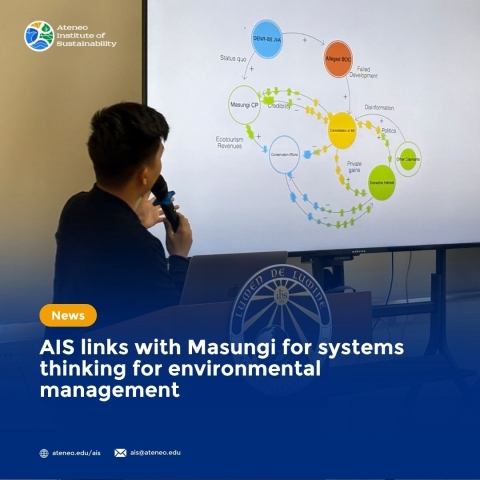
AIS links with Masungi for systems thinking for environmental management
Last 23-24 March 2026, the Ateneo Institute of Sustainability (AIS) , which manages the My Climate Risk – Ateneo de Manila University Regional Hub
Contingency Measures in Higher Education in the Face of a Worldwide Energy Crisis (HE Memo#Y4.16)
In response to the energy crisis caused by escalating tensions in West Asia, Ateneo Higher Education will implement the following class and operational adjustments.
Basic Education Class Schedules March – June 2026 (OVPBE memo)
In alignment with DepEd Memorandum No. 018, s. 2026, and our own commitment to Cura Personalis, we are refining our operations for the remainder of the school year to ensure that we finish strong, safe, and sustainable.
QS Subject Rankings 2026: Ateneo in top 100 for theology; ranked in 7 subject areas
Ateneo de Manila University is among the top institutions in seven subject areas, and among the top 100 for theological and religious studies, according to

URH residency application for Intersession SY 2026-2027 now open
Hey, Blue Eagles! Big news — URH INTERSESSION RESIDENCY SY 2026-2027 is NOW OPEN! Apply now to live where the vibes are unmatched! What’s in