Gen(eration)AI: A Reflection on GenAI in Higher Education
15 Feb 2025 | Teofilo Giovan Pugeda III



As a member of the Department of Theology, I was privileged to be invited as a discussant in a roundtable discussion on “The Ethics of Teaching and Learning in the World of GenAI [Generative AI],” hosted by the School of Humanities and the Ateneo Teacher Formation Institute on 4 February 2025, at Faber Hall 101. In this opinion piece, I offer two complementary insights I presented during the roundtable discussion for faculty members and students to think about when considering GenAI. For clarity, I write from a humanities, specifically theological, perspective. Nevertheless, GenAI is applicable in many disciplines and has different uses. Thus, I hope my insights cut across disciplines and uses insofar as they promote reflection.
GenAI poses benefits and risks for teaching and learning in general. The path forward may seem uncertain. But it is a hallmark of academia to learn, analyze, adapt, and move on. We have been doing it since the rise of the internet in the 1980s. Following the proliferation of email (1990s), social media (2000s), and others, GenAI is but another novel manifestation of the ongoing internet phenomenon. How long it remains novel depends on what would next capture our imagination. Until then, it is our responsibility to respond to GenAI in a just and effective manner.
For my purposes here, I refer to the Guidelines on the Responsible Use of Generative Artificial Intelligence in Higher Education, which the School Council approved on 18 November 2024, and presented to the President’s Council on 27 November 2024. The document is thirteen pages long, but the substance is ten, namely pages 3–12. I opine that the raison d'être of the document is on page 5, in section A, entitled Ethical Use. The first point states that instructors and students should “ensure that, in using GenAI technologies, the promotion of human dignity and the common good are upheld.” I believe this is the fundamental basis for the proper use of GenAI. Let us consider the following.
Firstly, what is human dignity? From the Roman Catholic perspective, the answer lies in our being in the image and likeness of God or Imago Dei. How can GenAI technologies help promote this? Consider what God whose image and likeness we are in. We are in the image and likeness of a God who chose to enter the human experience rather than just snap our salvation into reality. In becoming human, God entered into the complexities of human life from conception, birth, ministry, passion, death, and resurrection. With this in mind, I wonder if GenAI will encourage us to enter deeply into the human experience through serious thought and reflection, or perhaps it will disincentivize these by simply providing answers and solutions for us to consume passively. I think the foundation of a good life is not necessarily convenience but meaning, though the two are not mutually exclusive. Significantly, meaning comes from embracing the human experience. GenAI does make teaching and learning convenient, but how it can make them more meaningful is something we have to ask ourselves.
Secondly, some class materials will not have the same rigorous discussion level outside the university setting. In other words, the conditions of the university push one to think seriously about many topics. Yet, too often, we take a primarily utilitarian view of education: “I am learning this to get something out of it, particularly a lucrative job after graduation.” While not bad per se, if taken to the extreme, it can make us lose sight of the beauty of knowledge as truth. If we allow GenAI to think for us, we deprive ourselves, as rational beings, of much meaningful immersion with the class materials that we will likely encounter only in the university setting. I wonder how many Ateneo graduates will once again encounter the likes of Hannah Arendt, Karl Rahner, Roque Ferriols, Émile Durkheim, et al? With what little time there is to meet them in Ateneo, how can GenAI help us better appreciate their works?
Looking forward, GenAI will continue to normalize itself in education as time passes. I am cautiously optimistic that with correct information, regular discussions, and enough trial and error, GenAI would be more of an asset than a threat to the teaching and learning experience. Nonetheless, as the generation still grappling with GenAI, we are responsible for laying down the groundwork for an appropriate ethics for ourselves and succeeding generations. May the conversation continue.
Recent News
You may also like these articles
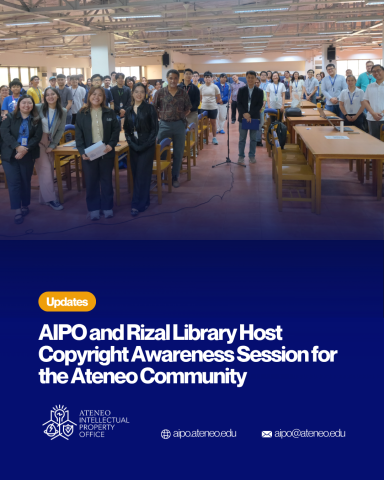
Protecting Creativity: AIPO and Rizal Library Host Copyright Awareness Session for the Ateneo Community
On March 18, 2026, the Ateneo Intellectual Property Office (AIPO), in collaboration with the Rizal Library, successfully conducted a Copyright Awareness Session held on the
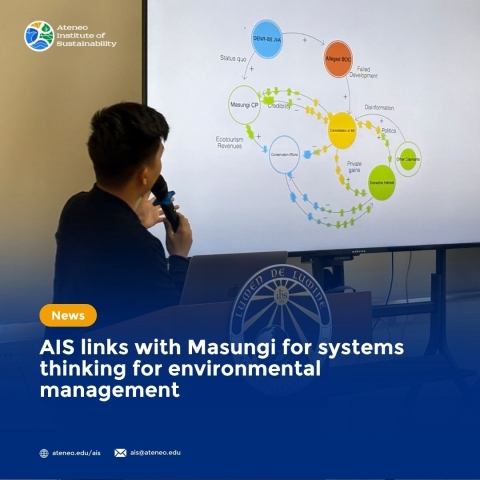
AIS links with Masungi for systems thinking for environmental management
Last 23-24 March 2026, the Ateneo Institute of Sustainability (AIS) , which manages the My Climate Risk – Ateneo de Manila University Regional Hub
Contingency Measures in Higher Education in the Face of a Worldwide Energy Crisis (HE Memo#Y4.16)
In response to the energy crisis caused by escalating tensions in West Asia, Ateneo Higher Education will implement the following class and operational adjustments.
Basic Education Class Schedules March – June 2026 (OVPBE memo)
In alignment with DepEd Memorandum No. 018, s. 2026, and our own commitment to Cura Personalis, we are refining our operations for the remainder of the school year to ensure that we finish strong, safe, and sustainable.
QS Subject Rankings 2026: Ateneo in top 100 for theology; ranked in 7 subject areas
Ateneo de Manila University is among the top institutions in seven subject areas, and among the top 100 for theological and religious studies, according to
URH residency application for Intersession SY 2026-2027 now open
Hey, Blue Eagles! Big news — URH INTERSESSION RESIDENCY SY 2026-2027 is NOW OPEN! Apply now to live where the vibes are unmatched! What’s in