Storying Climate: MCR-Ateneo opens Climate Research series with transdisciplinary lens
20 Apr 2023 | Daniel C Ratilla


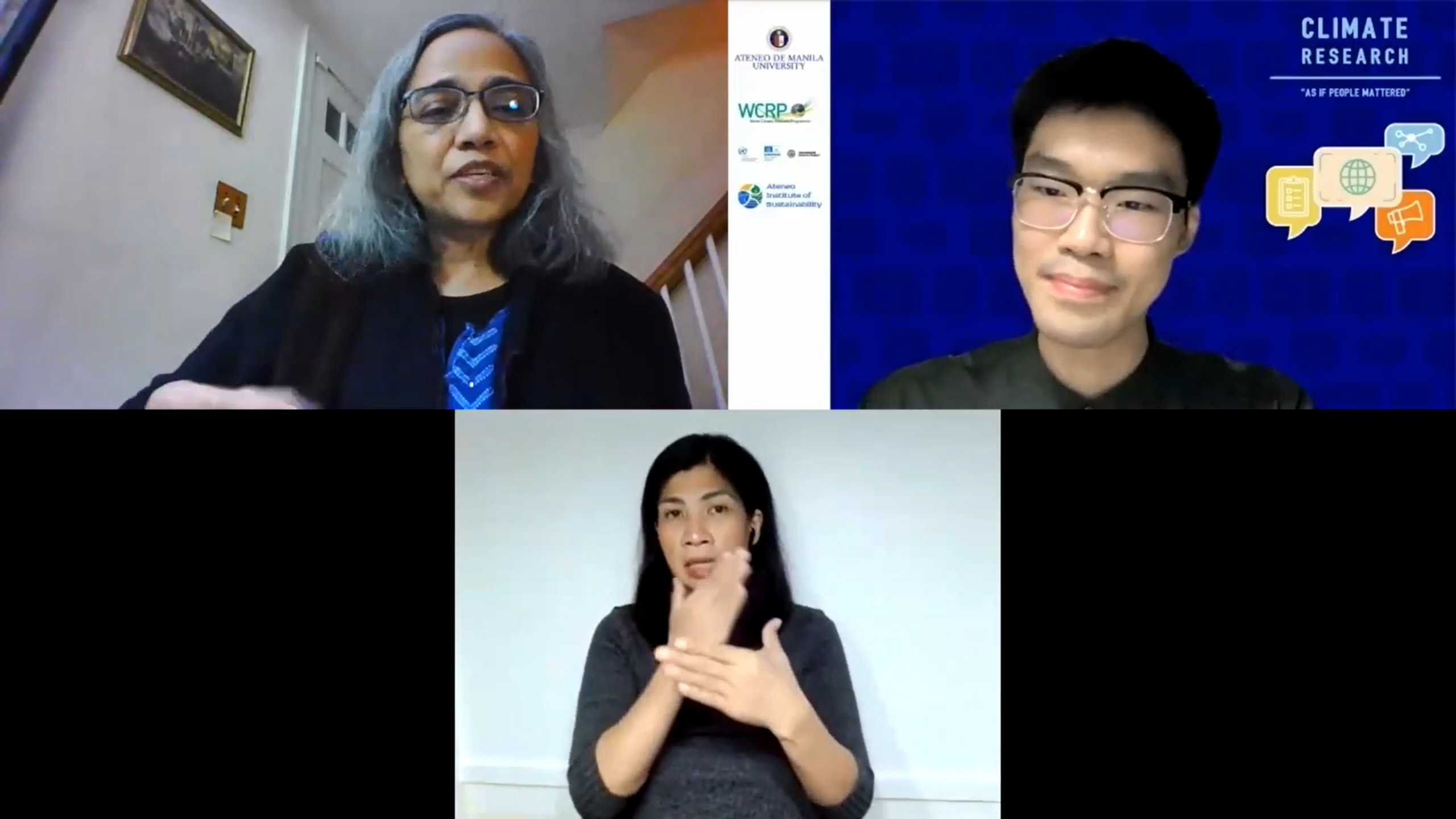
On 8 November 2022, the My Climate Risk – Ateneo de Manila University (MCR-Ateneo) Regional Hub, which is hosted by the Ateneo Institute of Sustainability, organized a webinar titled “Storying Climate: Transdisciplinary Adventures in the Classroom and Beyond.” My Climate Risk is a lighthouse activity of the World Climate Research Programme which aims to develop and mainstream a bottom-up approach to regional climate risk, and has a mycorrhizal network of hubs that span all continents except Antarctica.
The webinar featured Dr Vandana Singh as resource speaker. Dr Singh is Professor of Physics and Environment at the Department of Environment, Society and Sustainability of Framingham State University in Massachusetts, USA. In this session, she shared her experience as an educator, and in particular discussed a transdisciplinary pedagogy on climate change, something that she has been working on for over a decade.
Dr Charlotte Kendra Gotangco Gonzales, Director of the Ateneo Institute of Sustainability and Focal Point of the MCR-Ateneo Regional Hub, delivered the Opening Remarks, where she briefly discussed the goal of the Hub in exploring tools and approaches that can bridge the gap between how climate information is produced and used. Dr Gotangco Gonzales also reiterated the importance of stories across disciplines in understanding the phenomena around us. Dr Theodore G Shepherd, Grantham Professor of Climate Science at the Department of Meteorology of the University of Reading, UK, and Co-Chair of the Scientific Steering Group of the My Climate Risk lighthouse activity, delivered the Closing Remarks. Dr Shepherd harkened back to the previous Climate Voices series, linking the examples from previous sessions to the power of narratives to capture the essence of systems thinking, and how traditional climate science education can benefit from stories. Mr Daniel C Ratilla, Program Officer for Climate and Disaster Resilience of the Ateneo Institute of Sustainability, moderated the session.
Before beginning her presentation, Dr Singh acknowledged the Nipmuc people, who faced genocide and removal from their ancestral territory, which now comprises Framingham, Massachusetts, where she works. She then began the session with two stories: the first involving a scientist and an Inupiat elder in Alaska, and the second involving village women from Jharkhand, India and their relationship with the forest. In the first story, the Inupiat elder was able to warn the scientist and his time that the ice on which they stood would break. In the second story, the village women observed changes in the water table and agricultural productivity, disappearance of local wildlife, and malaria outbreaks following rampant deforestation, and so decided to form monthly forest patrols. These gave examples of the intimate knowledge that local populations have of their environment, the changes they observe, and their reliance toward it for their survival and culture. Dr Singh uses these stories to teach her students about climate change, describing her earlier attempts at climate change education as failures due to feedback from students who would express hopelessness or apathy. These feelings are counterproductive, as these tend to paralyze action and cause cognitive confusion. This reflection prompted her to treat the “climate as teacher,” and to become a student again to figure out the best approach to teaching climate change.
Through report findings, Dr Singh explained how climate change education is failing, due in part to insufficient attention to the role of education in climate strategies, and in part due to the rigidity of the education sector. Recalling the stories of the Inupiat elder and the women of Jharkhand, she urged the audience to consider education beyond the biophysical realm, and to explore and pay attention to contextual factors such as social inequality, colonialism, land rights, and the relationship between native populations and pollutive and destructive industries. Using this lens of interconnectedness, Dr Singh is thus able to allow her students to expand their understanding of the climate system, moving from simply understanding sea ice formation and loss, to a broader questioning of what sea ice loss means for Inupiat lives and cultural identity. Following this, she reflected on the mainstream perspective to place emphasis on global-scale climate impacts, which, while important, are prioritized at the expense of the local. She noted how impacts and resulting climate action also manifest in the local scale, especially in places where more vulnerable societies live; such a focus would lend toward teaching climate justice.
On the theme of interconnections, Dr Singh further noted the transdisciplinary nature of the climate crisis, as threads of multiple disciplines intertwined with other environmental, social, and economic concerns emerge; she thus dubbed it as part of a “polycrisis” entangled with other systemic problems. This transdisciplinary nature stands in contrast to a compartmentalized education system, where interactions between disciplines is lacking.
Dr Singh touched on the use of mapping activities to make connections between subsystems and variables clear. This approach encourages her students to think about similar connections they observe in their own contexts, and make connections to phenomena such as economic models, history, and power relations. Distilling her experience, Dr Singh enumerated four essential dimensions of an effective pedagogy of climate change:
- The scientific and technological dimension
- The transdisciplinary dimension
- The psycho-social dimension
- The epistemological dimension
She explained how the challenge for educators and scientists is to be able to adopt a transdisciplinary mindset, and to be able to discuss connections between their work to economics, history, and justice, and climate science basics; a good framing and understanding of climate science which helps students have a holistic understanding of the world. Acknowledging the challenge of other disciplines interacting with climate science basics, however, Dr Singh then focused on three meta-concepts which can facilitate how climate change science can be understood and taught in other disciplines:
- The idea of balances and imbalances (i.e., sea ice mass imbalance, carbon cycle, the Earth’s energy budget);
- Critical thresholds (planetary boundaries) which illustrate the connections of social and environmental problems; and
- Climate change as a complex system, which cannot be adequately described by its parts in isolation, but which needs a synergistic approach.
Dr Singh lamented the dominant “Newtonian” paradigm of industrial society, which frames a mechanistic, reductionist, deterministic, and impersonal view of the universe. Challenging this paradigm, she described stories as ontological tools which help consolidate identities, foster connections, and build realities; tools which can challenge dominant paradigms by showing multiple points of view and possibilities, allowing recipients to imagine alternative scenarios and understanding through causal sense-making.
Rounding out the session, she reiterated that the best stories are inherently transdisciplinary, as they can show interconnections. They can bring issues of justice and equity to the fore, and transcend barriers between reason and emotion, science and society, human and nature, as well as connect local and global, personal and political, and time and space. As epistemological tools, they can challenge our unquestioned assumptions, which we must push against as we tackle the climate crisis.
The session was attended by participants from the Philippines, with international attendees from Australia, Peru, South Korea, the United Kingdom, the United States, and Vietnam. This webinar was the inaugural session in a series titled “Climate Research ‘As If People Mattered’,” the name of which comes from the article “Small is beautiful: climate change science as if people mattered,” written by Dr Regina R Rodrigues and Dr Theodore Shepherd, Co-Chairs of the Scientific Steering Group of the My Climate Risk lighthouse activity. The series occurred from November to December 2022. Replays and highlights of the webinar series are available in the following page.
Recent News
You may also like these articles
Protecting Creativity: AIPO and Rizal Library Host Copyright Awareness Session for the Ateneo Community
On March 18, 2026, the Ateneo Intellectual Property Office (AIPO), in collaboration with the Rizal Library, successfully conducted a Copyright Awareness Session held on the
Why can’t we eradicate tuberculosis? AIS dissects the TB issue in a multidisciplinary panel
On 24 March 2026, the Ateneo Institute of Sustainability (AIS), through its Sustainable Development Goals (SDGs) Program, hosted a multidisciplinary panel in observance of World
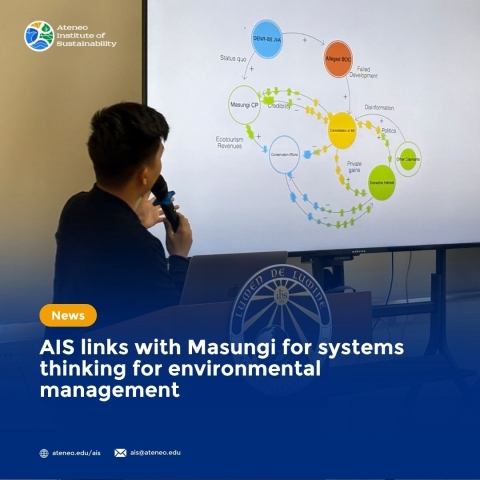
AIS links with Masungi for systems thinking for environmental management
Last 23-24 March 2026, the Ateneo Institute of Sustainability (AIS) , which manages the My Climate Risk – Ateneo de Manila University Regional Hub
Contingency Measures in Higher Education in the Face of a Worldwide Energy Crisis (HE Memo#Y4.16)
In response to the energy crisis caused by escalating tensions in West Asia, Ateneo Higher Education will implement the following class and operational adjustments.
Basic Education Class Schedules March – June 2026 (OVPBE memo)
In alignment with DepEd Memorandum No. 018, s. 2026, and our own commitment to Cura Personalis, we are refining our operations for the remainder of the school year to ensure that we finish strong, safe, and sustainable.
URH residency application for Intersession SY 2026-2027 now open
Hey, Blue Eagles! Big news — URH INTERSESSION RESIDENCY SY 2026-2027 is NOW OPEN! Apply now to live where the vibes are unmatched! What’s in