Dean Ronald Mendoza's remarks on the 2020 SWS Survey Review
31 Jan 2020

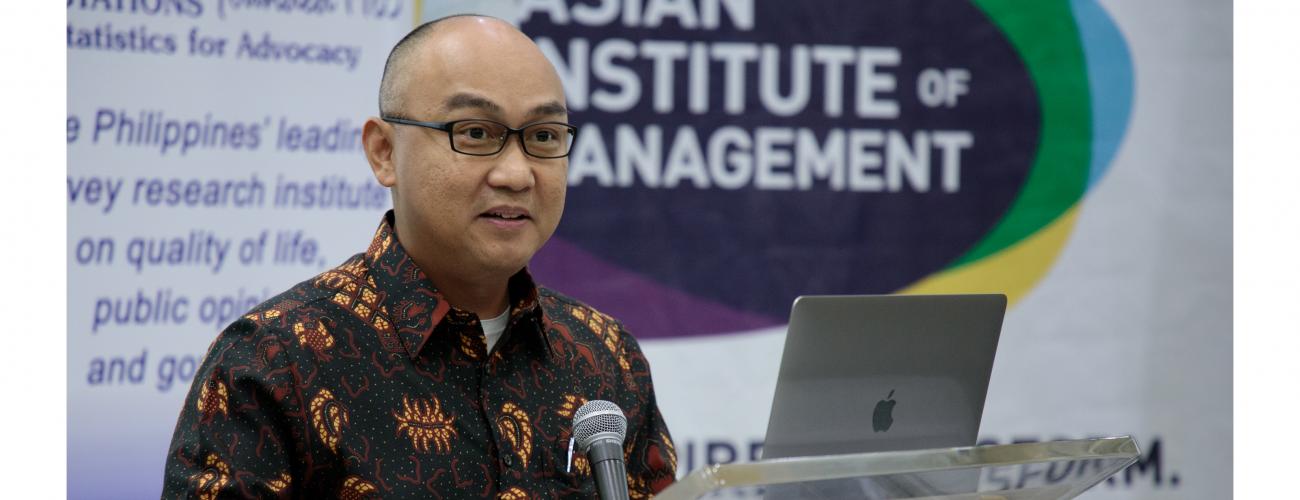
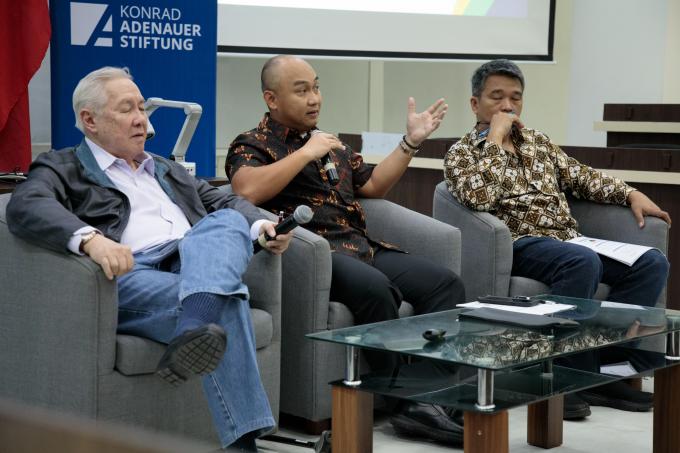
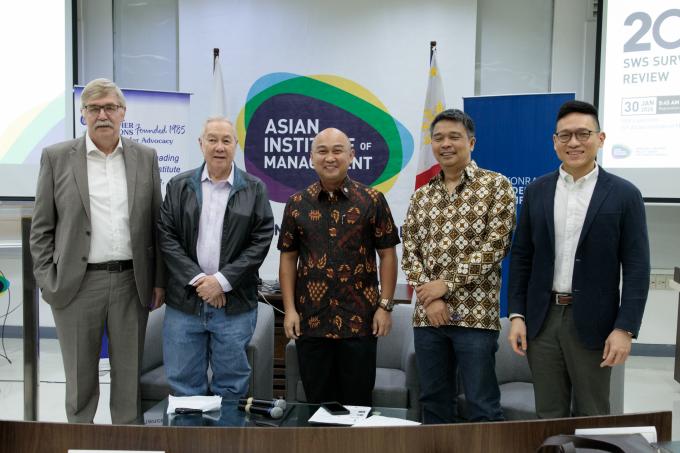
On January 30, 2020, Ateneo School of Government Dean Dr. Ronald U. Mendoza delivered his remarks at the 2020 SWS Survey Review at the Asian Institute of Management in Makati city.
Below is a transcription of his remarks:
- First of all, let me thank the credible survey firms in the country—and to my mind there are only two here, just like our two TELCOs—for having improved voice and agency in our democracy. By providing this service, they have played a key role particularly in the post-EDSA democratic rehabilitation.
- We have always faced a challenge of not just reporting these surveys, but also interpreting them. In many cases, the results are fairly intuitive, and the basic survey theory works – we have a rational and well informed respondent who reports a truthful response. I’m a big fan of the self-reported poverty and hunger figures. They continue to expose part of the evidence that our official poverty line is quite draconian—hence the discrepancy between official government estimates and the SWS estimates.
- I do think, however, that we face several major shifts in recent years—and these raise urgent questions on what the surveys show and how carefully we must interpret the results. First, we are facing a dramatically higher degree of connectedness through technology and social media innovations. In this environment, misinformation can just as easily be spread as facts and evidence. Second, the world is also on the cusp of as-yet largely unregulated tech-equipped capability to shape perceptions --- or in some cases, to confound them.
- One should note the various strategies and methods that could now be deployed to shape public perceptions, sometimes in pernicious ways. The use of troll armies, micro-targeting and deliberate spread of fake news are often not just undemocratic, they are also increasingly at odds with national security and social cohesion. Technology has helped to put propaganda machines on steroids—and the objective in some instances is not to drive home a particular narrative, but to flood society with confusing misinformation. The potential effect is that existing social divides become even more pronounced, and consensus and collective action ultimately become even more elusive.
- We face growing international evidence that the spread of misinformation, particularly in social media, can skew perceptions of some groups in society, and shape their political behavior—including during elections, but also presumably on much simpler exercises such as surveys. To better appreciate and interpret what the survey results tell us, we need to embark on a broader multi-disciplinary research agenda.
- For instance, there is evidence that people with weaker cognitive abilities are less able to shake off their initial misperceptions and more vulnerable to misinformation. Meanwhile, new studies also show that repeating a false claim tends to produce an “illusion of truth effect”.[1] Lab experiments have shown that “repetition increased the subjects’ perception of the truthfulness of false statements, even for statements they knew to be false.”[2]
- In our recent research—a study just released 2 days ago—we empirically analyzed some of the correlates of net satisfaction. Similar to what Mahar said earlier, we find little evidence that the net satisfaction across Presidents is linked to economic trends – this despite economic factors such as wages and prices are almost always on the top of people’s public policy priorities (as reported by surveys).
- If top policy issues are not linked to presidential approval, then what drives it? It might be useful to unpack some basic assumptions behind surveys. Access to information is one of the key factors thought to influence survey respondents’ perceptions. Put simply, citizens can more effectively assess their leaders if they (at least) have adequate access to facts and evidence; and if they are also able to translate this information effectively towards rational and truthful responses to surveys. But there are several weaknesses faced by the assumed “rational and well-informed survey respondent”.
- Perhaps we can better explain this by drawing an analogy with stock price bubbles. We expect that stock prices merely reflect an assessment of the company’s future returns. This assumes, of course, that investors have perfect access to information on the company and different conditions in which it will eventually operate. The latter is far from the reality most investors face, as we routinely see over-hyped assets and subsequent dramatic corrections in value.
- Herd behavior refers to the phenomenon in which the actual or perceived preferences and actions of a large group influences individual decisions and actions. Past research illustrated that people have a tendency to imitate other people’s choices not just to be accepted but to be safe.[3] Another mechanism in herd behavior is the human receptivity to social norms, and their dependency on others’ information obtained through social channels.[4] In the Philippine context, this simply means that the perceptions of local communities have a deep influence on personal perceptions. Yet, this is a circular logic—if there is imperfect information, perceived strong support by the group could be self-reinforcing. That is the characteristic of a herd.
- New literature on herd behavior has started to focus on the application of this concept in political phenomenon, including presidential approval ratings.[5] In the Philippine setting, there are various reasons why citizens (and their local leaders) join the bandwagon to support each President—gaining access to public services and currying favor from the State apparatus is not uncommon given the pervasive role of the Philippine government, and the still large inequality in wealth and opportunities facing the population.
- In our study, we exposed evidence on herd behavior—individual perceptions of the group’s satisfaction appeared to be linked to their own answer on satisfaction. We also found evidence that certain types of fake news may be highly corelated with net satisfaction. (In our study, the view that illegal drugs is among the leading causes of death among the youth.) Hence, some of the assumptions on the “rational and well informed survey respondent” are probably just as vulnerable as the assumptions on the “rational and well informed investor”.
- To conclude we probably need more robust multi-disciplinary studies on survey responses. We need to open up this space not just to the economists, statisticians and political scientists, but also to the psychologists and big data scientists. It would be good if we can empirically analyze survey results at the micro-/respondent-level. Perceptions in today’s world is a highly complex topic, and we believe surveys must be interpreted very carefully and in an evidence based way if these instruments will continue to bring us closer to the truth and to people empowerment.
*Ronald Mendoza, PhD is Dean of the Ateneo de Manila University, School of Government. This article draws on a new study by the Ateneo Policy Center which can be downloaded using this link: https://papers.ssrn.com/sol3/papers.cfm?abstract_id=3519651
[1] https://www.bbc.com/future/article/20161026-how-liars-create-the-illusion-of-truth
[2] https://www.scientificamerican.com/article/cognitive-ability-and-vulnerability-to-fake-news/
[3] https://onlinelibrary.wiley.com/doi/abs/10.1002/mar.20119
[4] https://www.ncbi.nlm.nih.gov/pubmed/2270480
[5] https://www.cell.com/trends/cognitive-sciences/fulltext/S1364-6613(09)00170-3?_returnURL=https%3A%2F%2Flinkinghub.elsevier.com%2Fretrieve%2Fpii%2FS1364661309001703%3Fshowall%3Dtrue
Recent News
You may also like these articles
Ateneo JGSOM and Philippine Leadership Society host forum on leadership amidst geopolitical conflicts
Held on 28 February 2026, at Escaler Hall, Ateneo de Manila University, the Leadership Forum on Leadership Amidst Geopolitical Conflicts, was a gathering that delved
Design Thinking workshop for KISLAP student entrepreneurs: AIPO helps teams refine their core problem
16 student founders representing 8 startup groups from the KISLAP cohort gathered on 7 Feb 2026 at the PLDT-CTC Bldg. Roomm 513, Ateneo de Manila
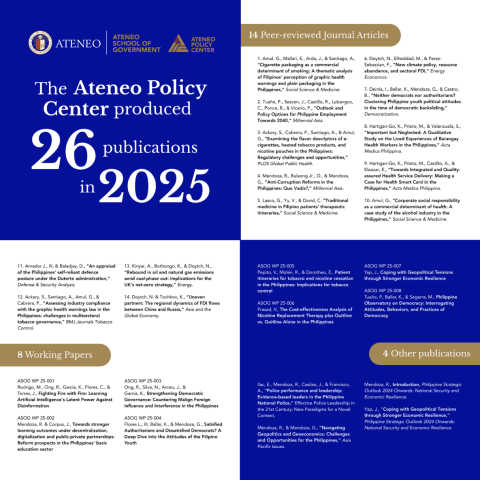
ASoG, through the Ateneo Policy Center, delivers 26 publications in 2025
As the research and public policy unit of the Ateneo School of Government (ASoG), the Ateneo Policy Center (APC) has continued to pursue cutting-edge research
Ateneo JGSOM joins Erasmus+ Kick-off Meeting and Training in Romania under Green Finance Project
Ateneo de Manila University, through the John Gokongwei School of Management (JGSOM), participated in the Erasmus+ Kick-off Meeting and Training conducted from 23 to 25
Amplifying impact: The Collective Good 2025 drives social enterprise forward
The landscape for social enterprises in the Philippines is complex, marked by both immense potential and significant challenges in achieving inclusive and sustainable development. Addressing
Ateneo Center for Social Entrepreneurship and KisLap: Inside the social enterprise boot camp
Building on the momentum of its formal launch on 25 Sept 2025, at the John Gokongwei School of Management (JGSOM), the KisLap: A Social Enterprise