Economic degrowth as the path towards sustainable development
09 Nov 2022




From product advertisements that feature smiling customers to promotions that encourage purchase, consumer culture is fueled by the commodification of happiness– the idea that the more we purchase goods, the happier we will be.
Consumerism is a key driver of economic growth, and growth is often associated with development. But directly correlating an increase in production with a better standard of living is inaccurate. Economic growth can induce development, but the fundamental question is ‘for whom is this development for?’

The Gross Domestic Product has been central to policies concerning economic growth since its conception in the 1930s, but it is not without its faults. In 2013, the Philippine GDP growth rate of 6.6% was the second highest in Asia, and for 2023, the country has a projected growth rate of 6.3%. Despite this, the Philippines still has the highest income inequality among the six largest economies in Southeast Asia.
Currently, the global manufacturing industry accounts for one-fifth of carbon emissions, and from 27 billion tons in 1970, consumption of natural resources rose to 92 billion tons in 2017. As population continues to increase, economic growth should no longer be the basis of development policies. Of course, this is not to discount its benefits, but given today’s social and ecological crises, GDP as a measure of prosperity should be obsolete.

Concepts such as green growth emerged as a response to these challenges, but one ideology aims to shift away from growth itself. Jason Hickel, an economic anthropologist, defines degrowth as “a planned reduction of energy and resource use designed to bring the economy back into balance with the living world in a way that reduces inequality and improves human well-being.”
Although reduced production and consumption seems akin to the economic downturn that leads to a recession, degrowth is anything but. A recession is an unplanned economic reduction that has unmanageable impact across various sectors, which often leads to mass unemployment and worsened inequality. Degrowth is a planned policy that seeks to scale down environmentally degrading and less essential production.
But there is more to degrowth than de-growth. It also explores the intersection among environmental sustainability, social justice, and well-being and it addresses the environmental and social impacts of untethered consumption and production: scarcity, inequality, climate change, environmental injustice. At a micro level, degrowth would mean our lifestyles are less materialistic, we would grow our own organic food when possible, and choose more sustainable transportation options. At a macro level, it includes shifting taxation from labor to luxury and material consumption, incentivizing sustainable mobility, and investing in green spaces.
The idea of degrowth may sound bewildering to many. Why should we halt the growth of our economy? For one, with all the power the term "growth" holds, it is obscure at best: growth for whom, exactly?
Doughnut Economics shares key ideas with degrowth– it aims to shift development from endless growth to creating a space where both the environment and its people can benefit from and thrive. For Kate Raworth, creator of the Doughnut, this space is found above the inner ring– the social foundation that everyone should have access to, like food, education, and gender equality; and below the outer ring– the ecological ceiling that ensures the planet’s stability. The key here is balance.
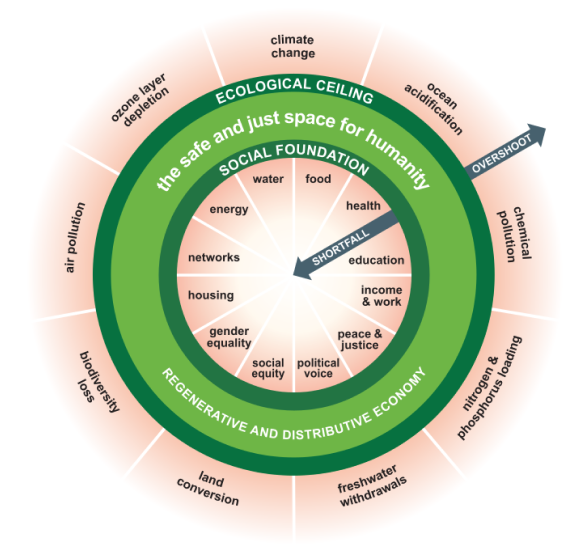
The framework was downscaled and implemented by cities at a local level. Amsterdam, among the first to adopt Doughnut economics, aims to reduce consumption, create a sustainable food system, and shift towards a circular approach to development.
Brussels emphasized a participatory approach to applying the framework by drawing on perspectives from political representatives, CSOs, private companies, and its residents.
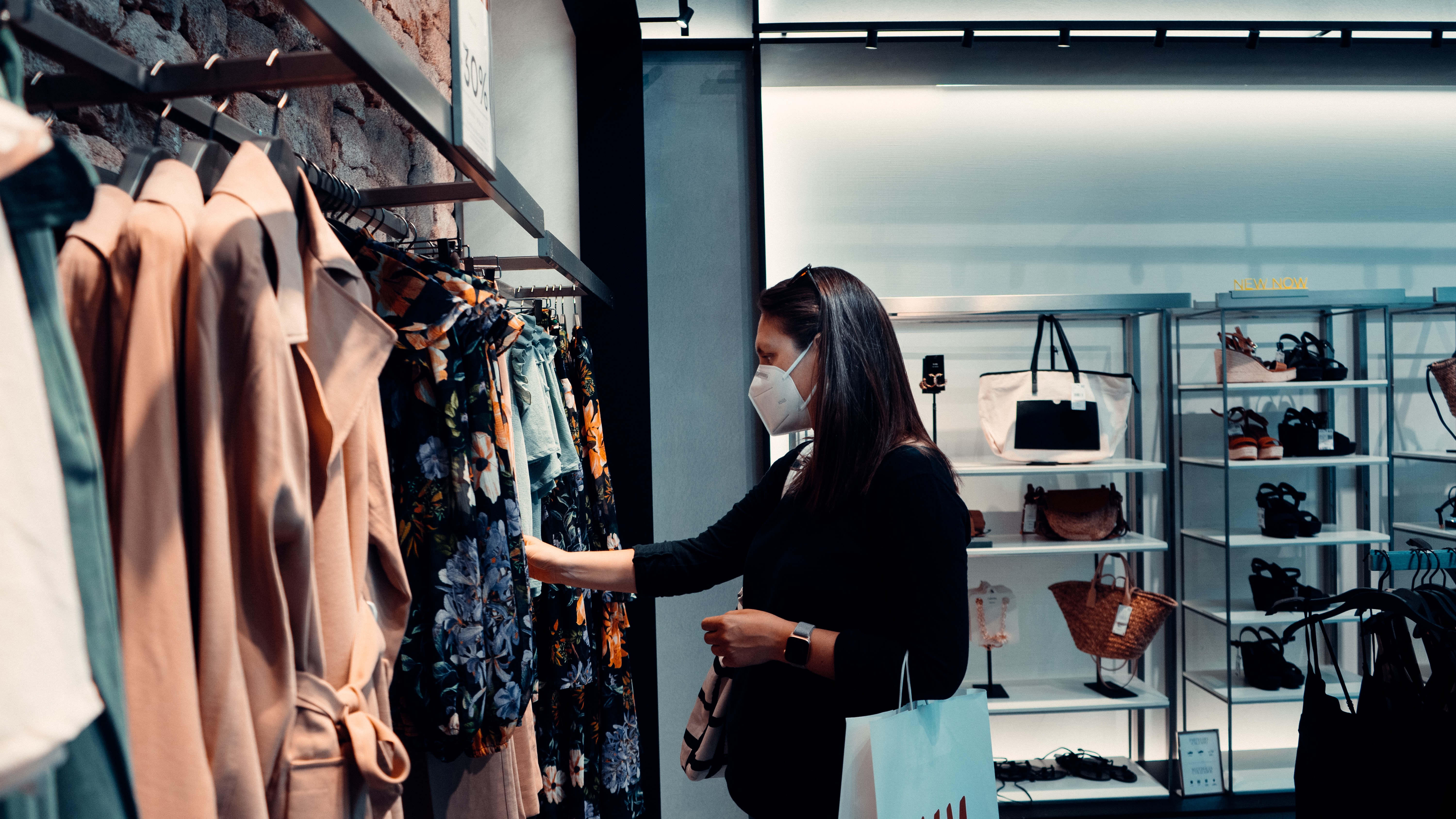
Our consumption habits can exacerbate climate change. In fact, a 2015 study found that the production and consumption of household goods and services was responsible for over 60% of global GHG emissions. This is not to say consumers are the sole culprits. In actuality, firms encourage and capitalize on consumer culture.
Degrowth is not merely adopting a minimalist lifestyle, rather, it advocates for sufficiency– the notion that we must be content with what we have. Admittedly, the idea of growth still has a firm grip on society– media and companies alike promote the idea that more is better. We must start to shift away from this culture by reflecting on our values and habits. We may ask ourselves, will this purchase add value to my life? How often will I use this product? Degrowth is not an easy undertaking, but it may just be what can lead us away from the worst effects of climate change.
This article was written by Antonella Sampang (3 AB Economics), a volunteer for the Ateneo Institute of Sustainability.
References:
About Doughnut Economics. Doughnut Economics Action Lab. (n.d.). Retrieved from https://doughnuteconomics.org/about-doughnut-economics
ADB sees robust 2022 GDP growth for the Philippines. Asian Development Bank. (2022, September 21). Retrieved from https://www.adb.org/news/adb-sees-robust-2022-gdp-growth-philippines#:~:text=The%20Philippines%27%20gross%20domestic%20product,Outlook%20(ADO)%202022%20Update.
Alexander, S. (2014, October 1). Life in a 'degrowth' economy, and why you might actually enjoy it. The Conversation. Retrieved November 8, 2022, from https://theconversation.com/life-in-a-degrowth-economy-and-why-you-might-actually-enjoy-it-32224 d
Confluences asbl. (2021, March 30). Downscaling the donut at 4 levels in Brussels. Doughnut Economics Action Lab. Retrieved from https://doughnuteconomics.org/stories/83
Doughnut Economics Action Lab. (n.d.). [The doughnut of social and planetary boundaries] [Image]. Doughnut Economics Action Lab. https://doughnuteconomics.org/about-doughnut-economics
Hickel, J. (2020). What does degrowth mean? A few points of clarification. Globalizations, 18(7), 1105–1111. https://doi.org/10.1080/14747731.2020.1812222
Higgs, K. (2021, January 21). How the world embraced consumerism. BBC . Retrieved from https://www.bbc.com/future/article/20210120-how-the-world-became-consumerist
Keenan, J. (2013, May 7). The grim reality behind the Philippines' economic growth. The Atlantic. Retrieved from https://www.theatlantic.com/international/archive/2013/05/the-grim-reality-behind-the-philippines-economic-growth/275597/
Masigan, A. J. (2022, January 23). Income inequality, a social timebomb. BusinessWorld Online. Retrieved November 8, 2022, from https://www.bworldonline.com/opinion/2022/01/23/425196/income-inequality-a-social-timebomb/
Policy: Circular economy. City of Amsterdam. (n.d.). Retrieved from https://www.amsterdam.nl/en/policy/sustainability/circular-economy/
Reducing the carbon footprint of the manufacturing industry through Data Sharing. World Economic Forum. (2022, March 23). Retrieved from https://www.weforum.org/impact/carbon-footprint-manufacturing-industry/
Rey, A. (2020, June 2). Coronavirus Shopping [Stock image]. Unsplash. https://unsplash.com/photos/5yP83RhaFGA
Rhodes, C. (2020, February 28). Human consumption of natural resources exceeds an annual 100 billion tonnes. Resilience. Retrieved from https://www.resilience.org/stories/2020-02-28/human-consumption-of-natural-resources-exceeds-an-annual-100-billion-tonnes/
Rigon, A. (2017, March 13). Degrowth politics and policies for Degrowth. Degrowth. Retrieved from https://degrowth.info/blog/degrowth-politics-and-policies-for-degrowth
Spiske, M. (2019, November 1). WEEKEND SALE MEN/WOMEN UP TO 70% OFF [Stock image]. Unsplash. https://unsplash.com/photos/5UJbKYUjFCk
White Field Photo (2020, December 15). Black and white image of factory pumping out white smoke. [Stock image]. Unsplash. https://unsplash.com/photos/rB4w5_DINt0
Wolverson, R. (2013, August 7). GDP and Economic Policy. Council on Foreign Relations. Retrieved from https://www.cfr.org/article/gdp-and-economic-policy#:~:text=As%20the%20broadest%20measure%20of,%2C%20businesses%2C%20and%20the%20government
Woodford, N. (2019, January 28). Why do so many brands choose to evoke happiness in ads? Unruly. Retrieved from https://unruly.co/blog/article/2019/01/29/happiness-ads-insights/
Recent News
You may also like these articles

Protecting Creativity: AIPO and Rizal Library Host Copyright Awareness Session for the Ateneo Community
On March 18, 2026, the Ateneo Intellectual Property Office (AIPO), in collaboration with the Rizal Library, successfully conducted a Copyright Awareness Session held on the

Class and work arrangements for March 30-April 1, 2026 (Memo No. AGSB-DO-2526-043)
AGSB-DO-2526-043 28 March 2026 TO: AGSB Community FROM: (sgd.) Jowett Cecilio F. Magsaysay, MBA, PhD Dean SUBJECT: Class and work arrangements for March 30-April 1

Why can’t we eradicate tuberculosis? AIS dissects the TB issue in a multidisciplinary panel
On 24 March 2026, the Ateneo Institute of Sustainability (AIS), through its Sustainable Development Goals (SDGs) Program, hosted a multidisciplinary panel in observance of World
AIS links with Masungi for systems thinking for environmental management
Last 23-24 March 2026, the Ateneo Institute of Sustainability (AIS) , which manages the My Climate Risk – Ateneo de Manila University Regional Hub
Class and work arrangements for March 26-27, 2026 (Memo No. AGSB-DO-2526-042)
AGSB-DO-2526-042 25 March 2026 TO: AGSB Community FROM: (sgd.) Jowett Cecilio F. Magsaysay, MBA, PhD Dean SUBJECT: Class and work arrangements for March 26-27, 2026

QS Subject Rankings 2026: Ateneo in top 100 for theology; ranked in 7 subject areas
Ateneo de Manila University is among the top institutions in seven subject areas, and among the top 100 for theological and religious studies, according to