‘Handover to Handshake’ closes MCR-ADMU’s Climate Research series for 2022
20 Apr 2023 | Daniel C Ratilla


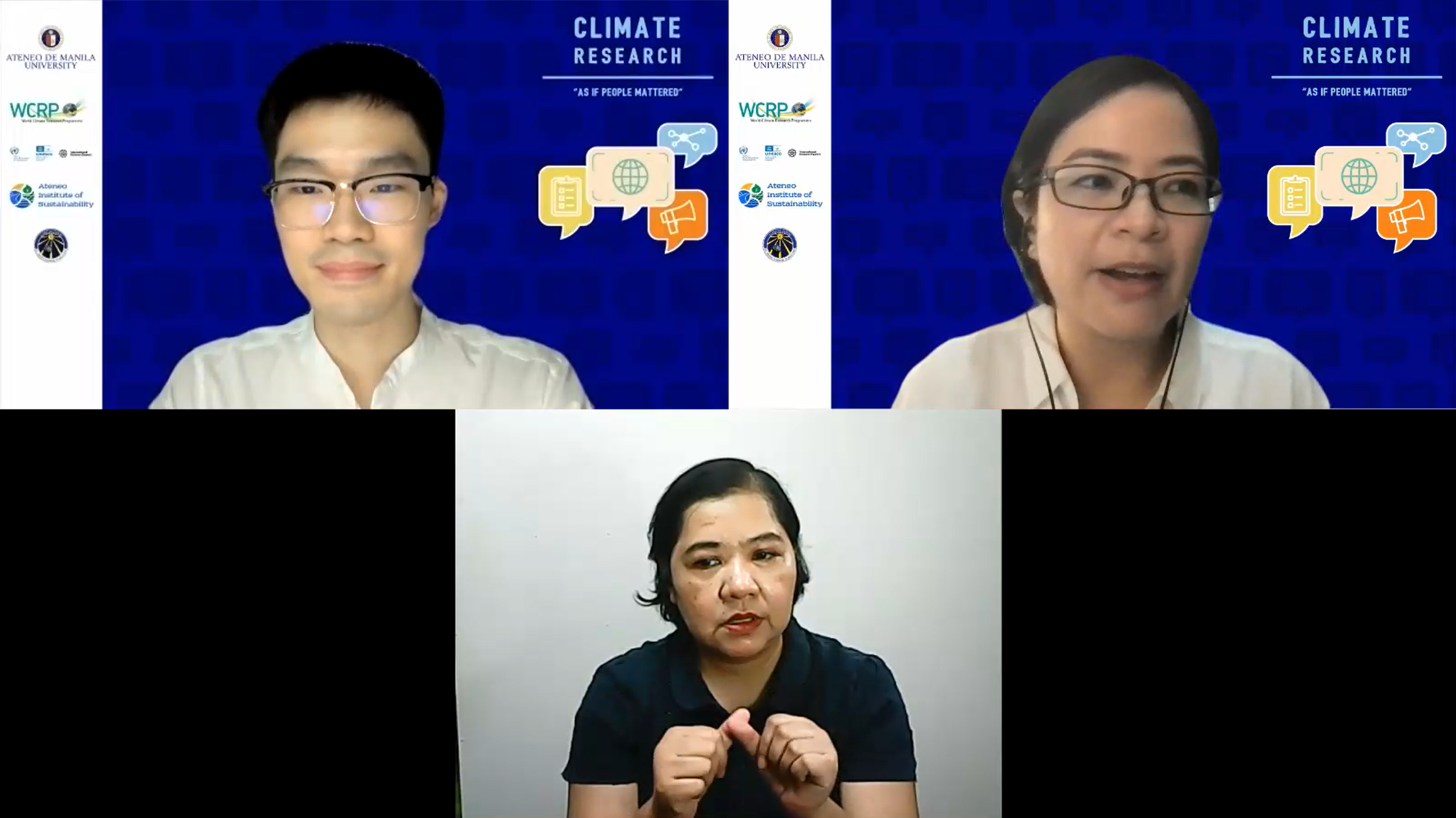
On 7 November 2022, the My Climate Risk – Ateneo de Manila University (MCR-ADMU) Regional Hub, which is hosted by the Ateneo Institute of Sustainability, organized a webinar titled “Shifting ‘From Handover to Handshake’: Co-generating Climate Change Information for Resilience.” My Climate Risk is a lighthouse activity of the World Climate Research Programme which aims to develop and mainstream a bottom-up approach to regional climate risk, and has a mycorrhizal network of hubs that span all continents except Antarctica.
The webinar was co-hosted by the Manila Observatory, and featured Dr Faye Abigail Cruz, Head of the Regional Climate Systems Laboratory at the Manila Observatory, as resource speaker. She spoke about her experience working with fellow scientists and various stakeholders in co-creating climate change information, for climate change adaptation and disaster risk reduction.
Fr Jose Ramon T Villarin, SJ, Executive Director of the Manila Observatory and a Collaborator of the Hub, delivered the Opening Remarks. Both he and Dr Cruz had recently arrived back from Sharm El Sheikh for the 27th Conference of the Parties of the UNFCCC (COP 27), with Dr Cruz as part of the Philippine delegation. He noted the increase in delegates throughout the years, and the increase in conversation and concern around the climate crisis as we become increasingly aware of its transboundary and transdisciplinary nature. Fr Villarin also noted the increasing call for an inclusive approach to addressing the climate crisis, one which involves the grassroots. Ms Jean Jardeleza Mijares, Program Manager for Climate and Disaster Resilience of the Ateneo Institute of Sustainability, closed the program and the webinar series. She reflected on the twin webinar series over the last few months, the lessons learned from the seven sessions, and the underlying principles of the My Climate Risk lighthouse activity. Mr Daniel C Ratilla, Program Officer for Climate and Disaster Resilience of the Ateneo Institute of Sustainability, moderated the session.
Prefacing her talk, Dr Cruz reflected on how she still considers herself a novice in transdisciplinary approaches to climate research, and shared the DIKW model as a framework for her presentation: moving from data, to information, to knowledge, to wisdom, towards achieving climate resilience.
Dr Cruz discussed the importance of down-scaling, or obtaining and using high-resolution climate information rather than broad and general data for local adaptation. While generating this high-resolution data is resource-intensive, she shared that this can be addressed through institutional collaborations. However, these models are often derived and presented from a physical science perspective, and thus run into the hurdle of being too technical for end users to be relatable, understandable, and ultimately, usable. Dr Cruz then shared her experience in working on the 1st Stakeholder Workshop on Climate Information for Local Adaptation in the Philippines on July 2019, which reached out to end-users to better understand their climate information needs and to learn how to tailor outputs and knowledge products that would be directly useful to local governments and agencies. The findings pointed to a need for climate education and to explain climate projections, and a lack of technical capacity and funding as prevalent barriers. It also revealed that temperature and rainfall extremes were most relevant to end-users. This was followed by consultations with selected local government units in March 2020 to collect feedback and discuss recommendations, such as the usefulness of producing visual materials for climate education, the need to produce localized climate data, determine impacts on priority sectors, and a wider dissemination of climate reports. Unfortunately, the COVID-19 lockdowns which followed prevented further action on recommendations. Despite this, Dr Cruz and her collaborators were able to use the inputs and integrate them into the Philippine Climate Extremes Report 2020.
Similar efforts to ensure that climate change information is usable, understandable, and relevant are also seen on the global scale. Dr Cruz explained that the title of her talk, “from handover to handshake,” was borrowed from the Intergovernmental Panel on Climate Change (IPCC). This was a principle adopted for its 6th Assessment Report, of which Dr Cruz was a Lead Author in the first working group. She reminded the audience that there are three working groups within the IPCC, and shared the conscious effort she observed for contributors from other working groups to work together, rather than in silos. This bridged information and helped to translate the implications and relevance of climate information, rather than just presenting figures and numbers.
Dr Cruz discussed how it is no longer enough to simply produce climate information, but to ensure that it is usable for impact assessment and decision-making. Climate knowledge can thus be the result of engagement between climate scientists and various end-users, such as those in the vulnerability, impacts, and adaptation (VIA) community, decision-makers, and ideally, indigenous and traditional knowledge-bearers. This can be done in the Climate and Disaster Risk Assessment (CDRA) process, which allows communities to arrive at evidence-based decisions on appropriate climate change adaptation and disaster risk reduction. Dr Cruz shared that this was an activity adopted by the Coastal Cities at Risk in the Philippines (CCARPH) Project. However, she cautioned the importance of understanding local contexts to prevent maladaptation, as achieving resilience is not a one-size-fits-all activity.
On the question of moving from knowledge to wisdom, Dr Cruz shared that values become essential in considering which climate actions to pursue. She used the concept of climate resilient development as an example, which recognizes the interconnectedness among climate, human society, and ecosystems; while already challenging, this points to the need to limit warming so that adaptation options will not be further limited.
In closing, she shared her thoughts on the shift from handing over to co-generating information, and what this means for resilience. Primarily, this is essential in making climate change information understandable and usable; it is thus important to understand the needs and capabilities of communities, and requires continued engagement. The session was an invitation to go beyond our respective intellectual comfort zones and understand each other’s languages, processes, and jargons. Dr Cruz also pointed out the need for humility, the importance of integrating socio-economic and political considerations in climate action while being just to the most vulnerable, and considering long-term impacts on ecosystems and future generations.
The session was attended by participants from the Philippines, with international attendees from Belgium, China, Egypt, Japan, Myanmar, Pakistan, Qatar, South Africa, South Korea, the United Kingdom, and the United States. This webinar was the final session in a series titled “Climate Research ‘As If People Mattered’,” the name of which comes from the article “Small is beautiful: climate change science as if people mattered,” written by Dr Regina R Rodrigues and Dr Theodore Shepherd, Co-Chairs of the Scientific Steering Group of the My Climate Risk lighthouse activity. The series occurred from November to December 2022. Replays and highlights of the webinar series are available in the following page.
Recent News
You may also like these articles
Protecting Creativity: AIPO and Rizal Library Host Copyright Awareness Session for the Ateneo Community
On March 18, 2026, the Ateneo Intellectual Property Office (AIPO), in collaboration with the Rizal Library, successfully conducted a Copyright Awareness Session held on the
Why can’t we eradicate tuberculosis? AIS dissects the TB issue in a multidisciplinary panel
On 24 March 2026, the Ateneo Institute of Sustainability (AIS), through its Sustainable Development Goals (SDGs) Program, hosted a multidisciplinary panel in observance of World
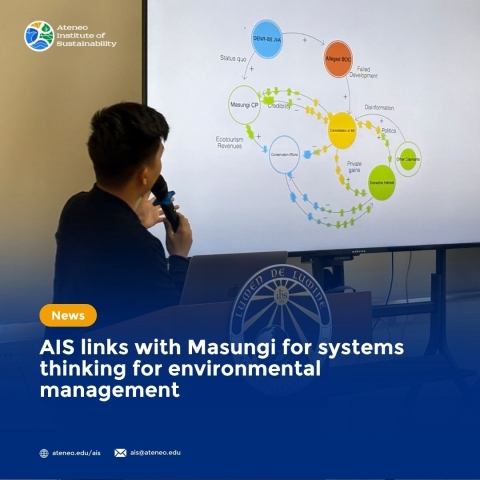
AIS links with Masungi for systems thinking for environmental management
Last 23-24 March 2026, the Ateneo Institute of Sustainability (AIS) , which manages the My Climate Risk – Ateneo de Manila University Regional Hub
Ateneo achieves 100% passing rate in March 2026 Electronics Engineering Licensure Exam
Ateneo de Manila University celebrates an outstanding performance in the March 2026 Electronics Engineering Licensure Examination, achieving an impressive 100% passing rate as released by
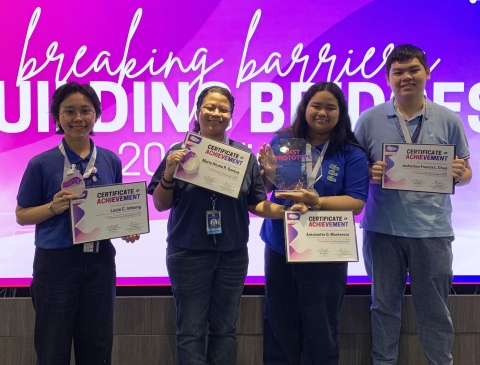
ASHS ProgVar clinches "Best Prototype" award at Breaking Barriers Hackathon
The Ateneo de Manila Senior High School (ASHS) community celebrates a significant technological milestone as Grade 11 Programming Varsity (ProgVar) students Lucia Imbong (11-Realino), Nicole
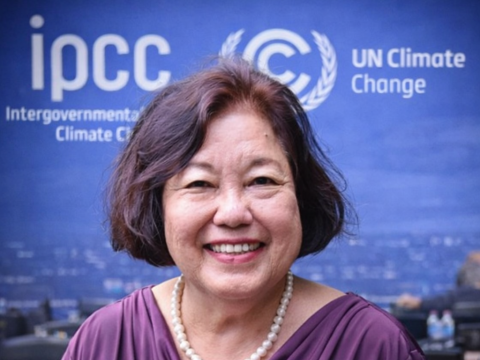
Mangroves as shields of history and resilience: Insights from Dr Emma Porio
Mangrove forests have long shaped both the history and survival of coastal communities in the Philippines. According to Dr Emma Porio, Professor Emeritus (Sociology -