Mangroves as shields of history and resilience: Insights from Dr Emma Porio
18 Mar 2026



Mangrove forests have long shaped both the history and survival of coastal communities in the Philippines. According to Dr Emma Porio, Professor Emeritus (Sociology - RGLSOSS) at Ateneo de Manila University and Lead Author of the UNFCCC-IPCC Climate Change and Cities 2027, the dense mangrove ecosystems surrounding Mactan Island played a decisive role in Lapu-Lapu’s victory over Ferdinand Magellan during the historic Battle of Mactan.
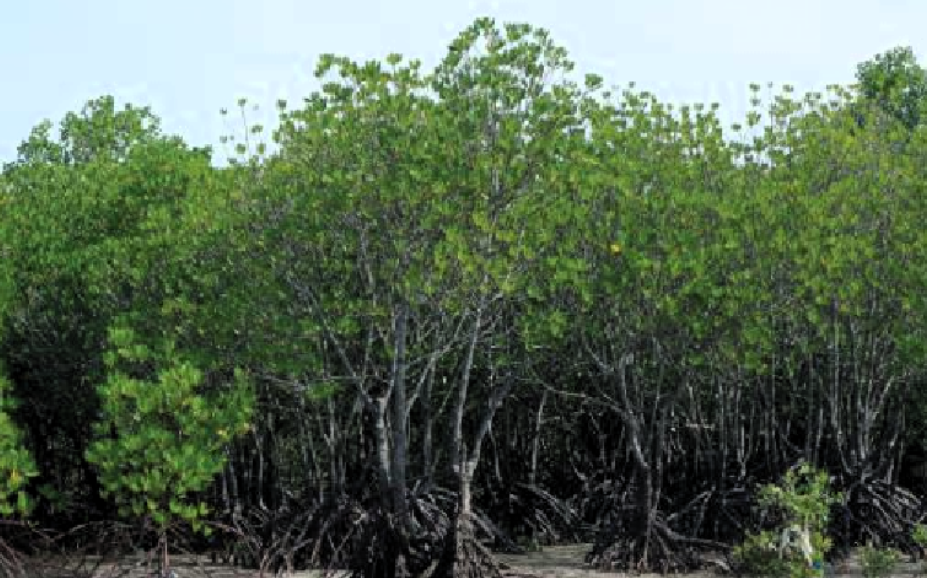
In her article published in Philippine Native Trees: Up Close and Personal, Vol. 4, Dr Porio describes how vast mudflats and dense mangroves surrounded Mactan Island during Magellan’s landing on 27 April 1521. Because the Spaniards arrived at low tide, their armored soldiers were forced to wade through thick mud before reaching shore. Hidden among the mangroves, Lapu-Lapu’s warriors attacked, ultimately killing Magellan and delaying Spanish colonization of the Philippines for decades.
Dr Porio highlights how this historical episode reflects the powerful interaction between ecology, topography, and human history. As she notes in her teaching at Ateneo, the relationship between environment, society, and culture continues to shape collective outcomes. However, she also laments the rapid loss of mangrove forests across the country due to land reclamation, urban expansion, and the cutting of bakauan timber for fuel because of its high heat value, alongside broader development pressures driven by industrialization and population growth.
Despite these losses, communities are demonstrating that restoration is both possible and impactful. In Bago City, residents of Barangay Sampinit have rehabilitated extensive mangrove areas through community-based organizations such as the Can-Itom Integrated Fisherfolk Association (CAIFA), Batad Integrated Fishers Association (BIFA), and Calubay-Anahaw Small Fishermen Association (CASFA). These initiatives highlight how local stewardship, supported by civil society and institutional partnerships, can restore degraded ecosystems and sustain livelihoods.
Local residents shared that during Typhoon Odette, their dense mangrove forests protected them from storm surges, reducing the need for evacuation, while also improving fish and shellfish harvests. These experiences underscore the critical role of mangroves in building climate resilience among vulnerable coastal communities.
Mangroves are among the world’s most powerful natural carbon sinks, storing up to 50 times more carbon than tropical forests. Beyond carbon sequestration, they provide essential ecosystem services—serving as nurseries for fish, maintaining water quality, stabilizing coastlines, reducing storm surges, and mitigating the impacts of climate change. For many coastal communities in the Philippines, mangroves are not only ecological assets but also vital sources of food security and livelihood.
Dr Porio further emphasizes the interconnectedness of upland and coastal ecosystems. Sustainable practices such as organic farming in upland areas contribute to the health of downstream mangrove and river ecosystems, reinforcing the need for integrated, landscape-level approaches to environmental management.
Looking ahead, she underscores the urgency of establishing a strong national framework for mangrove protection and rehabilitation. Such efforts require coordinated action among government, civil society, and the private sector to restore mangrove forests, establish coastal greenbelts, and prevent unsustainable coastal development. Through collective action, there remains hope that the Philippines can reclaim lost mangrove ecosystems and secure both environmental sustainability and community well-being for future generations.
Recent News
You may also like these articles

Why can’t we eradicate tuberculosis? AIS dissects the TB issue in a multidisciplinary panel
On 24 March 2026, the Ateneo Institute of Sustainability (AIS), through its Sustainable Development Goals (SDGs) Program, hosted a multidisciplinary panel in observance of World
AIS links with Masungi for systems thinking for environmental management
Last 23-24 March 2026, the Ateneo Institute of Sustainability (AIS) , which manages the My Climate Risk – Ateneo de Manila University Regional Hub
Professor Emeritus Dr Emma Porio to deliver keynote address at Regional Dialogue: Schools Climate Action Project
Dr Emma Porio, Professor Emeritus at Ateneo de Manila University's Dr Rosita G Leong School of Social Sciences (RGLSOSS) and Lead Author of UNFCCC-IPCC Climate
Klim@Musika
For most Filipinos, music is inseparable from daily existence. Music playlists accompany Filipinos in their commutes be it through walks, jeepneys, trains, or their private
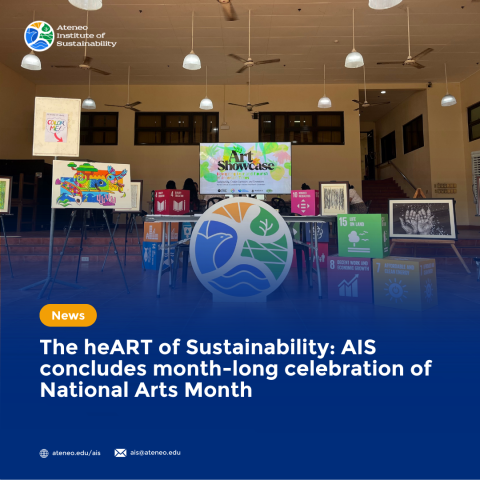
The heART of Sustainability: AIS concludes month-long celebration of National Arts Month
With the desire to make sustainability more accessible and promote its interdisciplinarity, the Ateneo Institute of Sustainability (AIS) hosted a month-long National Arts Month celebration
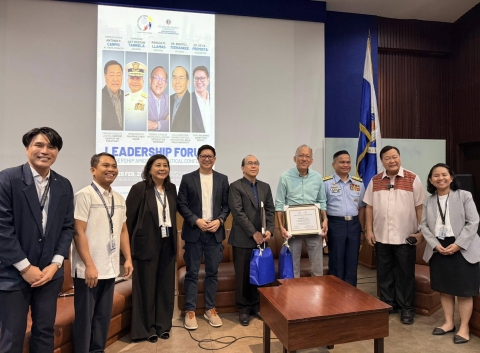
Ateneo JGSOM and Philippine Leadership Society host forum on leadership amidst geopolitical conflicts
Held on 28 February 2026, at Escaler Hall, Ateneo de Manila University, the Leadership Forum on Leadership Amidst Geopolitical Conflicts, was a gathering that delved