MCR-ADMU Climate Research webinar gleans insights from aquaculture
20 Apr 2023 | Daniel C Ratilla





On 11 November 2022, the My Climate Risk – Ateneo de Manila University (MCR-ADMU) Regional Hub, which is hosted by the Ateneo Institute of Sustainability, organized a webinar titled “Sustainable Production and Stakeholder Engagement.” My Climate Risk is a lighthouse activity of the World Climate Research Programme which aims to develop and mainstream a bottom-up approach to regional climate risk, and has a mycorrhizal network of hubs that span all continents except Antarctica.
The webinar was co-hosted by the Agriculture Sustainability Initiatives for Nature, Inc. (ASIN), and featured Mr Raymond S Rodolfo, Lecturer at the Department of Environmental Science of the Ateneo de Manila University, as resource speaker. Drawing from his experience, he shared his insights on sustainable oyster culture in estuaries, and highlighted the importance of community engagement and active collaboration across various stakeholders and institutions.
Dr Maria Assunta C Cuyegkeng, Executive Director of the Lily Gokongwei Ngochua Leadership Academy, Executive Director of the ASEAN University Network on Ecological Education and Culture (AUN-EEC), and a Collaborator of the Hub, delivered the Opening Remarks. Centering it on the role of industry in the face of climate change, Dr Cuyegkeng noted how progressive businesses and organizations reduce climate risk and build resilience through a good sustainability strategy that addresses production. Ms Abigail Marie T Favis, Program Manager for Campus Sustainability of the Ateneo Institute of Sustainability, and a colleague of Mr Rodolfo at the Department of Environmental Science, closed the program. She expressed her appreciation for Mr Rodolfo’s talk, which highlighted the intersections of sustainable development, food security, aquaculture, climate risk, and stakeholder and community engagement. The session was moderated by Ms Jean Jardeleza Mijares, Program Manager for Climate and Disaster Resilience of the Ateneo Institute of Sustainability.
Opening the plenary, Mr Rodolfo reflected on the concept of sustainability, latching onto its root word “sustain” as a concept of “enduring” and “nourishing” in the context of food production. Further inviting the audience to reflect, he discussed the importance of ecosystem services, and that these benefits are distilled as processes or cycles that sustain life. However, these are threatened by increased industrial output and the ecological strain of feeding a growing population on limited resources; the challenge for sustainable food production, therefore, is to juggle the needs of nourishment, avoiding land conversion, and lowering emissions.
Pivoting to his work in ASIN, Mr Rodolfo explained that the start-up company’s main goal is to provide high quality and traceable agricultural produce using sustainable and environmentally-sound practices. ASIN currently focuses on oyster production, and he humorously enumerated some of the challenges that oyster culture experiences using Filipino wordplay, “TalaBahay,” “TalaBaboy,” “TalaBanyo,” and “TalaBabaw,” which are portmanteaus of the Filipino words for oyster, “talaba,” and “bahay” (house), “baboy” (pig), “banyo” (restroom), and “babaw” (shallow). These illustrate the industry’s challenges that are intertwined with environmental factors of location, contamination and hygiene, and the practice of driving down stakes into the sediment for oyster culture, which causes the shallowing of the particular body of water. Noting their importance, ASIN shifted from simply buying oysters from local producers, to working towards changing and promoting alternative practices, which Mr Rodolfo noted in another play of words in the project name, Project Talaba TalaBEST. As an example, local growers have since moved from the stake method alluded to in TalaBabaw to a floating raft method, which is more environmentally-sound and is even promoted by the government. Adopting a ridge-to-reef approach, he added that the focus must go beyond estuarine activities in the downstream community, and look at upstream activities that could affect the ecological health of the waters where the oysters are grown.
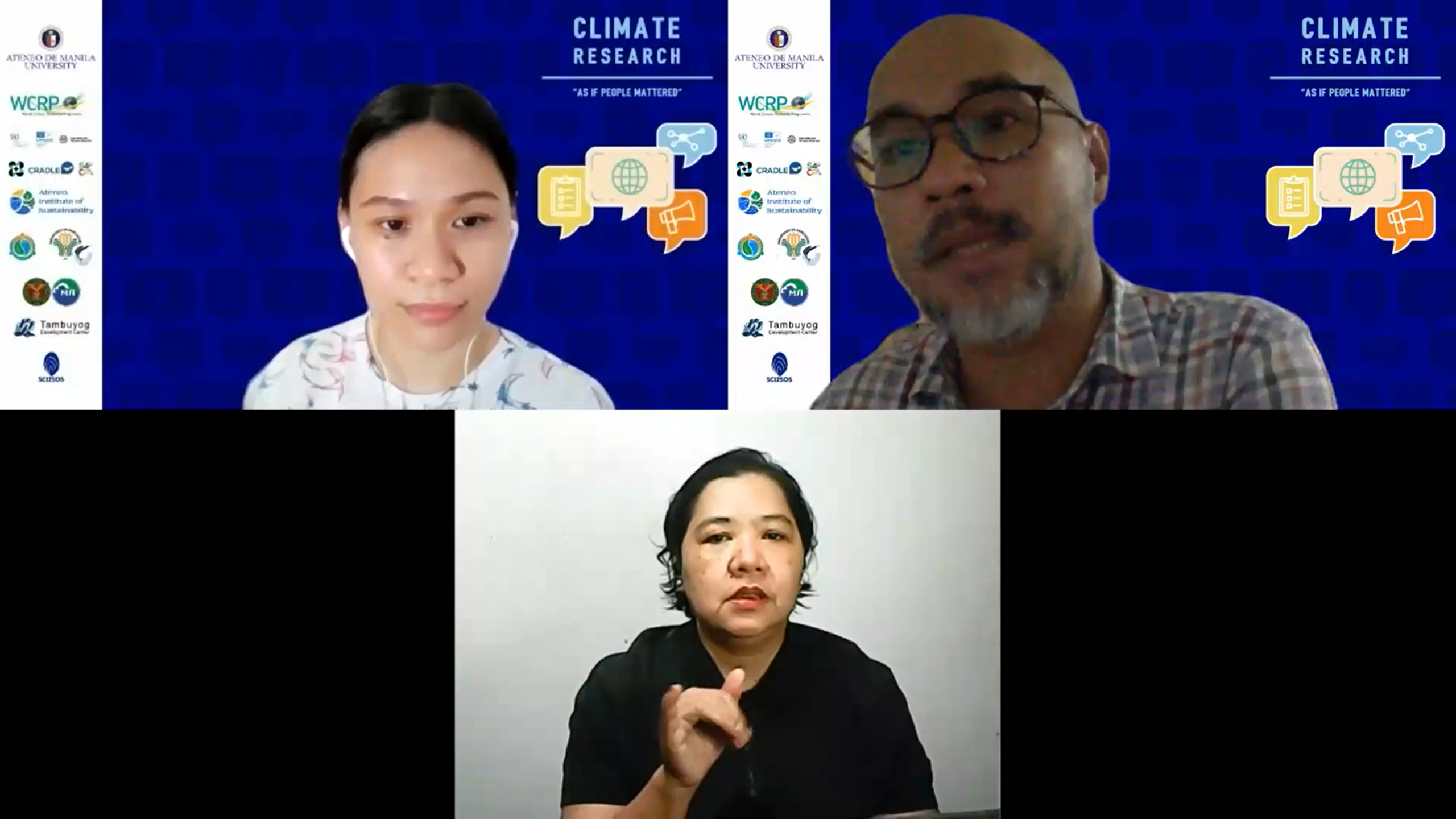
Mr Rodolfo noted the importance of having “champions” in partner communities who can galvanize support for an organization that seeks to form partnerships. He shared an example of a husband and wife from Padre Burgos, Quezon Province, two champions who share ASIN’s values. Notably, the community is also organized by the Tambuyog Development Center, a non-government organization which helps in community organizing. On multi-sectoral work, he also introduced SCI2SOS, or “Site Characterization and Implementation of Innovative Sustainable Oyster Systems,” with the tagline “Science to the Rescue,” another play on words. This project was initiated by ASIN in partnership with the University of the Philippines Marine Science Institute (UP MSI), the National Brackishwater Fisheries Technology Center of the Bureau of Fisheries and Aquatic Resources (BFAR-NBFTC), and Tambuyog Development Center. It is a collaborative effort to use science to bridge the gap between community and industry, with the hope of producing policy suggestions to make the industry more sustainable. Mr Rodolfo emphasized that the project is guided by the World Bank’s three sustainability points: (1) environmental sustainability, (2) economic sustainability, and (3) social and community sustainability. In order to achieve these three, he believes that cross-sectoral collaboration between business and industry, government, and citizens, must be present.
He recalled that the local government unit and the fisherfolk, who are the main beneficiaries of the project, were very supportive of SCI2SOS. Together, the different partners of the project collaborate through environmental monitoring to establish baseline data and citizen science, setting up a remote sensing network for the supply chain, training and technology transfer, engaging the community to develop a crop calendar, developing disaster risk resilience measures, and conducting financial literacy training. Mr Rodolfo noted that it was refreshing to see that the stakeholders themselves committed to participate, and understand that while they might not be able to earn as much during the first year, they see the long-term benefits and see oyster culture as a viable alternative livelihood. An example of their fruitful interaction is the fisherfolk being able to design a barrier to protect their rafts, but still allow for sufficient flow for circulation, hence improving the effectiveness of oyster production. This was prompted by their knowledge of the river, which would experience high flow velocities during certain times of the day. The community had also noticed that the areas where the rafts were located were getting shallower, and so suggested a transfer of site to allow the original spot to rest. This impressed Mr Rodolfo as it was their experiences which taught them the ecological principle “to rest.”
Noting the role of women, Mr Rodolfo shared that it is they who encourage their sons or husbands to support the project and advise patience. They also play an active role in making oyster clutches to hang from the rafts, making them integral partners of the project. Further reflecting on his experience with SCI2SOS, Mr Rodolfo noted the importance of engagement, which went beyond support for the project, but also allowed local knowledge to augment scientific knowledge and facilitate co-learning.
Closing his presentation, Mr Rodolfo mentioned a few challenges with community engagement, which included culture integration and political dynamics, organizing approaches, language differences, and the community bio-clock; the last of which Mr Rodolfo latched onto and explained that fishermen have their own schedule dictated by the lunar cycle and weather. He also highlighted the strengths of community engagement, which include the potential to develop a self-governing and self-sustaining community. He ended with a final message on making food production sustainable: cross-sectoral collaboration between partners who agree on the same values and principles, with the goal of environmental, economic, and social and community sustainability.
The session was attended by participants from the Philippines, with international attendees from India, Morocco, Pakistan, the United Kingdom, and the United States. This webinar was the second session in a series titled “Climate Research ‘As If People Mattered’,” the name of which comes from the article “Small is beautiful: climate change science as if people mattered,” written by Dr Regina R Rodrigues and Dr Theodore Shepherd, Co-Chairs of the Scientific Steering Group of the My Climate Risk lighthouse activity. The series occurred from November to December 2022. Replays and highlights of the webinar series are available in the following page.
Recent News
You may also like these articles
Protecting Creativity: AIPO and Rizal Library Host Copyright Awareness Session for the Ateneo Community
On March 18, 2026, the Ateneo Intellectual Property Office (AIPO), in collaboration with the Rizal Library, successfully conducted a Copyright Awareness Session held on the
Class and work arrangements for March 30-April 1, 2026 (Memo No. AGSB-DO-2526-043)
AGSB-DO-2526-043 28 March 2026 TO: AGSB Community FROM: (sgd.) Jowett Cecilio F. Magsaysay, MBA, PhD Dean SUBJECT: Class and work arrangements for March 30-April 1
Why can’t we eradicate tuberculosis? AIS dissects the TB issue in a multidisciplinary panel
On 24 March 2026, the Ateneo Institute of Sustainability (AIS), through its Sustainable Development Goals (SDGs) Program, hosted a multidisciplinary panel in observance of World
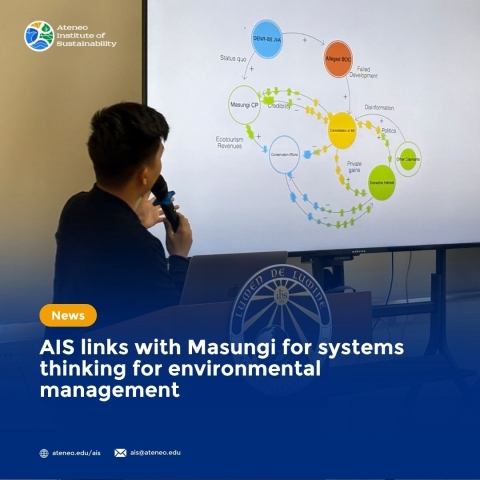
AIS links with Masungi for systems thinking for environmental management
Last 23-24 March 2026, the Ateneo Institute of Sustainability (AIS) , which manages the My Climate Risk – Ateneo de Manila University Regional Hub
Class and work arrangements for March 26-27, 2026 (Memo No. AGSB-DO-2526-042)
AGSB-DO-2526-042 25 March 2026 TO: AGSB Community FROM: (sgd.) Jowett Cecilio F. Magsaysay, MBA, PhD Dean SUBJECT: Class and work arrangements for March 26-27, 2026
QS Subject Rankings 2026: Ateneo in top 100 for theology; ranked in 7 subject areas
Ateneo de Manila University is among the top institutions in seven subject areas, and among the top 100 for theological and religious studies, according to