Unpacking climate communication in MCR-ADMU Climate Research webinar
20 Apr 2023 | Daniel C Ratilla


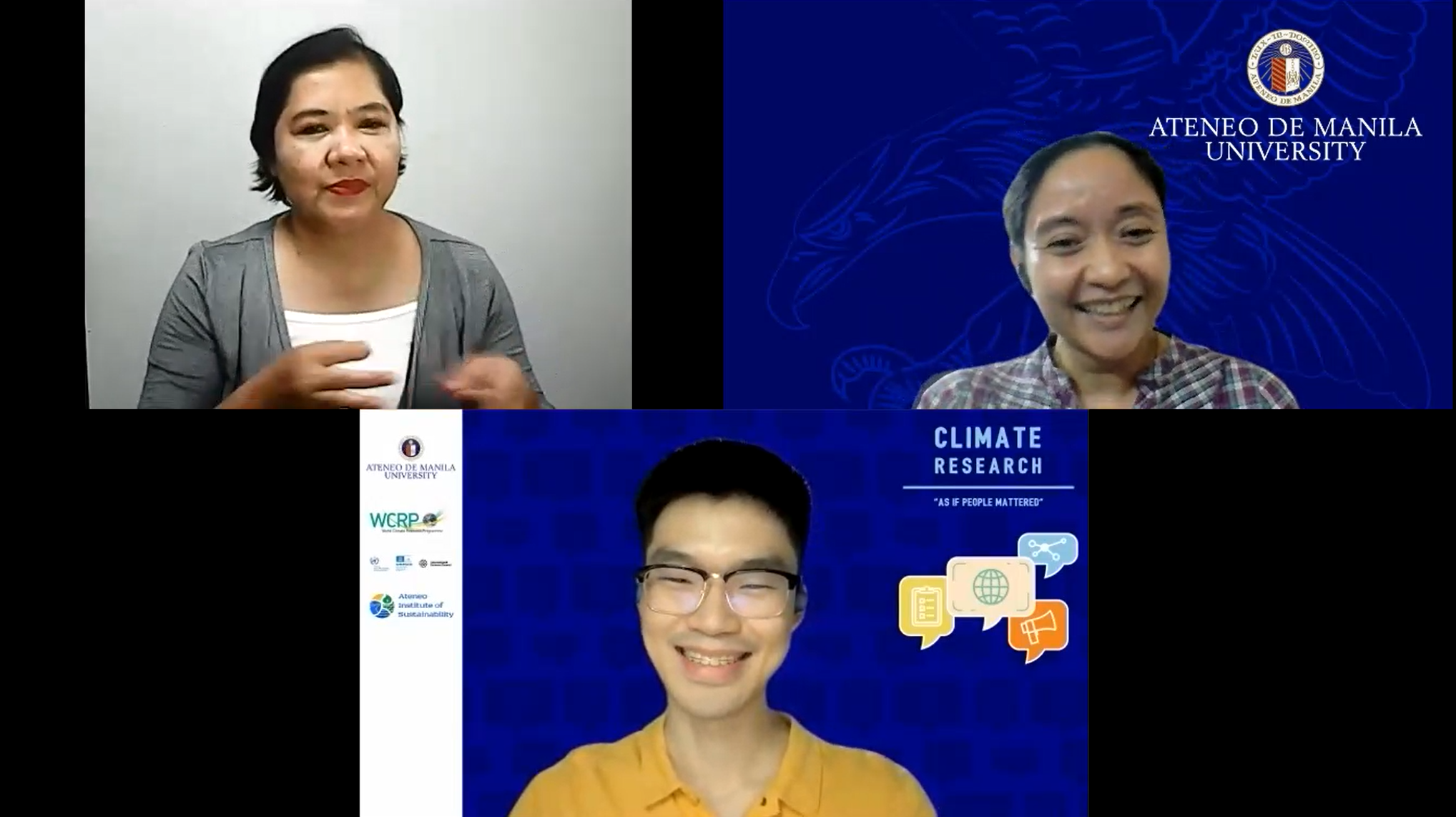
On 23 November 2022, the My Climate Risk – Ateneo de Manila University (MCR-ADMU) Regional Hub, which is hosted by the Ateneo Institute of Sustainability, organized a webinar titled “Conversations, Memories, and Dreams: Climate Communication that Goes Beyond Information Packaging.” My Climate Risk is a lighthouse activity of the World Climate Research Programme which aims to develop and mainstream a bottom-up approach to regional climate risk, and has a mycorrhizal network of hubs that span all continents except Antarctica.
The webinar featured Dr Maria Inez Angela Z Ponce de Leon, Associate Professor at the Department of Communication of the Ateneo de Manila University, as resource speaker. She highlighted the importance of reflecting on common misconceptions of climate information communication, and shifting the focus from simply repackaging information to understanding and listening to those at the forefront of climate risk. Beyond providing facts, it is also necessary to build meaningful relationships with people through stories, and forming conversations, memories, and dreams.
Dr Nikki Carsi Cruz, Assistant Professor and Chair of the Department of Interdisciplinary Studies of the Ateneo de Manila University, opened the program with a recollection of the power of everyday stories, which distill experiences into brief moments of delivery. She emphasized that the greatest stories register with both the mind and the heart, showcasing the best of the human spirit. Dr Priscilla Angela Cruz, Assistant Professor and Chair of the Department of English of the Ateneo de Manila University, closed the program and reflected on the transdisciplinary nature of the climate crisis, which calls for transdisciplinary and cooperative approaches. Both Dr Carsi Cruz and Dr Cruz are Collaborators of the Hub. The session was moderated by Mr Daniel C Ratilla, Program Officer for Climate and Disaster Resilience of the Ateneo Institute of Sustainability.
Dr Ponce de Leon opened her talk with the human affinity for stories, as these carry information in a way that is not a dry delivery of facts and numbers. She presented the famous Japanese woodcut, The Great Wave off Kanagawa, and how this demonstrates Japanese resilience by presenting endurance, a story that is embedded in art and in the memories and dreams of the Japanese people, and which can only be uncovered through interaction. Recalling her training as a theoretical scientist and molecular biologist, she remembered the misconception that simply presenting facts will cause an audience to change attitudes. This, she notes, becomes a common pitfall when scientists and science communicators expect the public to make the proper connections between information and action. When thinking of the concept of science communication, Dr Ponce de Leon says we initially think of making graphs and posters, but she made the distinction that these are “messages,” not necessarily “communication.” Communicators, she counseled, must also understand the recipients’ context as they have their own experiences and knowledge which will color their perception. Here, she noted the importance of understanding our “publics,” a term which acknowledges that there are different people in the public sphere with whom we interact. Science communication then, she stated, is not about packaging but about listening. She likened the human experience as “caught in a beautiful reality” in conversations, with memories as our paths and dreams as our future. Conversations thus level the exchange to one between equals, and becomes an experience of sharing rather than teaching.
In the second part of her talk, Dr Ponce de Leon discussed her research from 2017 and 2018, a few years after Typhoon Yolanda (international name Haiyan) blew through the Philippines. She reflected on the finger-pointing at the media, government, and scientists, but her research revealed that beyond questions of what the facts were, who delivered them, and in what language, it instead showed a need to understand how people talk about science. This uncovered a process of communities talking to each other before making decisions, which is often called “milling” in Western literature. Far from ignoring the science, however, or passively waiting for the weather to change, Dr Ponce de Leon countered that the phenomenon should instead be “deliberation.” This, she explained, needs discernment, and thus closeness and trust from a community before making decisions.
Talking about memories, Dr Ponce de Leon described these as “reflections on experience.” She showed a photo of a tsunami stone in Japan, a marker that informs viewers of the extent of the water from the time of a disaster; this is thus a reflection on experience. Both tangible objects and online archives serve this purpose, through the annual tropical cyclone tracking system of the Philippine Atmospheric, Geophysical and Astronomical Services Administration (PAGASA) and its database that depicts what typhoons of previous years looked like. These “online chronicles” invite us to look back, reflect, and act; memories and reflections thus give us lessons. She cautioned against conflating the idea of “moving forward” with “moving on,” which is especially dangerous in the context of climate risk, adaptation, and justice.
Dreams are described as aspirations of an imagined future. Beyond speculation, dreams are linked to the past and allow the imagining of a logical future. Relating this to science, dreams may look at trends or projections, and use imagination to look into the future by “dreaming” of what the data might look like, and what they might mean for long-term trends. The importance of experience and its connection to dreaming and imagination was illustrated by Dr Ponce de Leon when she recounted how localities were able to describe how signal number 2 and 3 typhoons would look like, but are unable to do so for typhoons that are stronger than what they had experienced. This, she noted, points to a need to reconfigure the conversation, from knowledge and charts, to an invitation to imagine.
Tying the components of her talk together, Dr Ponce de Leon explained that one cannot dream without one’s memories, and one cannot look back without knowing what one is looking for. Conversations are a way to access what people remember and dream about, and tell us that communication is not simply repackaging and disseminating information. A nuanced understanding of communication reveals that it is targeted and tailored, because far from an image of a single authority spreading information, there must be a recognition that “expertise is everywhere.” Dr Ponce de Leon shared a story by journalist Peter Rudiak-Gould about the Marshall Islands in the South Pacific which demonstrates the misconceptions of the scientific community and what they understand about indigenous knowledge: as one of the most vulnerable to climate change, the prevailing assumption was that with years of translating the term “climate change,” the Marshallese would understand it; however, Rudiak-Gould found that the translation of “climate” used the word “universe” or “cosmos,” thus discouraging action to address “cosmic change.” However, far from knowing nothing, the Marshallese instead knew much more about the changing of the tides and sea level rise. This reveals the need for greater participative research and listening, which could take a variety of forms and include inviting people to tell their stories of how they deal with hazards, ask them to build models of their communities, create a calendar of a group’s seasons, or even giving them a camera and invite them to take photographs to show how they understand their world.
In closing, Dr Ponce de Leon summarized that communicating climate change is not always just about putting facts together, but can be about conversing with people on equal ground, asking them to remember a past, and inviting them to dream because it is human nature. Our love of stories can also inspire us to act on the climate crisis, by tapping into our capacity to dream, and to help create a better story for future generations to tell.
The session was attended by participants from the Philippines, with international attendees from Egypt, Japan, Morocco, Pakistan, Qatar, South Africa, the United Kingdom, the United States, Vietnam, and Zimbabwe. This webinar was the third and penultimate session in a series titled “Climate Research ‘As If People Mattered’,” the name of which comes from the article “Small is beautiful: climate change science as if people mattered,” written by Dr Regina R Rodrigues and Dr Theodore Shepherd, Co-Chairs of the Scientific Steering Group of the My Climate Risk lighthouse activity. The series occurred from November to December 2022. Replays and highlights of the webinar series are available in the following page.
Recent News
You may also like these articles
Protecting Creativity: AIPO and Rizal Library Host Copyright Awareness Session for the Ateneo Community
On March 18, 2026, the Ateneo Intellectual Property Office (AIPO), in collaboration with the Rizal Library, successfully conducted a Copyright Awareness Session held on the
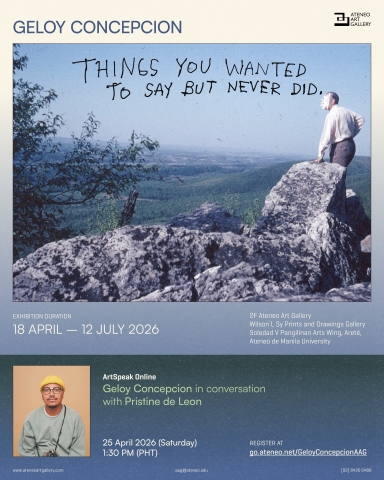
Things You Wanted to Say But Never Did: Geloy Concepcion’s six-year project makes Its exhibition debut at the Ateneo Art Gallery
Geloy Concepcion’s Things You Wanted To Say But Never Did comes to the Ateneo Art Gallery this 18 April 2026. After receiving almost 300,000 messages
Why can’t we eradicate tuberculosis? AIS dissects the TB issue in a multidisciplinary panel
On 24 March 2026, the Ateneo Institute of Sustainability (AIS), through its Sustainable Development Goals (SDGs) Program, hosted a multidisciplinary panel in observance of World
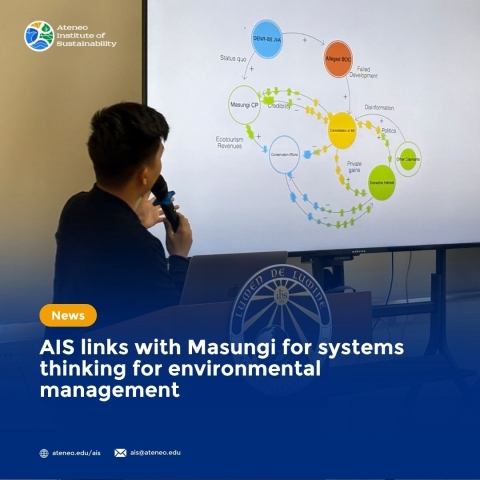
AIS links with Masungi for systems thinking for environmental management
Last 23-24 March 2026, the Ateneo Institute of Sustainability (AIS) , which manages the My Climate Risk – Ateneo de Manila University Regional Hub
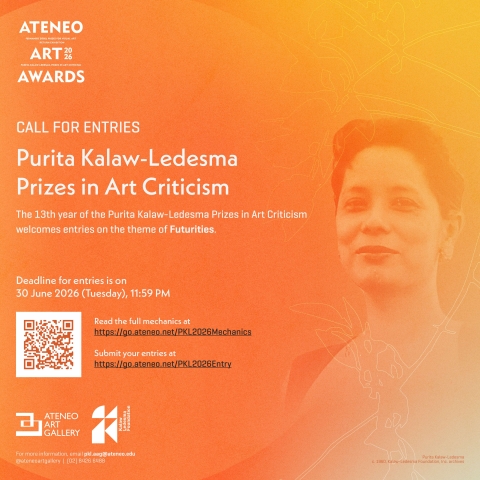
Call for Entries: 2026 Ateneo Art Awards - Purita Kalaw-Ledesma Prizes in Art Criticism
Co-presented with the Kalaw-Ledesma Foundation, Inc., the Ateneo Art Gallery is now accepting submissions for the 2026 Ateneo Art Awards Purita Kalaw-Ledesma Prizes in Art
Mangroves as shields of history and resilience: Insights from Dr Emma Porio
Mangrove forests have long shaped both the history and survival of coastal communities in the Philippines. According to Dr Emma Porio, Professor Emeritus (Sociology -