[Blueboard] Directions in Middle Power Diplomacy for a Leni Robredo Presidency
12 Apr 2022 | Alma Maria O Salvador
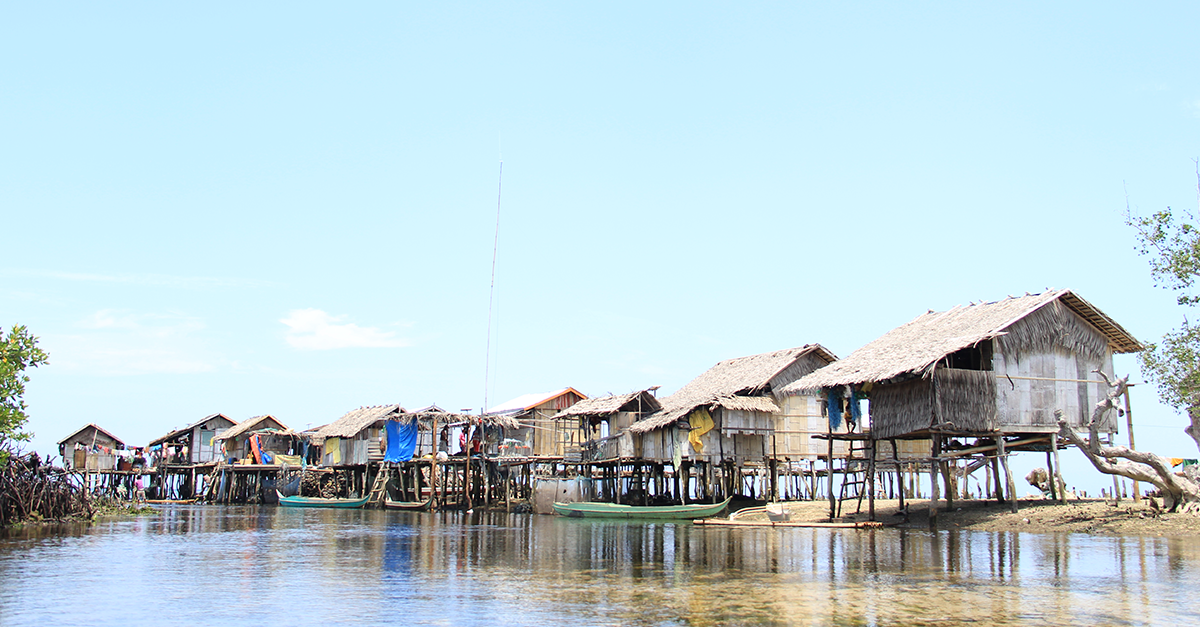
The Philippines is a maritime nation. Additionally, an archipelagic state with a coastline of 18,000 km in length, it is a country in which 60 percent of its total population are coastal dwellers whose livelihoods and food security depend on the preservation of marine systems and protection from climate change - induced extreme weather patterns.
Understanding our maritime and archipelagic identities as a nation is more crucial than ever. It is tied with our foreign/security priorities as a small state in the context of hegemonic rivalries, rising powers’ reclamation of their spheres of influence and a changing hierarchy of security concerns made evident during the pandemic. Acknowledging our role in terms of the impact of our positioning in Southeast Asia in the larger Indo Pacific region will shape how the next administration will advance Philippine foreign policy and diplomatic interests.
The components of the National Security Policy (NSP) 2017-2022 reflect our construction of our archipelagic and maritime identities in which the threats of piracy in the porous southern maritime border, maritime domain awareness priorities, claims in the South China Sea, interest in the Benham rise, and maritime boundary delineation form part of the Philippines’ maritime security interests. The Duterte Administration underscores the “protection of trade and marine resources against piracy, poaching, illegal instrusion, terrorism and human trafficking at sea” in its 12 Point National Security Agenda. However, in practice these are compartmentalized by a hierarchy of security concerns that privileges internal/ land based security over external/ maritime security. This privileging has resulted in the deprioritization of integrated coastal development, maritime law enforcement, maritime transport, shipbuilding and port services.
Furthermore a security framing based on the primacy of the more than 50 year old communist threat and of illegal drugs as the country’s major internal security challenge radically reduces a national security policy focus for emerging non conventional and existential security challenges of climate change, illegal,unreported and unregulated (IUU) fishing and marine degradation. Climate change which has been relegated as a part of “other strategic concerns” in the NSP impacts on coastal livelihoods and marine systems health. With 24 to 37.8 billion losses due to illegal fishing, it poses a threat to the nation’s human security.
Our construction of identity as a maritime /archipelagic nation must be sealed by our “positioning” as a small state in international relations. Small states, as distinct from the major and great powers, have been cast into the spotlight with the Russian invasion of Ukraine and China’s assertion of power against Southeast Asia’s littoral states. Small states are not necessarily minor powers and given the balance between the resources and influence they are in possession of, small states may assert themselves through middle power diplomacy.
Middle powers are challenged to transform their material capabilities and resources to influence by capitalizing on international regimes building, coalition formation, norm diffusion and niche diplomacy.In the context of a fluid and unpredictable security infrastructure, the Philippines with other middle powers in ASEAN can opt to advance middle power diplomacy based on a strategic autonomy from great powers and great power competition in the South China Sea and the larger Indo Pacific region. As a low middle power (Lowy Institute 2021), it ought to leverage the elements of its power “to direct or influence the behavior of other states, non-state actors, and the course of international events”. Diplomatic influence based on its defense networks, and ASEAN’s dialogue partnerships in the ARF, EAS and APEC and multilateralisms are what the Philippines can capitalize on while it simultaneously builds the military’s credible deterrence capabilities. Domestically, it should pay attention to our climate change resilience gap, made more pronounced during the pandemic, by implementing convergence in health, food and environmental security and foreign policies. Major gaps in domestic institutions strengthening have to be addressed in order to fortify a credible image as a normative middle power in the ASEAN region, specifically in areas of multilateral leadership (such as women, peace and security) where the Philippines has a strong track record to speak of.
Indeed, norm diffusion is a strategy that a Leni Robredo -led executive has the credibility to follow through. However it will remain incumbent upon her administration to weigh in on the middle power strategies based on distanciation and hedging against regional superpowers that the Duterte administration has instituted.
In the maritime domain, emphasis should be made in promoting a South China Sea Code of Conduct, practical cooperation involving US and China and non superpowers such as the Middle Power Quad (South Korea, Australia, Japan and India) in maritime domain awareness, marine protection and maritime safety and in upholding the UN arbitral ruling (2016). A middle power positioning should revitalize the role of the military as it pivots from a prioritization based on internal security to humanitarian assistance and disaster response (HADR) and military diplomacy.
These are some of the concrete means to operationalize middle power diplomacy for the next administration.
Alma Maria O Salvador is Associate Professor of Political Science at the Ateneo de Manila University, Philippines.

Recent News
You may also like these articles
QS Subject Rankings 2026: Ateneo in top 100 for theology; ranked in 7 subject areas
Ateneo de Manila University is among the top institutions in seven subject areas, and among the top 100 for theological and religious studies, according to
Congratulations to Dominic Craig Carpio (2 AB ECO-H) for placing 2nd in the EDSA Kwarenta Essay Writing Contest
The Department of Economics warmly congratulates Dominic Craig Carpio (2 AB ECO-H) for placing 2nd in the EDSA Kwarenta Essay Writing Contest. This achievement reflects
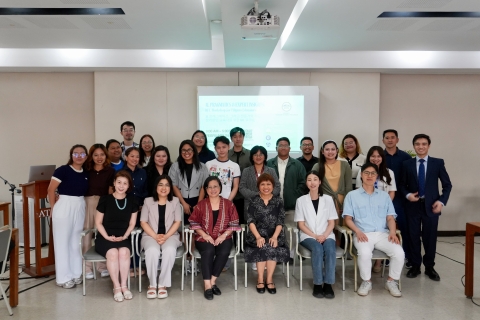
Ateneo Korean Studies Program Concludes KFL Workshop for Filipino Educators
The Ateneo Korean Studies Program, in partnership with the Global Leadership Development Institute, King Sejong Institute Quezon City 2, and the Dr. Rosita G. Leong
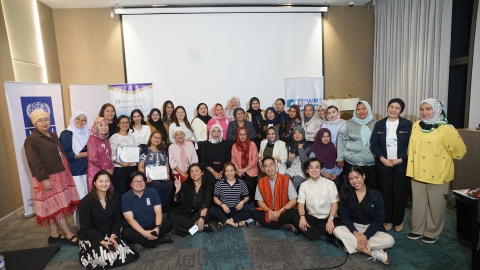
ASoG, UNDP hold training on Women, Peace, and Security in BARMM
Organized by the Ateneo School of Government (ASoG), in partnership with the United Nations Development Programme (UNDP), 33 women leaders from local government units and
Deanship of the Dr Rosita G Leong School of Social Sciences (Memo # U2526-071)
(Memo # U2526-071) Following the appointment of Dr Czarina A Saloma-Akpedonu as the new Vice President for Higher Education effective 1 June 2026, I have formed a Search Committee for the next Dean of the Dr Rosita G Leong School of Social Sciences (RGLSOSS).
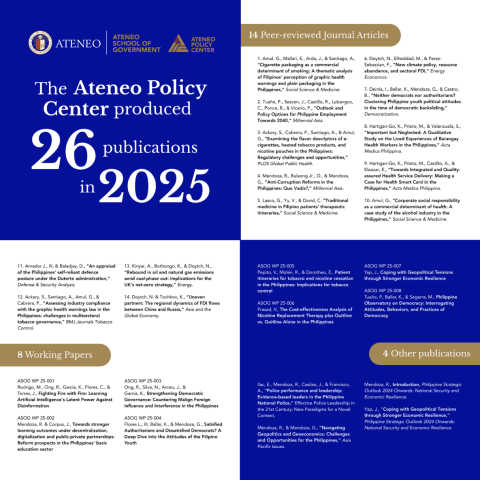
ASoG, through the Ateneo Policy Center, delivers 26 publications in 2025
As the research and public policy unit of the Ateneo School of Government (ASoG), the Ateneo Policy Center (APC) has continued to pursue cutting-edge research