[Tinig] Spirituality of Connectedness and Promoting a Culture of Care
12 Sep 2022 | Renato dela Cruz
Up until now, the tension between Russia and Ukraine continues to escalate, violence and conflict of all sorts, from all over the world seem to be unabated. Every day, newspaper accounts and news on radio, television, and various social media show us the reality of conflict and division. The experiences of war and terrorism become ordinary for most people in Asia. The sad reality is that there are even conflicts that happen in the name of religion. The situation led me to reflect further on the concepts of spirituality of connectedness and interfaith dialogue and the constant challenge to give flesh to it in the context of our contemporary society. Personally, I strongly believe that the immense social problems and conflict that afflict us today should pave the way for a certain spirituality that people in Asia and in the world, should develop, nurture, and practice. Today, we need a spirituality that should respond to the conflicts and divisions brought about by economic, political, socio-cultural, and religious factors. Thus, the basic premise in understanding the need for a spirituality of dialogue is the understanding the connectedness and the interdependence of all forms of life and the need to develop a sense of responsibility towards all created beings or what Pope Francis calls, a “culture of care” in his encyclical, Laudato Si'.
Our world is a pluralistic, multi-cultural, and a multi-religious one. In this regard, various attempts have been made both at the local and global levels in pushing the importance of dialogue. As previously mentioned, one of the fundamental reasons why people of different religious faith enter into a dialogue is precisely based on our connectedness. Whatever our religious or spiritual beliefs may be, we share a commonality; that we all belong to one human family. Such paradigm should lead us to understand that one of our most basic human needs is taking part in a trusting, loving, and caring relationships, connecting with someone or something beyond the self. Hence, at the heart of any spirituality is our relationship with ourselves, with God, and with others.
The spirituality of connectedness should lead us to empathize not only with people but also with the rest of creation. The spirituality of connectedness allows us to see that all individuals are worthy of respect and ultimately share the same human spirit that we have. Fundamentally, we are all the same in that we are all human beings. We may be of different races, different faiths and practices, different cultural traditions, but in the end, what connects or binds us together is our being human. While it is true that our world today is marked by conflict and division, most of us long for relatedness, to understand each other and to create friendship and togetherness. As social beings, our being dependent on each other in so many ways cannot be denied. We may be in Metro Manila but we cannot simply ignore what is happening in Mindanao. We may be Filipinos but we cannot help sympathizing with those victims of war and terrorism in Asia and other parts of the world. Our connectedness spurs us to help each other when we have difficulties, share our gifts that we enjoy to those who are most in need.
This kind of spirituality is something that I want my Theology students to imbibe and promote, particularly in relation to their NSTP-Punla experience. It is through cultivating a spirituality of connectedness that we aim for the common good. One of the major issues of social justice that we encounter today is the wide gap between the rich and the poor. This gap is not only between people but among nations as well. While there is truth in the premise that the problem rests on the social structures, this can also be interpreted as the inability or refusal on the part of other people to see our connectedness. Connectedness as a form of spirituality should awaken in us the realization that all living creatures and creation have essential values, that we truly are one, interconnected, and interrelated.
The encyclical Laudato Si' illustrates the idea that today’s situation should motivate us to cultivate a form of spiritual commitment in the pursuit of justice and peace and valuing the integrity of creation. We are especially called to be beacons of interfaith dialogue and action, to heal wounds, promote understanding and encourage human well-being and community. Johnston (1981) expresses the idea that even if religions have different precepts and beliefs, they can still join hands in a common method that is basically human and leads through conversion or enlightenment to truth and goodness.
People from all walks of life, from different cultures and traditions must try to live a spirituality rooted in the understanding of the interdependence of all forms of life and new sense of responsibility towards them. We all must try to connect. To connect is to have a discerning ear, the ear that hears the reality of a situation. It is a way of being with others.
Howard (2008) aptly pointed out, “Christian spirituality as lived relationship necessarily involves the expression of our care for others.” One of the ways to cultivate and promote this is developing a spirituality of connectedness and promoting a culture of care that can pave the way for a harmonious relationship with others and the rest of creation.
REFERENCES
Hill, Brennan. (1998.) Christian Faith and the Environment. Making Vital Connections. New York: Orbis Books.
Howard, Evan. (2008.) The Brazos Introduction to Christian Spirituality. Michigan: Brazos Press.
Johnston, William. (1981.) The Mirror Mind: Spirituality and Transformation. New York: Harper and Row, 1981..
Perrin, David B. (2007.) Studying Christian Spirituality. New York: Routledge.
Tinig is a monthly opinion and analysis series from the School of Humanities. The views expressed in this piece are those of the author and do not necessarily represent the views of School of Humanities or the Ateneo de Manila University.
Recent News
You may also like these articles
QS Subject Rankings 2026: Ateneo in top 100 for theology; ranked in 7 subject areas
Ateneo de Manila University is among the top institutions in seven subject areas, and among the top 100 for theological and religious studies, according to
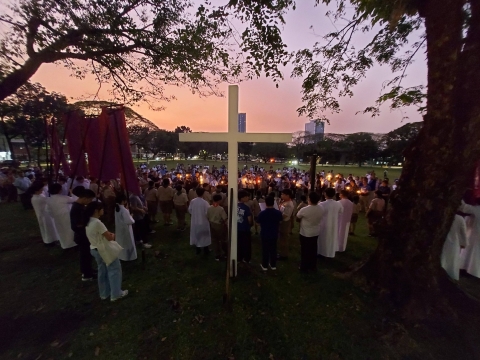
AJHS sponsors annual Way of the Cross gathering
Sponsored by the Ateneo de Manila Junior High School, the annual University Way of the Cross (Stations of the Cross) was held on the afternoon
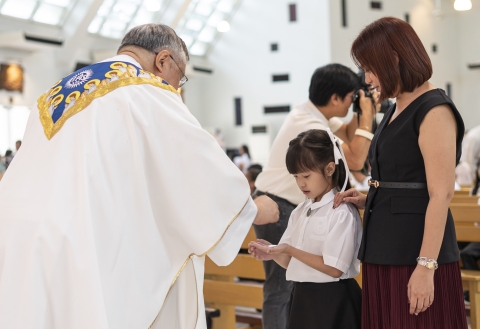
Another First: AGS girls receive their First Holy Eucharist
Ateneo de Manila Grade School’s Grade 2 students received their First Holy Communion on 7 and 14 February 2026 at the Church of the Gesù
An encounter with faith: Grade 6 Ateneans "Meet the Jesuits"
The following reflections were written by two Grade 6 students who participated in the recent “Meet the Jesuits” activity. In their personal accounts, they share
What really matters
On 27 January 2026, the Ateneo de Manila Senior High School commemorated its patron saint, Saint Aloysius Gonzaga, in a special way. Although his feast
University Way of the Cross 2026 (Memo U2526-060)
(Memo U2526-060)All members of the community (students, faculty, professionals, staff, administrators, parents, and alumni) are invited to participate in the University Way of the Cross on Friday, 27 February 2026, at the Loyola Heights Campus.