[Tinig] Forgetting and destroying our being kapwa
08 Feb 2023 | Marnie D Racaza
Last January 21, my close friend and I joined Renacimiento Manila’s Quiapo Heritage Walk. Our last stop was the Bahay Nakpil-Bautista, a historic house museum in Quiapo that used to be the home of national heroes like Gregoria de Jesus, who was the Lakambini of the Katipunan revolutionary movement, and her husband, Julio Nakpil, a musician and soldier appointed by Andres Bonifacio as Vice-President Supremo of the Katipunan.1 On one of the corner walls of the house hangs a picture of the family with a few Jewish refugees who found a haven here in the Philippines after President Manuel L. Quezon opened the country’s borders, through the Open Door Policy, for those fleeing the Holocaust.2 Every January 27, UNESCO enjoins the international community to remember the victims of the Holocaust and continue our commitment to counter all forms of discrimination and intolerance3 that could perpetuate a culture of violence and death.

Last year, I participated in a nine-month program called the Gandhi-Mandela-Freire Fellowship Program based at the Multiversity Platform of the Loyola Extension Services, a registered charity as well as the social lab and incubation center of the Loyola College of Social Sciences (LCSS), a Jesuit institution in Thiruvananthapuram (Trivandrum), India. The program explores, expands, and exhorts the practice of compassion guided by Paulo Freire’s pedagogy of the oppressed, Mahatma Gandhi’s philosophy of nonviolence, and Nelson Mandela’s commitment to reconciliation.4 A crucial discussion in the program is on human cruelty. Genocide was one of the topics we were asked to examine and immerse. I was assigned to look into and share about the Rwandan genocide.

I have never been to any country in Africa, but the continent holds a special space in my heart. When I was sixteen, I read an article from Misyon magazine about a Filipino missionary nun’s experience in Cameroon. She recounted how she taught the children in the local village how to say “I love you, Jesus” in different languages, including ours. Her story greatly fascinated me and sparked my desire to become a missionary. When I joined a religious formation for a year, my two Filipino formators were missioned to Congo and Cameroon. I also met and made friends with several African postulants and novices from other congregations. My longtime confidante and spiritual guide, who is now doing her mission in Senegal, is very fond of giving me artwork, postcards, and cloth from Africa. But one of the striking stories which I could not forget is my formator’s experience in Congo. She recalled how she had to cross rivers and hike mountains with others in her community to escape the violence brought about by the civil war in the country during those years. It was in her anecdote that I first heard and learned about the conflict between the Hutus and the Tutsis.
(Image from BBC News:https://www.bbc.com/news/world-africa-26875506)

The massacre occurred from April 6 to July 22, 1994. It was a hundred-day slaughter of 800,000 Rwandans who were mostly Tutsis. It was a product of years and years of producing and perpetuating hegemonic narratives and relationships of privileging and discriminating between the two major ethnic groups of Rwanda: the Hutus and Tutsis. Pre-colonial times, the two tribes lived harmoniously alongside each other. As indicated in an article by Human Rights Watch, “Hutu and Tutsi shared a common culture and language and occasionally intermarried.”5 The essay continued with how situations changed between the two when the colonizers controlled Rwanda: “During these years of colonial rule the categories of Hutu and Tutsi became increasingly clearly defined and opposed to each other, with the Tutsi elite seeing itself as superior and having the right to rule and the Hutu seeing themselves as an oppressed people. . . .In the mid-twentieth century, as the colonialists were preparing to leave, Hutu overthrew the Tutsi elite and established a Hutu-led republic.”6 I was particularly struck by the mechanism used by the Belgian colonizers in segregating these people. By measuring the Rwandan nose size and height and categorizing their eye type, Tutsis were set apart from the Hutus. The identification card indicating their ethnicity was considered the passport to the death of the Tutsis during the genocide.
The role of media was crucial in creating and sustaining the hate narratives against the Tutsis. The Hutu extremists proliferated and inspired hate and violence toward the Tutsis through their radio station Radio Television Libre des Mille Collines (RTLM). During the slaughter, the station encouraged their audience to kill their neighbors who were Tutsis, using domestic and agricultural tools like the machete. In print media, they depicted the Tutsis as cockroaches and snakes. But the most horrifying and painful to me was when I learned that the Catholic Church in Rwanda played an active role in the genocide. An essential teaching in Christianity, the Ten Commandments, was weaponized to incite segregation and hatred. “The Hutu Ten Commandments” was a document that was published in the pro-Hutu, anti-Tutsi newspaper Kangura in December 1990, almost four years before the commencement of the genocide in Rwanda. Tutsis seeking refuge in Catholic churches were slaughtered, with babies and children smashed to death against the walls of the church. These killings were even performed by priests and nuns.

Understanding human cruelty is one of the discussions I often have with my students in our Theology classes. We usually look closely into this when we reflect on the dynamics of sin. Fr. Jon Sobrino, a Jesuit liberation theologian pointed out in his work Awakening from the Sleep of Inhumanity that one may or may not believe in God but no one can deny the reality of sin. We only need to look back at our history and see it in the current conditions of the world.
Theologians define sin in many ways. After the Second Vatican Council, there have been developments in the theology of sin. For James Keenan, a Jesuit moral theologian, sin is a failure to bother to love. After learning deeply about the Rwandan genocide and coming across the word ubuntu, an African word that means shared humanity, kindness, and the greatness of heart, I would like to define sin as forgetting and destroying our shared humanity. In the Filipino context, I believe kapwa is our word corresponding to ubuntu. Kapwa, according to Virgilio G. Enriquez, is the “unity of the self and others…a recognition of shared identity, and an inner self shared with others.”7 To be complicit and even indifferent to such atrocities as genocide is forgetting and destroying our being kapwa to each other.
Sources:
1See “The House – Bahay Nakpil-Bautista,” n.d., accessed January 29, 2023, https://bahaynakpil.org/thehouse/.
2See “Remembering Our Humanitarian Legacy with ‘Safe Haven: Jewish Refugees in the Philippines,’” UNHCR Philippines, accessed January 29, 2023, https://www.unhcr.org/ph/17553-jewish-refugees.html.
3"International Day of Commemoration in Memory of the Victims of the Holocaust | UNESCO,” accessed January 29, 2023, https://www.unesco.org/en/days/holocaust-remembrance.
4“Home,” GMF Fellowship, accessed January 29, 2023, https://www.gandhi-mandela-freire.org.
5"The Rwandan Genocide: How It Was Prepared : Context,” accessed January 29, 2023, https://www.hrw.org/legacy/backgrounder/africa/rwanda0406/1.htm.
6Ibid.
7Virgilio G. Enriquez, “Kapwa and the Struggle for Justice, Freedom, and Dignity,” in From Colonial to Liberation Psychology: The Philippine Context (Quezon City: The University of the Philippines Press, 1992), 52.
Tinig is a monthly opinion and analysis series from the School of Humanities. The views expressed in this piece are those of the author and do not necessarily represent the views of School of Humanities or the Ateneo de Manila University.
Recent News
You may also like these articles
QS Subject Rankings 2026: Ateneo in top 100 for theology; ranked in 7 subject areas
Ateneo de Manila University is among the top institutions in seven subject areas, and among the top 100 for theological and religious studies, according to
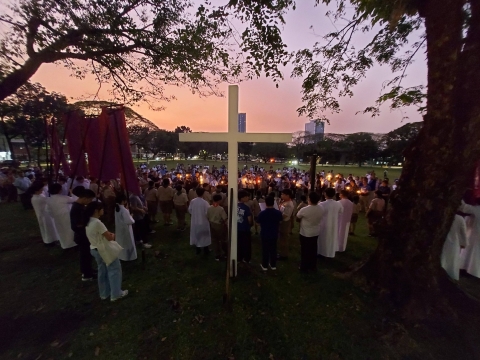
AJHS sponsors annual Way of the Cross gathering
Sponsored by the Ateneo de Manila Junior High School, the annual University Way of the Cross (Stations of the Cross) was held on the afternoon
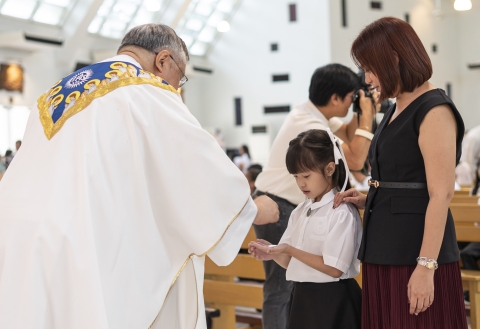
Another First: AGS girls receive their First Holy Eucharist
Ateneo de Manila Grade School’s Grade 2 students received their First Holy Communion on 7 and 14 February 2026 at the Church of the Gesù
An encounter with faith: Grade 6 Ateneans "Meet the Jesuits"
The following reflections were written by two Grade 6 students who participated in the recent “Meet the Jesuits” activity. In their personal accounts, they share
What really matters
On 27 January 2026, the Ateneo de Manila Senior High School commemorated its patron saint, Saint Aloysius Gonzaga, in a special way. Although his feast
University Way of the Cross 2026 (Memo U2526-060)
(Memo U2526-060)All members of the community (students, faculty, professionals, staff, administrators, parents, and alumni) are invited to participate in the University Way of the Cross on Friday, 27 February 2026, at the Loyola Heights Campus.