[Blueboard] Marcos foreign policy should embrace middle power identity
14 Feb 2023 | Alma Maria Salvador
Foreign policy and external relations are crucial aspects of President Ferdinand Marcos, Jr.’s government as they play a significant role in responding to the interaction between rapidly shifting domestic and international contexts. Furthermore, the administration should capitalize on the nation-state’s future demographic resources to build economic power and societal resilience, particularly against internal, geopolitical, and environmental threats, which are our weakest based on the Asia Power Index 2023.
Considering the Philippines’ specific military capability changes, it is time to utilize the nation-state’s resources as a middle power, maximizing our continuing source of influence through an expanding defense network (from the PHL-US alliance), our reach in the broadly integrating ASEAN plus network, and our potential multilateral power. These are crucial to navigating a complex interdependent world, where mounting US-China rivalry in the Indo-Pacific region has repercussions for the tightly integrated economies and securities in the region and the world.
As the primary architect of foreign policy, Marcos Jr. should promptly address the transformations affecting governance at different levels. The president must recognize that the Philippines has evolved into a middle power, occupying a favorable geopolitical and economic position in Asia between the great powers with their preponderant aims and the weaker nation-states that lack influence in global affairs.
Beyond a position in the distribution of power, middle power is also about positioning or how the nation-state and its leaders convert their resources and capabilities to real influence. Indeed, the notion of the middle power is also about foreign policy choice or strategy. To the middle power actor, with neither the immense military/economic wherewithal of the superpower but with the capabilities that can be the basis for voice in international and global politics, the Marcos Jr. administration must aim at a “middle” pathway to avoid being drawn into the escalating US-China rivalry.
At the 2023 World Economic Forum meeting, Marcos Jr. made it clear that when questioned about his stance, he stated, that he does not represent Beijing or Washington DC. His loyalty lies with the Philippines and that he stands with the Philippines. This approach of not siding with either party is known as having an independent or equidistant foreign policy in both its form and substance. However, its execution can prove to be challenging and require careful consideration in decision-making.
We have witnessed former Rodrigo Duterte’s execution of an independent (from the US) foreign policy through appeasement of China by affiliating within the ambit of the latter’s trade and investments. Similarly, a policy of downplaying the South China Sea arbitral ruling was necessary to deal with an aggressive neighbor. Towards the US, however, the policy was more of ambiguous distancing from the alliance while using a mix of incentives and pressure regarding the Mutual Defense Treaty, Visiting Forces Agreement, and Enhanced Defense Cooperation Agreement, which are cornerstones of the PHL-US relations. In addition, security and arms trade diversification of providers and partners underpinned the foreign policy separation from the US. Towards the end of his term, Duterte shifted the balance by reversing his appeasement policy towards a more cautious form of “soft balancing” towards China. Finally, to maintain a middle power choice, he revitalized US anti-terror support while resurrecting the legal force of the arbitral ruling power to respond to escalating Chinese provocations in the Philippine EEZ.
Is President Marcos Jr. shifting towards adopting a foreign policy approach that would establish the Philippines as a middle power?
His foreign policy incorporates vital elements necessary for the country to attain middle-power status and to embrace and solidify this identity. In his first 200 days in office, he continued and modified his predecessor’s foreign policy of soft-balancing China with strengthened economic ties and leveraging the arbitral ruling while reinforcing the Enhanced Defense Cooperation Agreement (EDCA) to increase US military access to Philippine bases and using this as the engine of the minimum credible defense. Additionally, like Duterte, Marcos Jr. is diversifying Philippine security beyond the US-led alliance system by strengthening bilateral strategic partnerships and security relations with Japan, South Korea, and Australia.
While these are forerunners in high politics, the middle power approach to foreign policy must necessarily entail that this administration develops the nation-state’s capabilities for what are otherwise non-traditional security and low political issues. For example, there are windows of opportunities found in the environmental agenda of the current administration under Secretary Toni Yulo-Loyzaga’s leadership. This administration should elevate its climate agenda to foster societal disaster resiliency and enhance maritime and marine sustainability in this area of great transnational significance. Furthermore, a prioritization of migration policy reform of overseas labor deployment under Secretary Enrique Manalo’s leadership is another window where a middle foreign policy choice based on some norm development at home will resonate globally.
Alma Maria O. Salvador, Ph.D. is an associate professor of Political Science at the Ateneo de Manila University.
This piece was first published on BusinessWorld.

Recent News
You may also like these articles
ASOG’s Tobacco Control initiatives spotlighted in DOH National Technical Working Group for Tobacco Prevention and Control
On March 10 to 12, 2026, the Ateneo School of Government (ASOG), through its research and public policy unit, the Ateneo Policy Center, participated in
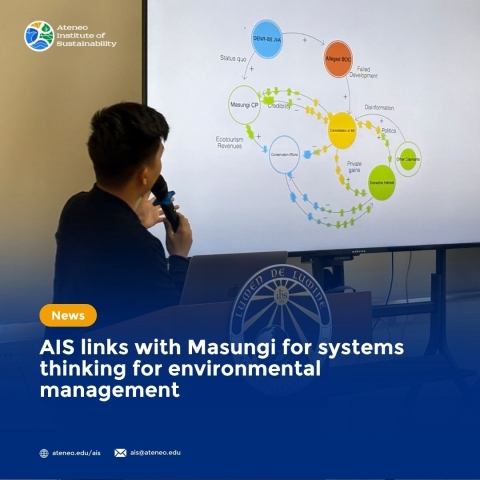
AIS links with Masungi for systems thinking for environmental management
Last 23-24 March 2026, the Ateneo Institute of Sustainability (AIS) , which manages the My Climate Risk – Ateneo de Manila University Regional Hub
BIR and Ateneo sign MOU for academic cooperation and research collaboration
The Bureau of Internal Revenue (BIR) and Ateneo de Manila University recently signed a memorandum of understanding (MOU) for academic cooperation and research collaboration. The
QS Subject Rankings 2026: Ateneo in top 100 for theology; ranked in 7 subject areas
Ateneo de Manila University is among the top institutions in seven subject areas, and among the top 100 for theological and religious studies, according to

Scribbles of discontent: Graffiti and banyulatin as works of literature
The law often dismisses graffiti as “destruction,” “anarchy,” or even as mere “dirt.” But new research from Ateneo de Manila University’s Filipino Department reveals what
ASOG meets with Department of Health—Bureau of International Health Cooperation to strengthen institutional partnership
On 27 February 2026, the Ateneo School of Government (ASOG), through its research and public policy unit, the Ateneo Policy Center, held a courtesy meeting