Duterte gov’t, third in most laws passed post-Martial Law
13 Jul 2021

FOR IMMEDIATE RELEASE
MC JAZER ROSINI MALONDA
Advocacy and Communications Officer
Ateneo School of Government
+639267698956
mmalonda@ateneo.edu
Duterte gov’t, third in most laws passed post-Martial Law
QUEZON CITY - Backed by allies from both the Senate and House of Representatives, President Rodrigo Duterte’s government ranked third among post-Martial Law administrations that passed the most number of legislations, research shows.
In a report published by the Ateneo School of Government, 139 laws were passed during the 17th and 18th Congress. Fifty-one of these were particularistic laws or legislations related to development of municipalities, among others, and 46 were focused on social reforms. Twenty-four laws were related to bureaucratic legislation that aimed to regulate government agencies and facilitate public policies. Nine laws were economic-related and eight were on political reforms.
However, despite the said output, Policy Analyst and Constitutionalist Atty. Michael Henry Yusingco said that these measures “cannot be said to have responded to what we ultimately need as a nation… to improve our lives.”
“There are laws that we need to improve the way we govern ourselves, to improve our political system, such as the enactment of a law that regulates political dynasties [or] a law that improves our political parties,” he explained.
Among the landmark legislations passed by the Duterte administration were the Bayanihan Laws, Tax Reform laws, Rice Tariffication Law, Free Higher Education Law, and the Universal Health Care Law.
Discussing the passage of the controversial Anti-Terrorism Law, Yusingco pointed out the strong influence of the Executive branch on its legislative counterpart.
“Our lawmakers, who are supposed to represent the interest of the people, sometimes or more often, would disregard their constituency and put more weight in what the president is directing them to do.”
“When the president certifies a bill as urgent, based on declarations of lawmakers, to them that is a signal that they should pass it as soon as possible, which is what happened to the Anti-Terror Law,” Yusingco said.
“Congress actually passed it even before passing the Bayanihan law which we all needed because of the pandemic. This is an example, I would say, of our lawmakers, giving more weight to the directive of the president, than the sentiment of their constituents.”
President’s influence over Congress undermines separation of powers
Yusingco also raised his concerns over the lack of checks and balances between these branches of government due to the “deferential” alliance between the President and the so-called supermajority at the House of Representatives.
“If the executive and the legislative are friends and they cooperate, then they can have a significant legislative output. However, it can undermine the principle of separation of powers.”
“Not all of our problems can be properly addressed. Because there is now a collusion or cooperation between the executive and the legislative, what happens most often than not is that they will only target situations or issues that can benefit them,” he explained.
“Would they address [the problem of] corruption? The answer to that is probably not.”
Moreover, noting the recent issue of speakership in the House of Representatives, Yusingco said that the act of going to Malacañang and asking the president to choose who should be the Speaker is a blatant example of the violation of the principle of separation of powers.
“A close partnership and collaboration between the House speaker and the President is key to electoral victory. Because the Speaker controls the progress of the budget. They hold how the budget is crafted, so they have full control of where the money goes, to whom it is allotted, and to where. With that kind of power, that makes them really important in terms of politics where political favors are distributed.”
Key legislation promises failed to pass
Despite the legislative productivity, President Duterte failed to pass some of its key legislation promises. Among these are the shift to a federal form of government and the revival of death penalty.
“Majority of Filipinos, I daresay if not all, do not support a death penalty law. Maybe that's because of our Catholic background, or maybe it's just because of our family culture that we value life, that we value redemption, more than retribution,”
“So, the promoters and the advocates of the death penalty law, the reason why they cannot push that in congress is because they have not convinced the public at large, that it is needed, today,” Yusingco explained.
###
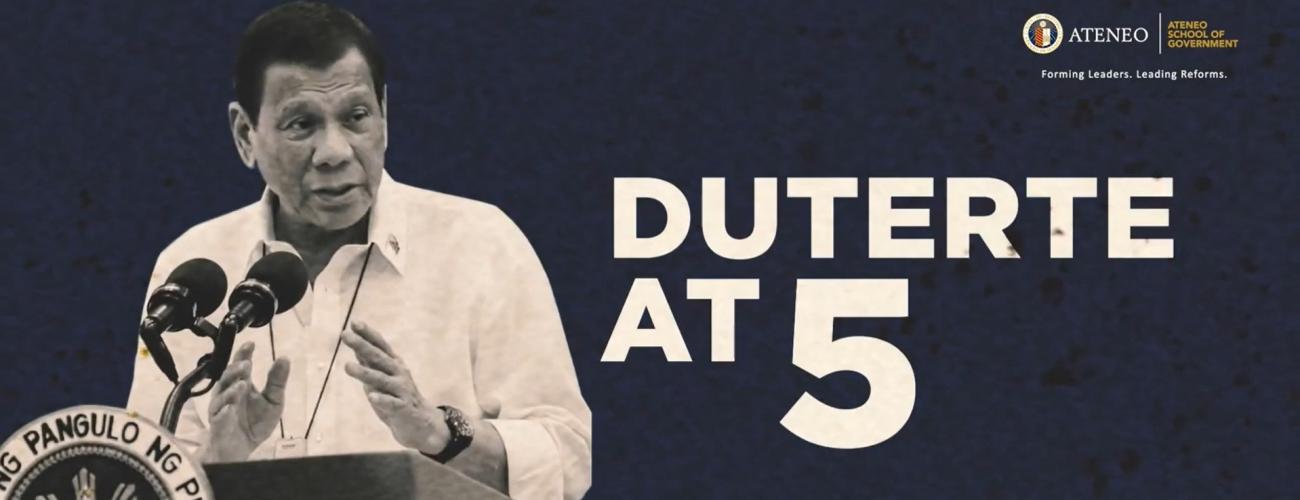
The Duterte at 5: The Duterte Administration By the Numbers is a series of comprehensive reports covering the Duterte Administration’s economic policy management, social and development programs, legislative reforms, and national security, anti-corruption, and anti-crime policies. Prepared by the Ateneo School of Government, the comprehensive reports feature write-ups, video interviews, and video explainers from economic professors, political science experts, and development fellows.
Links to the reports and videos will be made available on the website of the Ateneo School of Government (https://www.ateneo.edu/aps/asog), as well as on the Ateneo School of Government Facebook Page.
For more information on the reports, you may contact Jaz Malonda at mmalonda@ateneo.edu.
Recent News
You may also like these articles
ASOG’s Tobacco Control initiatives spotlighted in DOH National Technical Working Group for Tobacco Prevention and Control
On March 10 to 12, 2026, the Ateneo School of Government (ASOG), through its research and public policy unit, the Ateneo Policy Center, participated in
AIS links with Masungi for systems thinking for environmental management
Last 23-24 March 2026, the Ateneo Institute of Sustainability (AIS) , which manages the My Climate Risk – Ateneo de Manila University Regional Hub
BIR and Ateneo sign MOU for academic cooperation and research collaboration
The Bureau of Internal Revenue (BIR) and Ateneo de Manila University recently signed a memorandum of understanding (MOU) for academic cooperation and research collaboration. The

ASOG meets with Department of Health—Bureau of International Health Cooperation to strengthen institutional partnership
On 27 February 2026, the Ateneo School of Government (ASOG), through its research and public policy unit, the Ateneo Policy Center, held a courtesy meeting
ASOG Executive Education Program Leads Open Training Course on Public-Private Partnerships for the People: By and For Local Government Units
The Ateneo School of Government, through its Executive Education Program, conducted a two-day training course on Public-Private Partnerships for the People (PPPP): By and For

Dr Alfredo RA ‘Alran’ Bengzon (20 October 1935 – 3 March 2026 ) (Memo U2526-076)
(Memo #U2526-076) With deep sadness, we inform the University community of the passing of Dr Alfredo RA ‘Alran’ Bengzon on 3 March 2026.