[Blueboard] The 2021 Code of Conduct for the South China Sea: Navigating between norms and power politics
10 Aug 2021 | Alma Maria O. Salvador

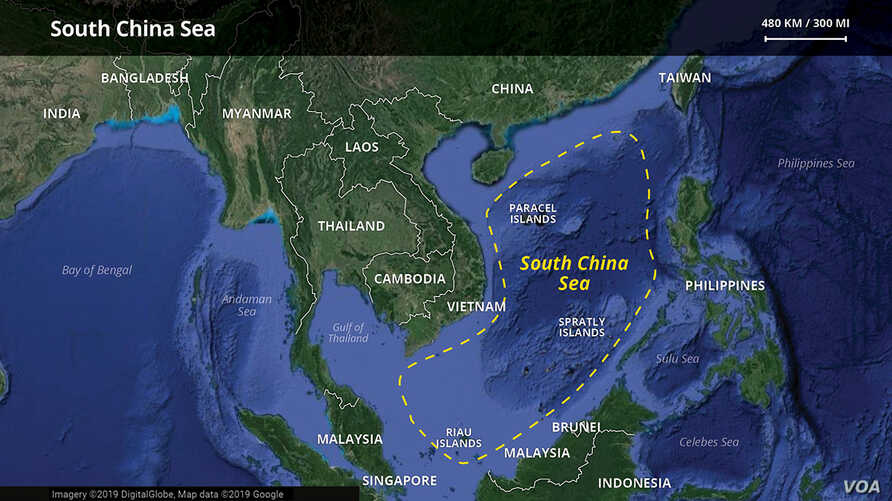
Renewed interest and hopes for a final Code of Conduct for the South China Sea have surfaced during the 37th ASEAN Summit. The focus is on moving forward an “effective and substantive” code from the Single Draft Negotiating Text (SDNT) that forms part of the latest agreement between ASEAN-China leaders as of 2019. This should have been seen as a positive turn for ASEAN and China relations in the light of establishing a rules based governance and dispute settlement system for the users/ littoral states in the region. However bilateral developments marked by China’s aggression against claimant member states before and during the pandemic have pushed the claimant states of ASEAN to resort to legal measures outside of the yet evolving regional code arrangement.
Between 2017 and 2018 when the Framework and the SDNT were formulated, China has upped the ante of making counterclaims against its own in this vital waterway. During the pandemic,Chinese navies, coast guards and fishing vessels’ deployment of complex military and militia tactics of firing water cannons, swarming and ramming against Philippine,Vietnamese and Malaysian fishing and oil exploration vessels have resulted in parallel militarism among ASEAN member states including the Philippines. One of the more recent forms of intimidation in 2019 was the swarming of hundreds of Chinese military-non military vessels in Pag-asa Island in the West Philippine Sea, where Philippine military and civilians established a community.
But the real tensions between parties are actually found in the provisions of the draft. The future of negotiations for what is hoped to be an enforceable regional code will have to address the polar views of China and individual ASEAN member states on framing the SCS as exclusive to the littoral states of the waterway or as part of the global commons. Needless to say China is the proponent of exclusivity in the SCS. Alternatively, the latter view which seeks to guarantee freedom of the seas and navigation has the support of Malaysia, Vietnam and the Philippines. Another thorny issue is China’s non recognition of the UN arbitral ruling of 2016 (Philippines vs China) which is detrimental for a governance regime anchored on the UN Law of the Sea Convention. Failure to align the code to the UNCLOS and the arbitral ruling is the first bottleneck for an effective dispute settlement arrangement in the SCS. Vietnam is most vocal about implementing an UNCLOS-aligned code of conduct. Given the asymmetrical nature of power play in the negotiations and the facts on the ground, could the horizon for an effective code of conduct be far behind?
How regional parties bridge competing ideas in the code poses a major challenge. The first set of these includes the narratives already mentioned in the preferences of parties for or against aligning the code to the UNCLOS and hence to the practice of freedom of navigation. These issues mirror the politics and ideologies of China and are mobilizing points for counter US involvement. This is thus an example of how an interface of norms and great power politics can dangerously impact on the region.
On the other hand, are practical cooperative measures that are proposed in the draft notably, to advance marine environmental protection, research, safety of navigation and communication at sea, transnational crimes, search and rescue and resource exploration, when implemented at bilateral and mini-lateral levels within ASEAN will help build confidence and maritime security among users. These practical arrangements also serve to cushion the limitations of a code that is increasingly being embedded in a precarious geopolitical environment.
Under the current circumstances, ASEAN may not be able to fully depend on an enforceable code of conduct that incorporates global rules and norms and the voices of smaller claimant states vis-a-vis China’s revisionism. In addition to this, ASEAN should strengthen the cooperative security institutions it has built overtime. Revisiting ASEAN way in order to strengthen ASEAN centrality is a pragmatic move as well as strengthening of defense level security arrangements such as the ASEAN Defense Ministers Meeting (ADMM)- Plus to further practical cooperation in jointly safeguarding against the unintended consequences of asymmetrical power relations in the SCS.
Alma Maria O. Salvador PhD is a full time member of the Ateneo de Manila University Department of Political Science.

Recent News
You may also like these articles
ASOG’s Tobacco Control initiatives spotlighted in DOH National Technical Working Group for Tobacco Prevention and Control
On March 10 to 12, 2026, the Ateneo School of Government (ASOG), through its research and public policy unit, the Ateneo Policy Center, participated in
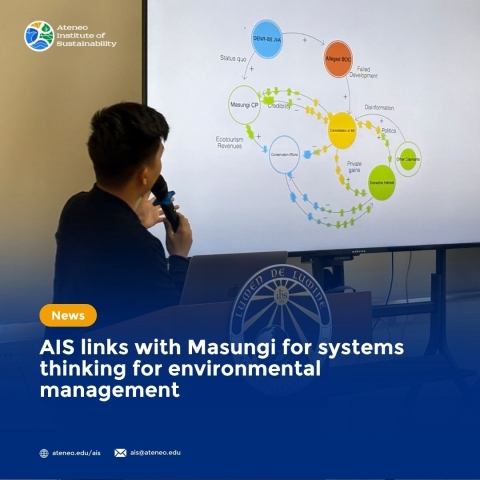
AIS links with Masungi for systems thinking for environmental management
Last 23-24 March 2026, the Ateneo Institute of Sustainability (AIS) , which manages the My Climate Risk – Ateneo de Manila University Regional Hub
BIR and Ateneo sign MOU for academic cooperation and research collaboration
The Bureau of Internal Revenue (BIR) and Ateneo de Manila University recently signed a memorandum of understanding (MOU) for academic cooperation and research collaboration. The
QS Subject Rankings 2026: Ateneo in top 100 for theology; ranked in 7 subject areas
Ateneo de Manila University is among the top institutions in seven subject areas, and among the top 100 for theological and religious studies, according to
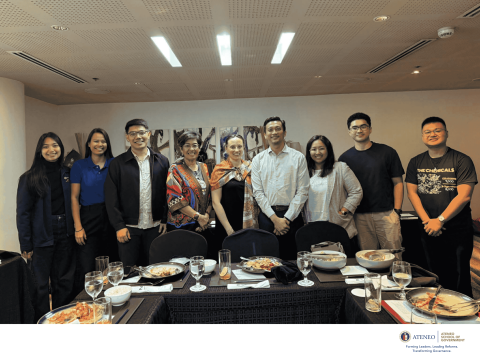
ASOG meets with Department of Health—Bureau of International Health Cooperation to strengthen institutional partnership
On 27 February 2026, the Ateneo School of Government (ASOG), through its research and public policy unit, the Ateneo Policy Center, held a courtesy meeting
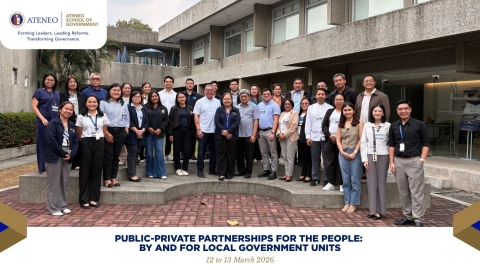
ASOG Executive Education Program Leads Open Training Course on Public-Private Partnerships for the People: By and For Local Government Units
The Ateneo School of Government, through its Executive Education Program, conducted a two-day training course on Public-Private Partnerships for the People (PPPP): By and For