[Blueboard] On Urban Living and Community Building
14 Sep 2021 | Miguel Paolo P. Rivera


As someone who teaches political science for a living, one of the most common sentiments that my students bring up whenever I ask them to ask me anything is a simple question: “Bakit ang gulo ng lahat sa Pilipinas (Why is everything so chaotic in the Philippines)?”. I am always struck by the straightforwardness of the question but despite its broadness, the nods from the rest of the class are a testament to how relatable this sentiment is for everyone.
Of course, there is no simple answer to this question. That is why whenever this is brought up, I see it more as an opportunity for my students to therapeutically vent about their frustrations. Of course, while most of the anger is directed towards the political games that elites play, I remind my students that there is much more to politics than these kinds of actions. It is also embedded and reflected in the everyday lives of ordinary people. In this article, I will structure some of these conversations I have had with them over the years and focus on what I think is a major source of frustration: urban living.
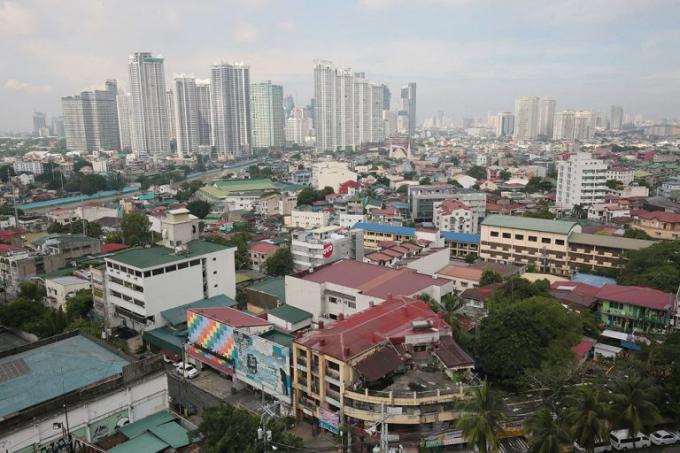
We cannot deny that our urban living, especially Metro Manila, remains largely hostile to its people. Commuting remains to be the most discussed aspect of this hostility. Public transport, despite pronouncements to the opposite, are still largely miserable affairs. To be privileged seems to be the only way to gain respite from the poor design of our public places and services. The simple activity of being able to walk along spacious and unobstructed sidewalks, with evenly paved roads and ample greenery, without fear of being struck by passing cars remains a privilege only available to those who live in gated and exclusive communities.
The importance of increased mobility for all our people is a worthy advocacy. But it must go hand in hand with the improvement not just of our means of transport, but of the quality and accessibility of our public spaces. Shared spaces accessible to the public, for myriad functions such as leisure, services, learning, or cultural exchange is a pivotal piece of cultivating our capacity to be in solidarity with other citizens and to deepen the democratization of our political institutions. After all, we could have the most efficient public transport in the world, but I personally feel that it would be somewhat a waste if I had nowhere else to go but my place of work.
The political theorist Hannah Arendt emphasized that our experience of physical space is one of the most important aspects of the constitution and maturity of our political minds and organizations. In her work The Human Condition (1958, p. 52), for example, she argues: “To live together in the world means essentially that a world of things is between those who have it in common, as a table is located between those who sit around it; the world, like every in-between, relates and separates men at the same time”.
The heart of this argument applied to our contemporary situation points to a simple, but nonetheless essential argument: to cultivate a strong political culture amongst citizens, shared physical spaces must be built, maintained, functional, and accessible. Examples of these are parks, libraries, theaters, museums, monuments, and walkways. Therefore, the lack of these spaces and our tepid appreciation of these means that we also lack the visceral, physical dimension of political imagination. How can we expect our people to imagine that they are a part of a strong citizenry if they cannot encounter other citizens as citizens? We only encounter our neighbors through the lens of other institutions such as one’s religion, alma mater, or our place of work. The way I put it, if we want to feel that we are with our own “people”, we go to a church or to a UAAP game. But where do you go if you simply want to feel that you are a citizen, a Filipino?
That is why it becomes difficult for people to imagine community and to take care of their unseen neighbors in solidarity. Our political spaces are themselves inaccessible, ill-maintained, and neglected. In the Philippines, especially in Metro Manila, common spaces are absent, unavailable, or inaccessible in the first place. For example, students can only feasibly have a modicum of peace and quiet to study in their own university libraries or in a coffee shop. For the rest of the public, access to books remains limited as public libraries (if there is one near them at all) are poorly stocked.
I find that my students never point to malls as an example of a public or common space, and I think they don’t for good reason. Despite these kinds of spaces insisting that they have got it all, no one really feels any attachment to malls. These are spaces that centralize capital accumulation, kill small local businesses, and concentrate traffic choke points. Malls are only deceptively communal but remain to be segregated spaces whose full enjoyment are only for those with cars and with money to spend.
Everywhere are examples of how our leaders tend to neglect the importance of spaces and how they shape our perception of the importance of communal citizenship. This current government remains to be an exemplar of this urban decay and general feeling of kaguluhan. To say build, build, build is merely a banal slogan if its planning and implementation is devoid of public consultation and riddled with corruption. A high-rise condominium destroys the viewing horizon of the resting place of our national hero. Nearby, a dolomite beach exists supposedly for the reason of coastal protection and beatification, a poor excuse that goes against the advice of environmentalists and experts. Congressmen see it fit to elect a Speaker of the House of Representatives in a private clubhouse. A cabinet secretary sees a picture of a gigantic highway devoid of bustling humanity as “beautiful”. They bury a murderous, kleptocratic dictator in a cemetery meant for the nation’s heroes.
I do believe there is hope despite all of this. For example, museums and other similar establishments have consciously made the decision to keep entrance fees at a minimum or even free for our citizens. Public pressure is mounting to improve our urban spaces, with myriad resources available from a diverse range of experts on the topic. I do hope that we maintain these pressures especially when we can have access to these spaces again after the pandemic. After all, I do think a lot of us are eager to see other people again. Finally, of course, the upcoming elections gives us an opportunity to elect leaders whose political visions and actions are not based on the language of division, contempt, and mistrust but rather with that of a capable, mobile, engaged, and united citizenry. Upon pointing this out, however, the more astute students then ask a logical follow-up question: “Bakit ang gulo ng eleksyon dito sa Pilipinas?”, opening another can of worms that I inevitably dock for the next classroom session.
Miguel Paolo P. Rivera is an Instructor at the Department of Political Science and Coordinator for the Ateneo Martial Law Museum, Ateneo de Manila University. He can be reached at mprivera@ateneo.edu.

Recent News
You may also like these articles
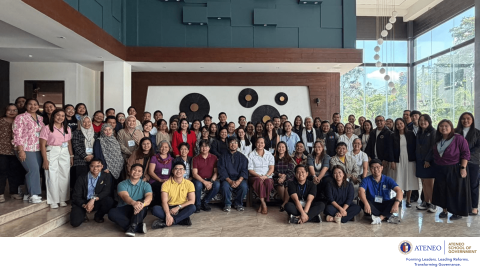
ASOG’s Tobacco Control initiatives spotlighted in DOH National Technical Working Group for Tobacco Prevention and Control
On March 10 to 12, 2026, the Ateneo School of Government (ASOG), through its research and public policy unit, the Ateneo Policy Center, participated in
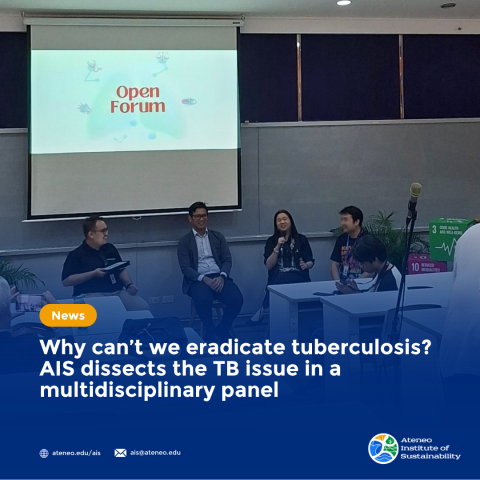
Why can’t we eradicate tuberculosis? AIS dissects the TB issue in a multidisciplinary panel
On 24 March 2026, the Ateneo Institute of Sustainability (AIS), through its Sustainable Development Goals (SDGs) Program, hosted a multidisciplinary panel in observance of World
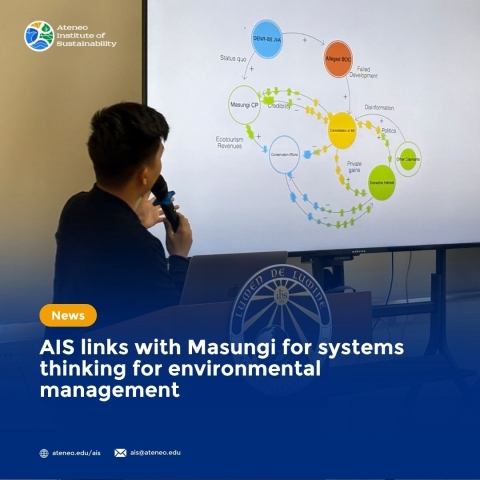
AIS links with Masungi for systems thinking for environmental management
Last 23-24 March 2026, the Ateneo Institute of Sustainability (AIS) , which manages the My Climate Risk – Ateneo de Manila University Regional Hub
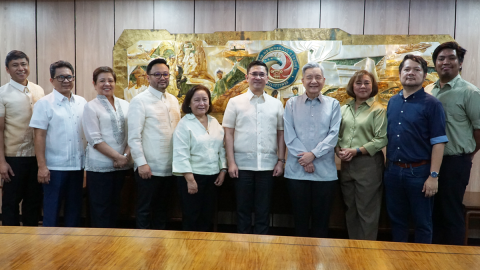
BIR and Ateneo sign MOU for academic cooperation and research collaboration
The Bureau of Internal Revenue (BIR) and Ateneo de Manila University recently signed a memorandum of understanding (MOU) for academic cooperation and research collaboration. The
QS Subject Rankings 2026: Ateneo in top 100 for theology; ranked in 7 subject areas
Ateneo de Manila University is among the top institutions in seven subject areas, and among the top 100 for theological and religious studies, according to
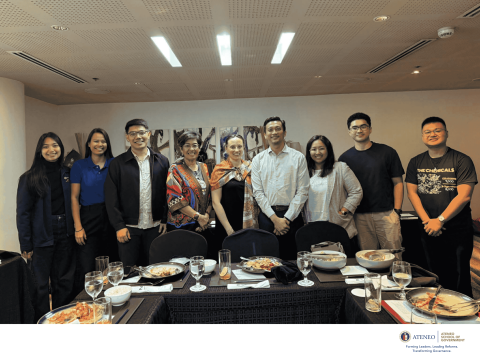
ASOG meets with Department of Health—Bureau of International Health Cooperation to strengthen institutional partnership
On 27 February 2026, the Ateneo School of Government (ASOG), through its research and public policy unit, the Ateneo Policy Center, held a courtesy meeting