[Blueboard] Navigating the South China Sea Code of Conduct negotiation process: Insight into ASEAN’s Options
12 Oct 2021 | Alma Maria O Salvador

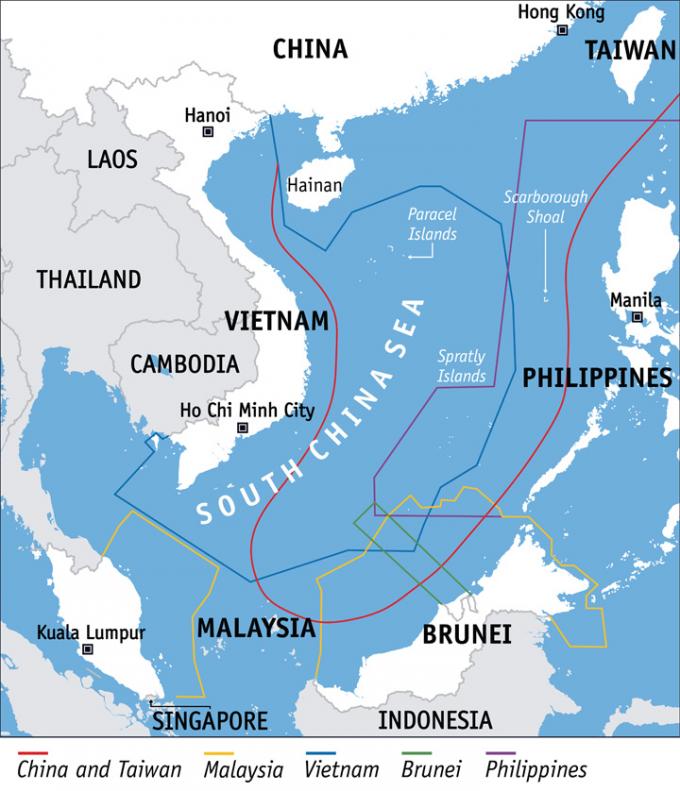
ASEAN and China have failed to make progress in finalizing the Code of Conduct (CoC) in the South China Sea (SCS). Two decades of negotiations, since the Declaration on the CoC was signed in 2002, have not yielded an agreement to effect a dispute settlement mechanism aligned with the United Nations (UN) Charter and a well-defined geographic scope to which the 2016 UN arbitral ruling will apply.
Partial gains from forging a multilateral code of conduct in the SCS in the context of power asymmetry and weak ASEAN centrality can be bridged when we shift our sight lesser on the final output of the negotiations and towards cultivating ways in which ASEAN member states operationalize and reinforce parts of the whole. This is to say that as optimism in concluding a regional code of conduct in 2021 wanes, ASEAN leaders should compartmentalize the objectives of idealism and pragmatism in their approach.
One is to take the pragmatic route which requires littoral and other states to invest in measures that strengthen existing various formats of cooperation in the already evolving regional maritime security community. The second approach is to couple practical maritime cooperation with diplomacy in the arbitral ruling. Both of these approaches enable the creation of spaces for centralizing power within ASEAN as a precondition for dealing with hegemonic powers, for integrating collective and individual interests and for diversifying and pluralizing strategic partnerships.
Practical cooperation in maritime domain awareness
Strengthening practical cooperation should begin within the ASEAN member states themselves. Practical cooperation based on continuous and institutionalized, not one-time action reinforces ASEAN centrality that is key to dealing with China. Member states taking concrete steps to realize the provision on states’ “duty to cooperate” and to “enter into arrangements of a practical nature” found in the Single Draft Negotiating Text (2019) of the proposed CoC concretely align the latter to the UN Convention on the Law of the Sea (UNCLOS). In addition, functional cooperation creates a platform for establishing a range of rules and institutions that tests the ability of states to enforce and/or be bound by them.
Among the critical junctures in the maritime domain is for ASEAN governments in existing mini-lateral agreements to regularize practices and activities in maritime domain awareness (MDA), which according to the International Maritime Organization impacts on the safety, environment, security and economy of the maritime realms. MDA is an “enabler” of maritime security, for instance reducing insecurity against piracy requires MDA based on intelligence and technology- aided tracking of pirate vessels.
The Trilateral Maritime Patrol arrangement that the Philippines, Indonesia and Malaysia launched in 2016 to arrest Abu Sayyaff’s kidnap for ransom in the Sulu Sulawesi waters is a relatively weak maritime security arrangement that must overcome multiple coordination problems in intelligence gathering and coordinated patrols. Enhancing enabling structures to launch operationalized and coordinated maritime patrols can generate spaces on “joint” structures such as joint commands/ joint patrols that effectively bridge the domestic and intergovernmental governance gap. Operationalization further equips states to participate more effectively in other multilateral MDA based arrangements such as the Regional Cooperation Agreement on Combating Piracy and Armed Robbery Against Ships in Asia (ReCAAP) agreement - based Information Sharing Center and the Information Fusion Center --- which are big data intelligence sharing, fusion and training centers respectively in the fields of anti-piracy and transnational (in)security.
The prevention and management of incidents at sea, which is one of the proposed basic undertakings of states in the latest Single Draft Negotiating Text (2019) is also a convergence point of maritime security community building among ASEAN states. This can be harnessed towards building a groundwork for rules - based conflict management in the South China Sea where geopolitical conflicts and fishing rights competition intersect.
Practices in preventive diplomacy which are aimed at managing unplanned encounters, disasters and crises at sea also include search and rescue and the establishment of hotlines between agencies. In 2014, twenty one states, including ASEAN claimant states, US and China in the Western Pacific Naval Symposium adopted a norm that underpins specific communication and maneuvering protocols in the high seas based on the Code of Unplanned Encounters at Sea (CUES)--- thereby widening the scope of the emergent security community in crisis management that ASEAN-China and ASEAN Defense Ministers Meeting (ADMM) defined in terms of resolutions, statements, guidelines, declarations and training exercises.
Diplomacy anchored on the arbitral ruling
The other approach based on international law will require ASEAN claimant states in particular to publicly invoke the arbitral ruling. By far, Indonesia has been specific in invoking the 2016 arbitral ruling in a recent submission to the United Nations, to reply to China’s response to Malaysia's application to the UN to define the limits of its extended continental shelf in 2019. So has the Philippines belatedly invoked the arbitral ruling in its note verbale to the UN. Vietnam has instead made reference to the UNCLOS. Diplomacy in arbitral ruling will help define the geographical scope of the CoC as much as it internationalizes the SCS dispute through moral suasion from within and from external states.
Evidently there are limits to both approaches. Practical cooperation recursively requires a united ASEAN political front, strong leadership at home and resources. Compared to functional cooperation, diplomacy anchored on the arbitral ruling is politically sensitive and divisive to ASEAN centrality in terms of various dichotomies based on claimant versus non-claimant states, pro and anti-Chinese; aligned (pro US) or non-aligned foreign policies among others. Both routes must be underpinned by a pluralistic approach to strategic partnerships with extra-regional states.
Alma Maria O. Salvador PhD is a full time member of the Political Science Department of the Ateneo de Manila University.

Recent News
You may also like these articles
ASOG’s Tobacco Control initiatives spotlighted in DOH National Technical Working Group for Tobacco Prevention and Control
On March 10 to 12, 2026, the Ateneo School of Government (ASOG), through its research and public policy unit, the Ateneo Policy Center, participated in
AIS links with Masungi for systems thinking for environmental management
Last 23-24 March 2026, the Ateneo Institute of Sustainability (AIS) , which manages the My Climate Risk – Ateneo de Manila University Regional Hub

BIR and Ateneo sign MOU for academic cooperation and research collaboration
The Bureau of Internal Revenue (BIR) and Ateneo de Manila University recently signed a memorandum of understanding (MOU) for academic cooperation and research collaboration. The

QS Subject Rankings 2026: Ateneo in top 100 for theology; ranked in 7 subject areas
Ateneo de Manila University is among the top institutions in seven subject areas, and among the top 100 for theological and religious studies, according to

ASOG meets with Department of Health—Bureau of International Health Cooperation to strengthen institutional partnership
On 27 February 2026, the Ateneo School of Government (ASOG), through its research and public policy unit, the Ateneo Policy Center, held a courtesy meeting
ASOG Executive Education Program Leads Open Training Course on Public-Private Partnerships for the People: By and For Local Government Units
The Ateneo School of Government, through its Executive Education Program, conducted a two-day training course on Public-Private Partnerships for the People (PPPP): By and For