[Blueboard] A Nexus Approach to Foreign-Security Policy: Imperatives for the Next Philippine President
11 Jan 2022 | Alma Maria O Salvador, PhD


An infinite set of foreign and security policy challenges will confront the next presidential administration of the Philippines. This is particularly evident in view of the US and China geopolitical transition as well as the emerging challenges from an altered geophysical milieu, where threats (pandemics, climate change, disasters), non-traditional in nature, have had a devastating impact for the southeast Asian region.
A nexus approach to Philippine foreign and security policy becomes an imperative, entailing the integration of domestic and international security and foreign policy issues. Defined by Cook, A and Nanthini, S (2021), the nexus approach is collaborative, holistic, strategic and multi-stakeholder. It is essential given that, firstly, domestic security issues such as economic, regime and environmental changes have increasingly transnationalized with spillover effects beyond national borders. As a consequence, this will redefine diplomatic approaches (such as one that incorporates science diplomacy) as much as it will call for a diversification of strategic partnerships towards cooperation in non-traditional security.
Added to this, on the one hand, the rise of non-traditional or non-military security issues does not obliterate the continuing challenge of geopolitical security threats. In many ways non-traditional security is conflated with traditional security. For instance, we’ve seen how governments conflated (or securitized) their pandemic responses, simultaneously as public health with military led border controls. We’ve also witnessed how the EU and the US under Trump have conflated migration with terrorism, resulting in heightened application of homeland security more than labor protection rules. Such conflation of non-military with military issues is also evident in the South China Sea (SCS) where the increasing intrusion by military and grey zone actors, mainly of China in contested Exclusive Economic Zones is entangled with fishery depletion and food insecurity. In terms of foreign-security policy response, these developments will require approaches that either compartmentalize or couple issue-areas.
Critics have essentially noted a general lack of strategic framing of Philippine national security policy and an undeveloped strategic culture vis-a-vis external defense (Arugay, A and Kraft, HJ, 2020). Bello, W and Heydarian, J (2010) also have noted earlier the inability of the Philippines to leverage its “huge demographic, economic and geo-strategic value” that could have allowed it to perform a “pivotal role in the shaping of the broader international order” albeit as a small state.
With above considerations at stake, the recasting of our national security-foreign policies should be sought in order to achieve outcomes that locate our country in the context of the geostrategic lenses of the Indo Pacific and that rearrange our loyalties and alliances given the multi polarization of power.
Framing based on the Indo Pacific region requires that the Philippines reflects its role as a middle power whose primary asset (in 2021) is its defense network (Lowy Institute 2021). A middle power foreign-security posture will demand the harnessing of maritime security strategies that are more responsive to the extent of China’s power across two oceans and across two continents of the Asia Pacific and Africa and to the evolving US-led/ aligned multipolar and democratic Indo Pacific powers structure of India, Australia and Japan. The outgoing Duterte administration has experimented on middle power strategies that ranged from appeasement and hedging vis-a-vis China and distanciation from the US. It fortified strategic partnerships with South Korea, Japan and Australia based on maritime domain awareness (MDA) which are key to a repositioning from US led hub and spokes system. However, this is devoid of a clear convergence with the articulated National Security Strategy (DND, 2018). At the crossroads of the Pacific and the Indian Oceans, it is also high time to reframe diplomacy in the SCS. Viewed as a geopolitical region and a large marine ecosystem, diplomacy should be anchored on the pursuit of a Code of Conduct and the arbitral ruling. Foreign-security policy making should further ASEAN centrality in regimes building in information sharing and fusion in MDA and in practical maritime security cooperation.
Alma Maria Salvador, PhD, is an Associate Professor of the Department of Political Science of Ateneo de Manila University.

Recent News
You may also like these articles
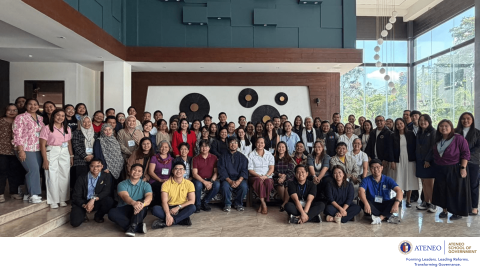
ASOG’s Tobacco Control initiatives spotlighted in DOH National Technical Working Group for Tobacco Prevention and Control
On March 10 to 12, 2026, the Ateneo School of Government (ASOG), through its research and public policy unit, the Ateneo Policy Center, participated in
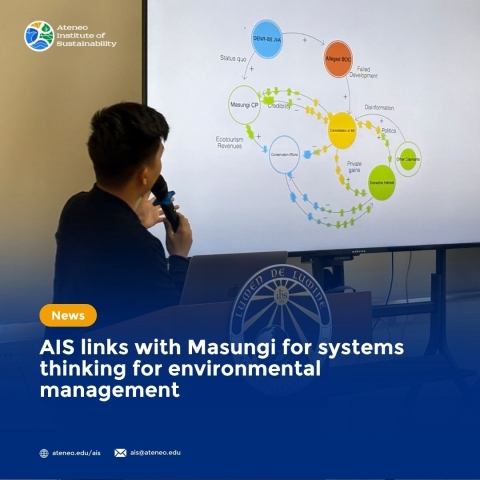
AIS links with Masungi for systems thinking for environmental management
Last 23-24 March 2026, the Ateneo Institute of Sustainability (AIS) , which manages the My Climate Risk – Ateneo de Manila University Regional Hub
BIR and Ateneo sign MOU for academic cooperation and research collaboration
The Bureau of Internal Revenue (BIR) and Ateneo de Manila University recently signed a memorandum of understanding (MOU) for academic cooperation and research collaboration. The
QS Subject Rankings 2026: Ateneo in top 100 for theology; ranked in 7 subject areas
Ateneo de Manila University is among the top institutions in seven subject areas, and among the top 100 for theological and religious studies, according to
ASOG meets with Department of Health—Bureau of International Health Cooperation to strengthen institutional partnership
On 27 February 2026, the Ateneo School of Government (ASOG), through its research and public policy unit, the Ateneo Policy Center, held a courtesy meeting
ASOG Executive Education Program Leads Open Training Course on Public-Private Partnerships for the People: By and For Local Government Units
The Ateneo School of Government, through its Executive Education Program, conducted a two-day training course on Public-Private Partnerships for the People (PPPP): By and For