[Tinig] Feast Failure: Reflections on the Global Food System in the Time of the Pandemic
11 Feb 2022 | Justin Joseph G. Badion

Access to food has become one of the great challenges for people during the pandemic, especially in the Philippines. Now more than ever, the cracks in the seemingly monolithic food system are exposed. “From farmers and field workers to food processing plants and retailers, the pandemic is disrupting almost all segments of the Philippine food supply chain.”[1] A Social Weather Stations survey estimates that on the onset of the pandemic between February and May of 2020, more than 4.2 million families suffered involuntary hunger.[2]
Due to the initially tepid national government response to the pandemic, and especially in light of disruptions in the Philippine food system, there was a need for alternative interventions in relation to food security, at least in the short term, coming from the local communities, non-government organizations, religious organizations, and even the youth. For instance, the rise of food pantries showcased the capacity for local communities to organize a response to food availability and access issues, addressing major gaps in both government and private-led response efforts, at least for the short term. Ultimately, these stopgap measures are only temporary, and a more sustainable and long-term response to the food crisis is needed that goes beyond the pandemic.

But first, what is the global food crisis? Think of the global food system as a feast, an abundance of food brought about by the advancements of the Green Revolution. The aim of the Green Revolution was agricultural productivity to feed the increasing population of the world. “Intensive agricultural development assistance dominated international aid programs in the 1960s–1970s and promoted the development and dissemination of new seeds and other agricultural inputs necessary for the installation of an industrial agricultural model on a global scale.”[3] These investments and aid, however, were focused on mainstay staples like corn and rice, incentivizing the rise of massive monocultures—“that is, one crop variety grown in a field, as opposed to intercropping of many different species and varieties in the same field. Monocropping is practiced for maximum efficiency, especially in the application of fertilizers, pesticides, and the use of farm machinery.”[4] The Green Revolution assumed “that technology is a superior substitute for nature, and hence a means of producing limitless growth, unconstrained by nature’s limits.”[5] The “adoption of this model around the world was a key ingredient to the globalization of the world food economy. But the effects have been stark: biodiversity has been drastically reduced with a focus on relatively few species of plants grown in a mono-cropped fashion, soils have been depleted by mechanization and over-use, land has been poisoned by chemical fertilizers and pesticides, water has become more scarce, and the list goes on.”[6]
Although the global food system that resulted from the Green Revolution actually produces more than enough food to feed the world, so many people around the world remain hungry. Agroecologist Stephen R. Gliesmann highlights this paradoxical reality:
Globally, the food system currently produces more than enough food calories to adequately feed every single living human being and more. One problem is that 9% of these calories are diverted to make biofuels or other industrial products and another 36% are used for animal feed (less than 10% of which is recovered in the form of animal-based food calories), leaving only 55% to be eaten directly by humans. Another problem is that an estimated one-third of the food produced globally is lost to spoilage, spillage, and other problems along the supply chain or simply wasted at the household level. In the United States, the amount of food wasted and lost equates to 1249 cal/person/day, which is more than half of what an average person needs. Further, the calories that are eaten by humans directly and not lost as waste are distributed very unevenly, with much of them going to expand the waistlines of affluent populations.[7]
In the end, the response to the food crisis should not be simply an issue of increased agricultural productivity.
If the global food system is a feast, what we are experiencing now can be considered a “feast failure.” In her work on the archeology of feasting, scholar Monica L. Smith showed how ethnographic accounts illustrate the potential for this so-called “feast failure,” in which “the intent, expectations, and offerings of the hosts and guests are unequally matched.”[8] During the feast, bad weather, party-crashers, breaches of etiquette, unexpected arrivals and departures, distractions, violence, accidents, and food shortfall all contribute as well to “feast failure.”[9] In many ways, the experience of the global food crisis, exacerbated by the COVID-19 pandemic, is a kind of collective “feast failure” on the part of the world’s food systems. The key actors of food systems around the world, and especially in the Philippines, have failed to account for the possible impact of a pandemic on the food supply.
Smith’s suggestion in response to this feast failure in the time of pandemic is the concept of “right-sizing.” In her online article, Smith explains that the “idea of right-sizing compels us to think beyond a single meal or a single crisis to envision how entire food systems are configured at scales from the individual and the household to entire communities and cultures. What counts as an appropriate amount of food is measured not only by nutritional adequacy but also by every aspect of production, distribution and consumption.”[10]
The metaphor of “right-sizing,” identifying the appropriate portions for a meal, can be expanded to the greater food system. It is about managing properly and adequately the system, now and for years to come, with a mindfulness to crisis. My hope is that this short reflection challenges us to participate further in this conversation on food justice and “right-sizing” the food system, we will need all the help we can get to turn failure into feasting.
Clapp, Jennifer. Food. Cambridge: Polity, 2011.
Gliessman, Stephen R. Agroecology: The Ecology of Sustainable Food Systems. Third edition. Boca Raton, FL: CRC Press, 2015.
Shiva, Vandana. The Violence of the Green Revolution: Third World Agriculture, Ecology, and Politics. Second edition. London: Zed Books, 1993.
Smith, Monica L. “Feasts and Their Failures.” Journal of Archaeological Method and Theory 22, no. 4 (2015): 1215–1237.
———. “Right-Sizing the Feast: Archeological Insights from the COVID-19.” UCLA Institute of the Environment & Sustainability Magazine, December 22, 2020. https://www.ioes.ucla.edu/article/right-sizing-the-feast-archaeological-insights-from-the-covid-19-pandemic/.
Xu, Xiaoyun. “Building More Crisis-Resilient Supply Chains: A Case Study on Philippine Food Security during Pandemic.” In Countering COVID-19: Cases in Crisis Response, edited by Edilberto C. De Jesus, Manuel M. Dayrit, and Ivyrose S. Baysic, 157–170. Quezon City: Bughaw, 2021.
[1] Xiaoyun Xu, “Building More Crisis-Resilient Supply Chains: A Case Study on Philippine Food Security during Pandemic,” in Countering COVID-19: Cases in Crisis Response, ed. Edilberto C. De Jesus, Manuel M. Dayrit, and Ivyrose S. Baysic (Quezon City: Bughaw, 2021), 157–158.
[2] Ibid., 158–159.
[3] Jennifer Clapp, Food (Cambridge: Polity, 2011), 12.
[4] Ibid., 50–51.
[5] Vandana Shiva, The Violence of the Green Revolution: Third World Agriculture, Ecology, and Politics, Second edition. (London: Zed Books, 1993), 24.
[6] Clapp, Food, 20.
[7] Stephen R. Gliessman, Agroecology: The Ecology of Sustainable Food Systems, Third edition. (Boca Raton, FL: CRC Press, 2015), 17.
[8] Monica L. Smith, “Feasts and Their Failures,” Journal of Archaeological Method and Theory 22, no. 4 (2015): 1232.
[9] Ibid., 1222–1224.
[10] Monica L. Smith, “Right-Sizing the Feast: Archeological Insights from the COVID-19,” UCLA Institute of the Environment & Sustainability Magazine, December 22, 2020, https://www.ioes.ucla.edu/article/right-sizing-the-feast-archaeological-insights-from-the-covid-19-pandemic/.
Tinig is a monthly opinion and analysis series from the School of Humanities. The views expressed in this piece are those of the author and do not necessarily represent the views of School of Humanities or the Ateneo de Manila University.
Recent News
You may also like these articles
Why can’t we eradicate tuberculosis? AIS dissects the TB issue in a multidisciplinary panel
On 24 March 2026, the Ateneo Institute of Sustainability (AIS), through its Sustainable Development Goals (SDGs) Program, hosted a multidisciplinary panel in observance of World
AIS links with Masungi for systems thinking for environmental management
Last 23-24 March 2026, the Ateneo Institute of Sustainability (AIS) , which manages the My Climate Risk – Ateneo de Manila University Regional Hub
Mangroves as shields of history and resilience: Insights from Dr Emma Porio
Mangrove forests have long shaped both the history and survival of coastal communities in the Philippines. According to Dr Emma Porio, Professor Emeritus (Sociology -
Professor Emeritus Dr Emma Porio to deliver keynote address at Regional Dialogue: Schools Climate Action Project
Dr Emma Porio, Professor Emeritus at Ateneo de Manila University's Dr Rosita G Leong School of Social Sciences (RGLSOSS) and Lead Author of UNFCCC-IPCC Climate
Klim@Musika
For most Filipinos, music is inseparable from daily existence. Music playlists accompany Filipinos in their commutes be it through walks, jeepneys, trains, or their private
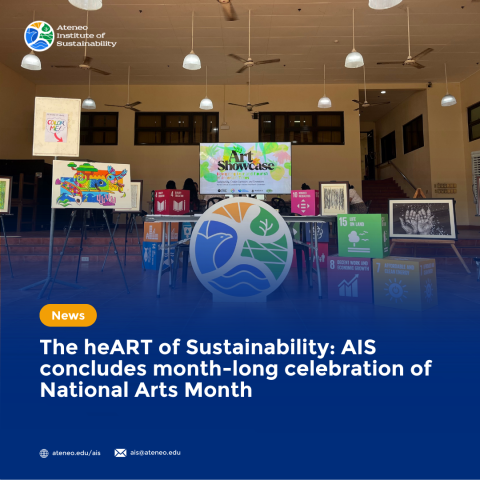
The heART of Sustainability: AIS concludes month-long celebration of National Arts Month
With the desire to make sustainability more accessible and promote its interdisciplinarity, the Ateneo Institute of Sustainability (AIS) hosted a month-long National Arts Month celebration