[Blueboard] Reflections on the 2022 Philippine Presidential Race
09 May 2022 | Diana J Mendoza, PhD
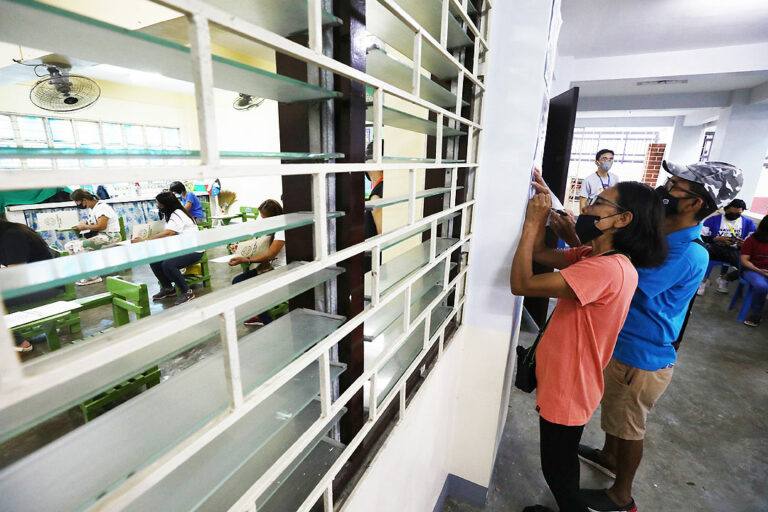
The race for the presidency in the 2022 Philippine elections may be the most highly divisive and contested referendum for the highest public office in the country. It is a high stakes and high risk contest with intense pressures to win from both the contenders for the office and those who support them. Focused on the top two contenders, the presidential race is a race between stopping one seeking a path back to power and electing one seeking a great reset of powers in the government.
Instead of focusing on what challenges await the next President and the country, we focus on what we can learn from the race for the presidency.
- Elections are not just about voting candidates into or out of office. These are not merely about change of names and faces. Elections are about transfer and legitimation of power. Should we take a step forward to usher in a new (or reformed) governance system or take two steps back to restore an old, tarnished and contested rule?
- Elections should not be about those who run for office. It is about the people who should be served — their needs, rights, interests, and demands. Don’t we all deserve a new government that helps more (or most) the vulnerable and the marginalized while seeking to protect all regardless of any markers of differences?
- People cannot be retrained or constrained. Filipinos are resilient people. True. But when it’s their future and their loved ones’ future at high stake, they mobilize and organize. Doesn’t the spirit of volunteerism we all witnessed renew and give new meaning to the Filipino’s “Bayanihan”, from that of communal cooperation to collective action and accountability?
- Conventional politics must end. Political parties cannot effectively steer the public space until genuine political party reforms are made. Shouldn’t we sustain the “people’s movements” seeking to expand the political space available and bring in the concerns of everyday life that are silenced by dominant powers operating in the society?
- No issues are either politically or morally compelling. Politically contentious or not, all issues are and should always be both politically and morally compelling. Shouldn’t we stand up for the oppressed and unjustly persecuted and the basic sectors who are really in need? Shouldn’t we stand against the politically and morally corrupt?
- Public service is the name but public accountability is the rule of the game. Article XI , Section 1 of the 1987 Philippine Constitution states that “Public office is a public trust … officers and employees must at all times, be accountable to the people…”. Why is it so difficult to execute? Shouldn’t all those who run audit themselves first even before running?
Instead of focusing on what opportunities await the next President, we focus on the salient issues and tasks for the next President to act on. These issues and tasks echo those of the Ateneo de Manila University’s Department of Political Science published in a working paper series related to the 2022 presidential and vice presidential elections and accessible via admupol.org.
- Pass a Security of Tenure (SOT) law that will protect workers against abusive contractualization. The next President must certify the SOT bill as urgent and mobilize support from both the House of Representatives and the Senate. Review overseas employment and prioritize the creation of jobs locally and the organization of a task force on reintegration while sustaining protection mechanisms. Forge bilateral agreements to safeguard Filipinos abroad and create migration resource centers outside of NCR and urban areas to assist families back home.
- Stop the misogyny and privileging of men over women that still envelope Philippine governance and politics. Socio-economic targets should not be gender-blind. They should be specific and implicit in achieving gender equality and underscore bringing people together instead of polarizing the polity as well as framed and executed with an ethic of care.
- Declare and address a crisis in education aggravated by the COVID-19 pandemic. Provide higher funding for education where Philippines’ current 3 percent budget is lower than what is required by UN standards. The next President must be able to resolve issues concerning mismatch of the skills and talents of graduates that our education system produces and the needs of our society as well as demands of industries.
- Develop a strong public healthcare system with strong public health infrastructures throughout the country able to respond to any pandemics like the COVID-19, non-communicable diseases and other-health related concerns. Toward this end, the next President must ensure the effective and efficient implementation of the Universal Health Care law, the provision of free and accessible healthcare through the National Health Insurance Program and Health Care Provider Network in provinces and cities.
- Synergize the imperatives of the security sector and justice sector reforms with Sustainable Development Goal 16 which includes the promotion of peaceful and inclusive societies for sustainable development, the provision of access to justice for all, and building effective, accountable institutions at all levels. There is a need to shift from a militaristic, anti-insurgency approach toward human security and a whole of government approach to addressing the root causes of rebellion.
- Put inclusivity, transparency and accountability at the core of the government. Don’t we all deserve public officials who do not only demonstrate excellence in public service but also maintain a culture of excellence? Under the leadership of the next President, can all agencies and instrumentalities of the government aim for a culture of excellence by meeting International Public Sector Accounting Standards and earn the Commission on Audit’s seal of approval? Can the next President direct all government agencies to an audit of its management system to meet the international standard for quality management systems? To start the process, will the next President boldly order a full disclosure policy that can promote greater transparency in public service, and hence, start combating problems of corruption and patronage politics?
In light of these salient lessons and tasks, will the next President of the Philippines draft a new history with a renewed faith in democracy? Or will the next President thrust the country and its people back to a history that will forever remain tarnished, mired and highly contested?
Diana J Mendoza, PhD is faculty and former Chair (2017-2021) of the Department of Political Science, Ateneo de Manila University.

Recent News
You may also like these articles
QS Subject Rankings 2026: Ateneo in top 100 for theology; ranked in 7 subject areas
Ateneo de Manila University is among the top institutions in seven subject areas, and among the top 100 for theological and religious studies, according to
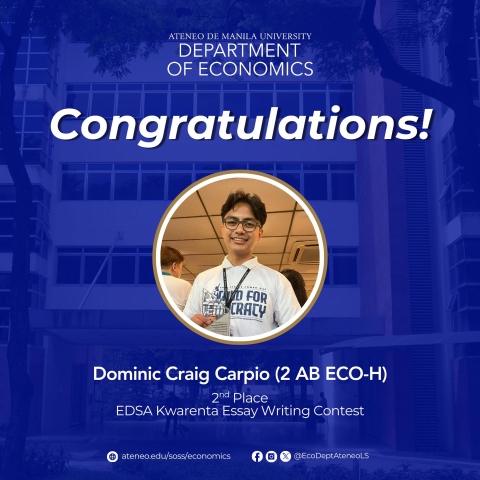
Congratulations to Dominic Craig Carpio (2 AB ECO-H) for placing 2nd in the EDSA Kwarenta Essay Writing Contest
The Department of Economics warmly congratulates Dominic Craig Carpio (2 AB ECO-H) for placing 2nd in the EDSA Kwarenta Essay Writing Contest. This achievement reflects
Ateneo Korean Studies Program Concludes KFL Workshop for Filipino Educators
The Ateneo Korean Studies Program, in partnership with the Global Leadership Development Institute, King Sejong Institute Quezon City 2, and the Dr. Rosita G. Leong
Deanship of the Dr Rosita G Leong School of Social Sciences (Memo # U2526-071)
(Memo # U2526-071) Following the appointment of Dr Czarina A Saloma-Akpedonu as the new Vice President for Higher Education effective 1 June 2026, I have formed a Search Committee for the next Dean of the Dr Rosita G Leong School of Social Sciences (RGLSOSS).
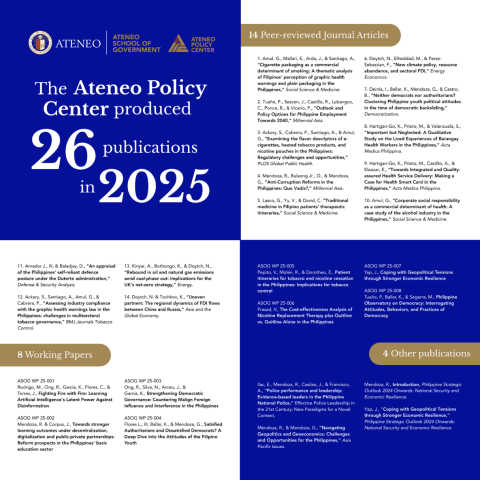
ASoG, through the Ateneo Policy Center, delivers 26 publications in 2025
As the research and public policy unit of the Ateneo School of Government (ASoG), the Ateneo Policy Center (APC) has continued to pursue cutting-edge research
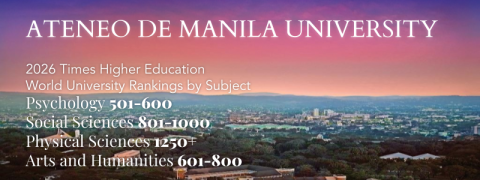
2026 THE Subject Rankings: Ateneo among top universities globally in 4 subject areas
Ateneo de Manila University is among the top higher education institutions in four subject areas in the latest Times Higher Education (THE) subject rankings. The