The Urgent Call for Sustainable Mobility in Our Cities
01 Jul 2022






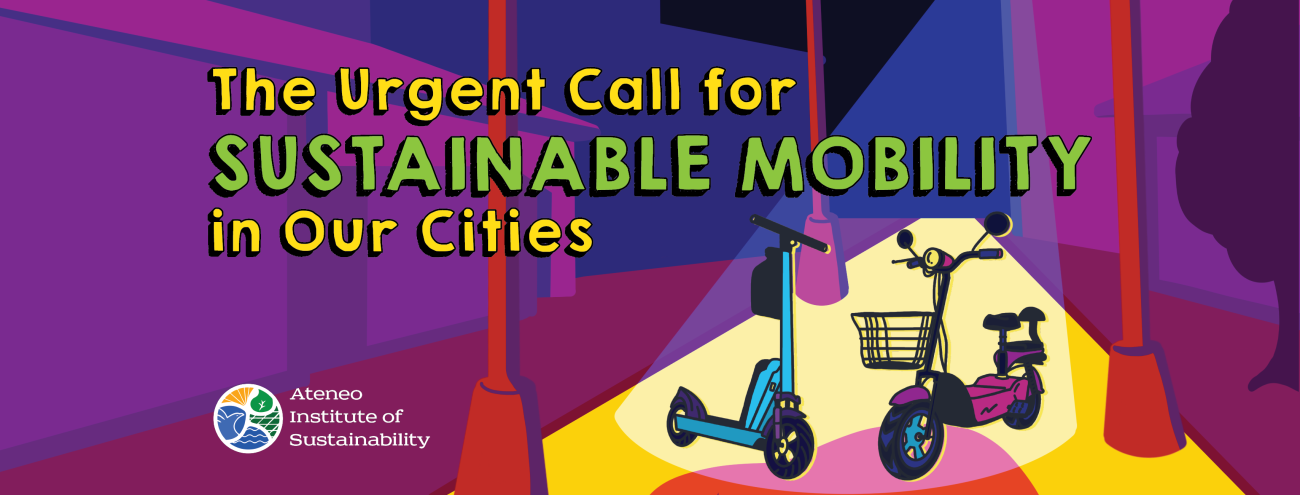
In late 2021, the Pasig River Expressway (PAREX) project aroused controversy since it was proposed by San Miguel Corporation (SMC). At the heart of the issue is the desire to solve the traffic crisis that has long burdened everyday Filipino travelers. For many, it is only logical that the construction of more highways is the solution to traffic congestion. As clusters of vehicles swarm the streets, expansion seems likely to solve what is evidently a scarcity of spaces.
The problem with this idea is that it fails to address the root cause of traffic congestion. In an economy where private transportation is the more convenient option, and where newly developed roads are made exclusive to high-income earners, what appears to be a commonsensical answer is the very crux of the matter.
Understanding sustainable mobility
In sustainable mobility, more roads are not necessarily the better option. The United Nations defines sustainable transport as “the provision of services and infrastructure for the mobility of people and goods advancing economic and social development to benefit today’s and future generations in a manner that is safe, affordable, accessible, efficient, and resilient, while minimizing carbon and other emissions and environmental impacts.”
Sustainable mobility is intersectional, where a reorientation in transportation generates development in life and the environment. It does not only consider addressing traffic congestion but also making spaces safer and more accessible to the public, reducing air pollution by incorporating nature in cities, and even encouraging lifestyles that are conducive to economic development.
One key aspect of sustainable mobility is minimizing carbon emissions. A passenger vehicle produces about 4.6 metric tons of carbon dioxide per year. Meanwhile, vehicle emissions account for 88% of air pollution in Metro Manila. As far as sustainability is concerned, building more highways will only encourage car dependency when the call to reduce air pollution is louder than ever.
When infrastructure for mass transportation is provided, fewer people will take private cars—greatly reducing traffic congestion and the amount of air pollution. Public transportation makes it possible to travel with less: less cost, less pollution, and less traffic.
But public transportation cannot exist on its own. Since commuters are also pedestrians, they would also need sidewalks, cycling lanes, and other spaces for alternative transport. Beyond mass transportation, active transportation is part and parcel of sustainable mobility—where physical activity is undertaken for travel.
Naturally, the necessity for travel is a puzzle on its own. Ironically, in the highly congested Metro Manila, 88% of households do not own cars, leaving many Filipinos no choice but to commute in their working days. To reduce the pressure on mass transportation, a truly sustainable model should also focus on reducing the demand for travel. With remote work as a readily available alternative since the onset of the pandemic, providing more flexible work options is one way to forward sustainable transport.
Finally, spaces must prioritize the needs of vulnerable groups too. Beyond ramps and elevators, sustainable mobility aims to reduce social exclusion by addressing the range of mobility needs of those who are challenged by the current transport design.
Change starts now
The shift to sustainable mobility is not a reality that is far removed from Filipinos. In fact, cycling is more common than one might think—even to the extent that bicycle owners outnumber car users. Moreover, a Social Weather Survey reveals how 87% of Filipinos believe that “local roads will be better if public transportation, bicycles, and pedestrians are given priority over private vehicles.”
In Bogotá, Colombia, people are seeing a significant increase in bicycle commuting thanks to investments in bicycle infrastructure. On the other hand, Jakarta, Indonesia prides itself on its longest bus rapid transit (BRT) system in the world.
If the call for sustainable mobility is right around the corner, one question remains: how do we start?
The immediate solution is to choose public or active transportation whenever you can. You can join mobility groups such as the Move As One Coalition, AltMobility PH, and Bicycle Friendly Philippines. Engaging with your local government unit is also an option to promote more policy-based changes. Finally, it doesn’t harm to talk about sustainable mobility with your friends and family.
References:
Bikenomics: Assessing the Value of Cycling in the Philippines. Friedrich Human Foundation for Freedom. (n.d.). Retrieved from https://www.freiheit.org/philippines/bikenomics-assessing-value-cycling-philippines
Greenhouse Gas Emissions from a Typical Passenger Vehicle. U.S. Environmental Protection Agency. (2021, July 21). Retrieved from https://www.epa.gov/greenvehicles/greenhouse-gas-emissions-typical-passenger-vehicle/
High-level Advisory Group on Sustainable Transport. (2016). Mobilizing Sustainable Transport for Development. United Nations.
“Liberate the 88%!”: Rep. Legarda echoes experts’ calls to prioritize Metro Manila majority of non-car owners. Institute for Climate and Sustainable Cities. (2020, June 11). Retrieved from https://icsc.ngo/liberate-the-88/
Magisterial Lectures | Victor S Venida PhD - Urban Economic Analysis and Management. (2021). YouTube. Retrieved from https://www.youtube.com/watch?v=ZN3xjeF_iKQ.
Mangubat, L. (2021, September 29). Pushback against the 19.4km PAREX, explained. SPIN.ph. Retrieved from https://www.spin.ph/life/cars-and-tech/the-parex-protests-explained-a1017-20210929-lfrm
Number of registered private cars in the Philippines from 2012 to 2021. Statista. (2022, February 8). Retrieved from https://www.statista.com/statistics/708042/number-of-registered-private-cars-in-the-philippines/
Rodrigue, J.-P. (2020). The Geography of Transport Systems. Routledge.
Rodriguez-Valencia, A., Rosas-Satizabal, D., Unda, R., & Handy, S. (2021). The decision to start commuting by bicycle in Bogotá, Colombia: Motivations and influences. Travel Behaviour and Society, 24, 57–67. https://doi.org/10.1016/j.tbs.2021.02.003
Siy, R. (2022, January 22). Bicycle-owning households outnumber those with cars. The Manila Times. Retrieved from https://www.manilatimes.net/2022/01/22/business/top-business/bicycle-owning-households-outnumber-those-with-cars/1830168
Siy, R. (2022, January 5). Fighting transportation inflation. The Manila Times. Retrieved from https://www.manilatimes.net/2022/06/25/business/top-business/fighting-transportation-inflation/1848618
Transjakarta: A Study in Success. Institute for Transportation & Development Policy. (2019, July 15). Retrieved from https://www.itdp.org/2019/07/15/transjakarta-study-success/
What is sustainable mobility? Neste. (n.d.). Retrieved from https://www.neste.com/media/sustainable-mobility/what-is-sustainable-mobility
Recent News
You may also like these articles

Why can’t we eradicate tuberculosis? AIS dissects the TB issue in a multidisciplinary panel
On 24 March 2026, the Ateneo Institute of Sustainability (AIS), through its Sustainable Development Goals (SDGs) Program, hosted a multidisciplinary panel in observance of World
AIS links with Masungi for systems thinking for environmental management
Last 23-24 March 2026, the Ateneo Institute of Sustainability (AIS) , which manages the My Climate Risk – Ateneo de Manila University Regional Hub
Mangroves as shields of history and resilience: Insights from Dr Emma Porio
Mangrove forests have long shaped both the history and survival of coastal communities in the Philippines. According to Dr Emma Porio, Professor Emeritus (Sociology -
Professor Emeritus Dr Emma Porio to deliver keynote address at Regional Dialogue: Schools Climate Action Project
Dr Emma Porio, Professor Emeritus at Ateneo de Manila University's Dr Rosita G Leong School of Social Sciences (RGLSOSS) and Lead Author of UNFCCC-IPCC Climate
Klim@Musika
For most Filipinos, music is inseparable from daily existence. Music playlists accompany Filipinos in their commutes be it through walks, jeepneys, trains, or their private
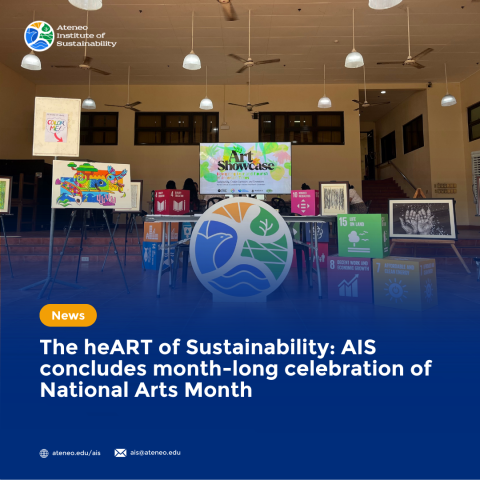
The heART of Sustainability: AIS concludes month-long celebration of National Arts Month
With the desire to make sustainability more accessible and promote its interdisciplinarity, the Ateneo Institute of Sustainability (AIS) hosted a month-long National Arts Month celebration