Ateneo Sustainable Futures : Insights by Albert Lagliva
14 Mar 2025 | Albert Lagliva




I am a lake person. Probably a big chunk of my best memories in life are experiences in bodies of water. I particularly love to spend my leisure time fishing in bodies of freshwater in and around Metro Manila. It is while floating on a boat or just casting on the shoreline that I truly feel being “one with nature.” The calmness that a body of water can offer reminds me of what Pope Francis’ Laudato Si says, that our common home is like “a beautiful mother who opens her arms to embrace us.”
But sadly, these good memories are also tarnished by experiences of degradation. that these bodies of water are subjected to, namely, destruction of their habitat and ecosystem, introduction of invasive species, rapid urbanization leading to pollution, and risks of shoreline inundation. Perhaps the biggest culprit to these is that experientially I can point to is none other than climate change.
We admire the beauty of nature because we are able to witness that everything falls in its proper place. May tamang kinahuhulugan ang lahat kaya tinatablan tayo ng kalikasan sa angkin nitong kaayusan at kagandahan. Climate change, brought about by humanity’s propensity to perform personal, collective, and institutional actions that destroy, undermine, and pervert the inherent order in nature, runs contrary to the qualitative functioning of the different elements here on earth.
Climate change has affected the water systems tremendously. Rising heat and drought bring disruption to the biodiversity of the water systems, which causes the reduction or even extinction of some fish and aquatic plant species. High water temperature results in excessive algae bloom, which depletes oxygen levels in water, thus making the survival of aquatic life difficult. This is exacerbated by human beings’ habitual disposal of pollutants, excessive fish feeds, and human waste in our waterways.
Too much rain that brings flooding, on the other hand, also affects water quality. as different elements such as harmful sediments, pollutants, and chemicals find their way into our rivers and lakes. Invasive species such as the knife fish, flowerhorns, and toman, which are ornamental fish, rapidly grew in number when they were washed into our water systems as high levels of precipitation brought by such typhoons as Ondoy (2009) and Ulysses (2020). Endemic species such as biya, ayungin, and even kanduli prove no match against these aggressive predators and thus affected their numbers. Intense rains also cause the weakening of ground structures, and the continuous Inundation of shorelines threatens the lives of people in these vulnerable communities. Climate change endangers human lives in more ways than one.
Climate change is real. Its harmful effect is mostly absorbed by the different bodies of water since more than two-thirds of the earth’s surface is water. Science has constantly provided us with knowledge concerning this phenomenon. We are made aware of how fragile life is in general in relation to the destructive force of climate change in bodies of land and water.
Given this situation, we are now called to action. The task of acting to mitigate The onslaught brought by climate change is immense. People can respond to this in different ways. We are truly grateful for the scientific communities and groups with technical know-how who are at the forefront of this task. As a teacher, I personally would like to use the challenge as my guide to action. that Pope Francis posted in Laudato Si when he asked the question, “What kind of world do we want to leave to those who come after us, to children who are now growing up?” This call to action towards climate change seems not to be about individual human flourishing. This is not simply an issue of “palakasan at patibayan ng loob sa harap ng pagsubok.” This is a kind of action that is ethical, a response to climate change that takes root in the recognition of the other as deserving of an environment that is true, good, and beautiful. Otherwise, climate change responses and initiatives might only be directed to one’s own survival and interest.
Martha Nussbaum says that part of human development is the recognition of our capability of associating with people, for us to “imagine the situation of the other.” Perhaps climate change responses and initiatives should first and foremost be grounded on the lifeworld of the communities that we are responding to. Sustainable ethical Responses to climate change affirm that the people in the communities experience the brunt of nature differently from the conceptions and measurements of agencies responsible to oversee all these events. I remember one study with a couple of science faculty members, where we found out that people in the typhoon-prone areas of Marikina has difficulty following local government directives because the technical language and categorizations of typhoons are not in sync with how the communities experience such calamities.
Vulnerable communities, whose livelihood depends on the condition of these water systems cope with the challenges posed by climate change, have each other as their social capital to make the necessary collective actions to bear these difficulties because, in the end, they would like to continue building a community that is reflective of how human life is lived. The national and local governments, academe, and line agencies, scientific communities and concerned civic groups should listen to them, appreciate their own conceptions of their lifeworld, and empower them to participate in the establishment of dignified human communities. Sustainable action concerning climate Changing responses is an ethical action that is directed towards the human flourishing of the other.
Recent News
You may also like these articles

Why can’t we eradicate tuberculosis? AIS dissects the TB issue in a multidisciplinary panel
On 24 March 2026, the Ateneo Institute of Sustainability (AIS), through its Sustainable Development Goals (SDGs) Program, hosted a multidisciplinary panel in observance of World
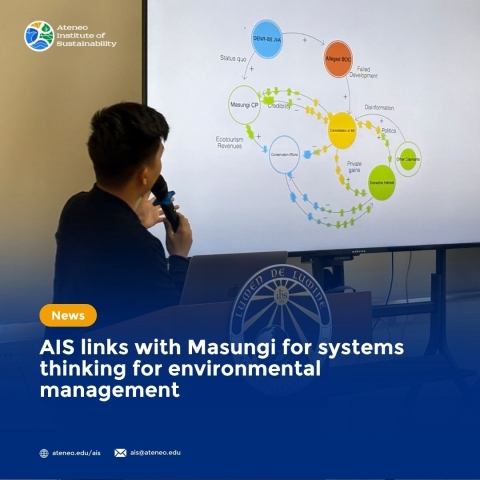
AIS links with Masungi for systems thinking for environmental management
Last 23-24 March 2026, the Ateneo Institute of Sustainability (AIS) , which manages the My Climate Risk – Ateneo de Manila University Regional Hub
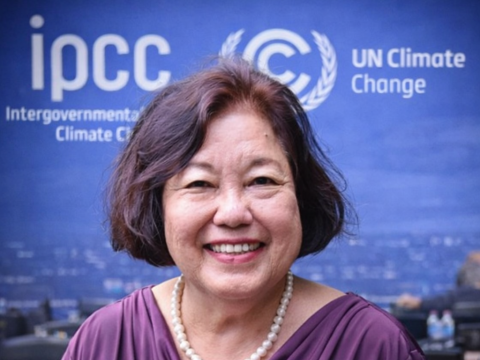
Mangroves as shields of history and resilience: Insights from Dr Emma Porio
Mangrove forests have long shaped both the history and survival of coastal communities in the Philippines. According to Dr Emma Porio, Professor Emeritus (Sociology -
Professor Emeritus Dr Emma Porio to deliver keynote address at Regional Dialogue: Schools Climate Action Project
Dr Emma Porio, Professor Emeritus at Ateneo de Manila University's Dr Rosita G Leong School of Social Sciences (RGLSOSS) and Lead Author of UNFCCC-IPCC Climate
Klim@Musika
For most Filipinos, music is inseparable from daily existence. Music playlists accompany Filipinos in their commutes be it through walks, jeepneys, trains, or their private
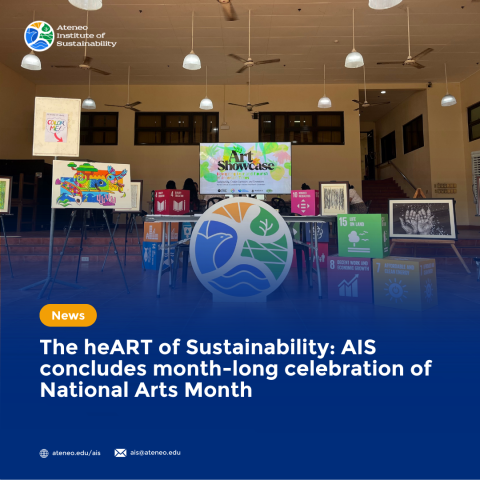
The heART of Sustainability: AIS concludes month-long celebration of National Arts Month
With the desire to make sustainability more accessible and promote its interdisciplinarity, the Ateneo Institute of Sustainability (AIS) hosted a month-long National Arts Month celebration