Creating Shared Value in the Peripheries: Ateneans in the Heartlands
21 Oct 2025 | by Sharon Jean Gonzales- Gulmatico, PhD Cand.




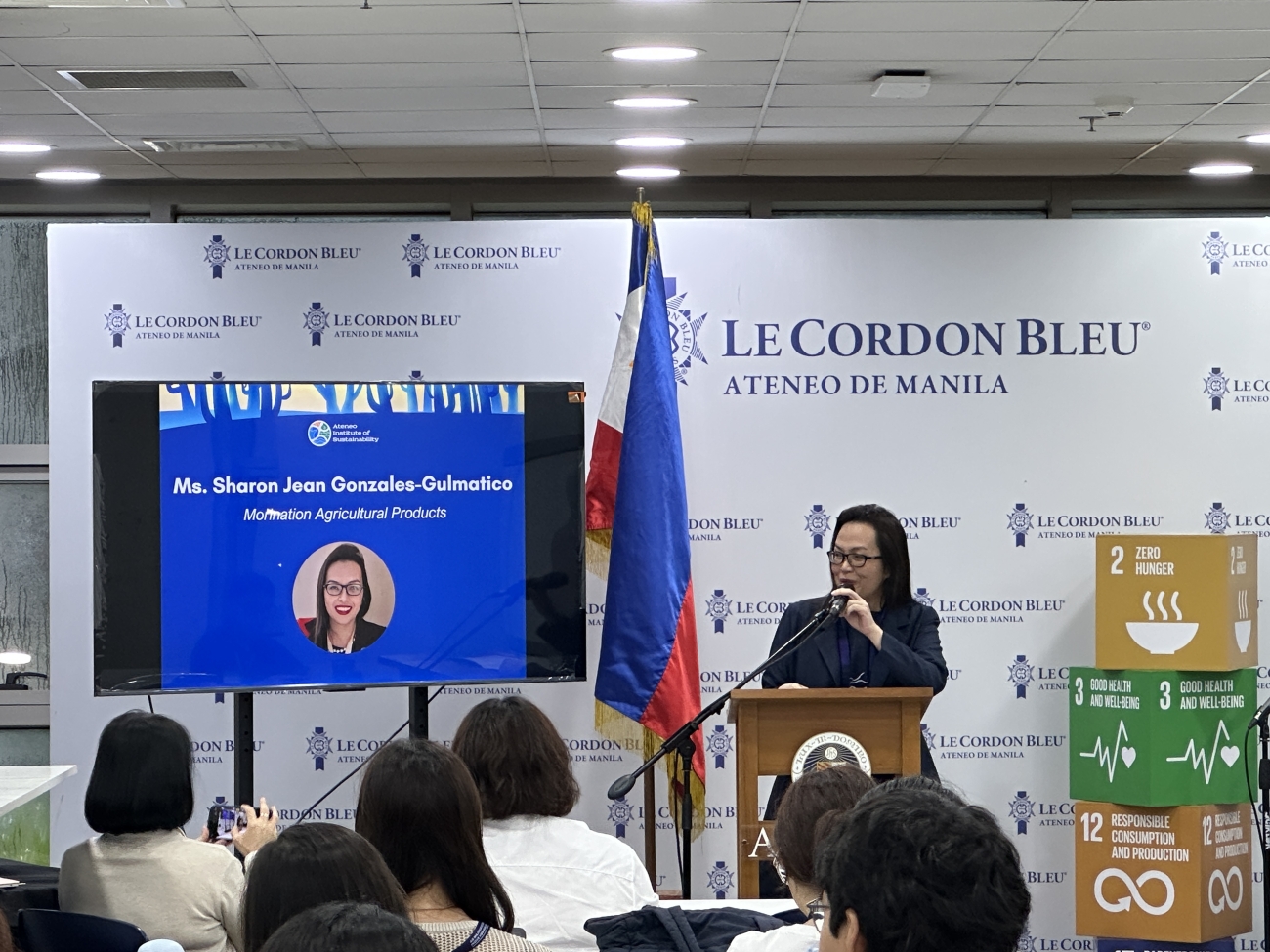
What follows below is the transcript of the talk by Ms. Sharon Jean Gonzales-Gulmatico in “Blue Roots: Ateneans for Sustainable Food Systems” event organized by the Ateneo Institute of Sustainability last 15 October 2025.
Good morning, everyone. To the Ateneo Institute of Sustainability, thank you so much for this invitation. It’s a privilege to be here at the Le Cordon Bleu. It's an honor to share this stage with Chef Annalisa, and Dr. Valenzuela.
I am so happy to be called home and be back home. Events like these are so Atenean. At the core is Magis, true to the form of being men and women for others as we break bread and gather, so we can collectively and sustainably strengthen the world we all share.
When I left Ateneo after completing both my BA and my MA academic requirements, and when Arete was just a cornfield, 30 years ago, I was still not sure what to do. But in my heart, like any Atenean, I knew I wanted to make a difference. During my MA, I learned about the synchronicity of events leading up to what we are supposed to do. Through grace, we are drawn to people and circumstances to actualize our potential and materialize our purpose.
Ten years ago, Morination started because I wanted to go home to Baguio and plant pine trees. But my father, who mixes malunggay powder into my picky boys’ rice so they can eat their vegetables every day, told me to plant malunggay instead. In Morination, we have posited that the Malunggay, our national vegetable, will be one of our solutions to end world hunger, provide livelihood support to our communities, and is our climate champion. I feel so much joy. I left Ateneo with a purpose, and today I return home to talk about food.
I want to highlight a fundamental paradox that has shaped my career. Here at Ateneo, we learned that everyone has a purpose. Quoting from St. Kostka, Patron Saint of the Ateneo Jr. High, “We are born for greater things.” Yet, millions of Filipinos remain trapped in poverty and injustice. Our country is blessed with rich natural resources, yet we are the largest importer of rice, and 20 million Filipinos still go to bed hungry. The very people who grow our food are among the poorest and most food insecure. Ito pa dagdag, the most vile and evil people steal trillions of pesos meant for programs such as food security. During the flood control sessions at the Senate, Sen. Bam Aquino stated that it would only take 3 billion pesos to feed 3 million undernourished children for 30 days. Ending hunger among the young ones is imperative because the youth are the hope of our nation. The World Bank and its partners have conducted numerous studies and reports that consistently demonstrate a significant return on investment for school feeding initiatives. The consensus from these studies is that for every $1 invested, the economic return can be as high as $23, due to growth in human capital and contributions to our GDP as our schoolchildren grow into productive citizens. In other countries, where students are being taught AI and other skills to prepare for the future, the Philippines again lags, with children who are hungry and lack the support and facilities to learn properly. Our inaction to resolve where 30% of our schoolchildren are stunted, where farmers are neglected, and where our environment continues to degrade has set us and our country up for failure. That is why I came here today: more than a homecoming, more than ever, I come for the community. Our country needs you, our current and future sustainability leaders, to prepare to take on the helm and work with us in the peripheries.
When Pope Francis visited the Philippines in 2015, he called on the faithful to go to the peripheries where Jesus is among the downtrodden and marginalized. A few weeks later, our teams in Morination were in Leyte, delivering hundreds of thousands of seedlings for the UN's beneficiaries affected by the worst typhoon to hit the Philippines. Morination never left the peripheries. We are with them in the supply and delivery of goods for the UN’s peace, development, and humanitarian efforts. Our involvement with the UN on this front has solidified our conviction that the Sustainable Development Goals, such as No Poverty, Zero Hunger, and Net Zero, can only be achieved through hyper-local, community-driven solutions. This belief was forged in the ground of farming communities, from the highlands of the Cordilleras to MILF villages in Mindanao, where we have worked in solidarity with our growers’ struggles. We saw them losing their harvests to typhoons and overproduction before these even reached the market. We met with red rice growers who were reduced to tears by the land, forced to eat their rice seeds, silenced into submission, and forced to sell their rice grains for a pittance to middlemen.
I saw a system that was efficient at extracting value, but profoundly inefficient at delivering nourishment and equity. It was a system that was not just unsustainable for our planet, but deeply excluded the very people who are its foundation.
This realization changed everything in Morination. We understood our assignment that ending hunger wasn't just about producing more food. It was about transforming the entire system, building bridges where gaps existed, and putting our farmers and local businesses at the center of the equation.
Our work in Morination is focused on rewiring this system from the ground up. We do this through two core principles: radical inclusivity and deep sustainability.
Radical inclusivity involves what I learned in our Liberation Theology classes. In our work, we see farmers as partners. We use systems and strategies such as providing them with enabling environments to empower them, such as developing fair and sustainable trade mechanisms, ensuring more income remains with them for the subsequent planting cycles, and uplifting their family’s quality of life, and designing programs for women-led organizations, recognizing their central role in food security.
Deep sustainability is going beyond being "organic." It’s about embracing regenerative agroecology—viewing farms as ecosystems, not factories, and using third-party metrics to measure our impact. Our farmers are not just workers but food champion partners, whose strategic location, expertise, and experience create value in food systems transformation.
This is what we are doing in the Juan Million Moringa initiative.
Our malunggay is so Filipino, resilient that it grows anywhere. This grows fast and in abundance. Globally, it is known as the "miracle tree" due to its incredible nutritional value and its resilience to drought. In the Philippines, it is our national vegetable. The Juan Million Moringa initiative is our answer to malnutrition, one seed and one community at a time. The malunggay significantly contributes to meeting our Net Zero targets, as each mature tree can absorb more than 70 kgs of CO2. If each of us plants 60 malunggay trees every year, then we can offset our carbon footprint. In Morination, we partner with various institutions to plant millions of malunggay trees. We provide training on how to cultivate it and, crucially, how to integrate it into daily meals to combat hidden hunger, especially in children. We also connect these communities to markets for value-added products like moringa nutripacks and powder, creating a sustainable livelihood. It is a simple, powerful model: nourishing our people with our own native resources, while empowering them economically.
The challenges are immense, but the opportunities to make a difference are even greater. A career in the agri-food systems and ending hunger is no longer a niche field for agriculturists. It is one of the most dynamic, interdisciplinary, and fulfilling spaces to be in today, as it shapes a more sustainable, inclusive, and equitable food system.
If you are an SOM student, we need you to build the next generation of social enterprises and sustainable agri businesses.
If you're from the School of Science and Engineering, we need you to help us optimize moringa supply chains and systems so that our farmers' lives can truly be uplifted and for them to take on their roles as food champions.
If you're a student of the ASoG, we need you to help us integrate nutrition-sensitive agriculture into national policy. As a Political Science graduate, I am part of the CSO lobbying for the passage of the Moringa Law. I am also a Development Partner of the DA’s Philippine Council for Agriculture and Fisheries and I also represented the Philippines in the UN COP 16 to end desertification in Saudi Arabia. There, they are planting billions of trees across the Sahara Desert, and one of the trees they intend to plant is the malunggay because it can grow anywhere, even in the desert.
If you're in the humanities, we need you to amplify the voices of our farmers and document the stories of our lands as we fight injustice and oppression, and even our triumphs, contributions, and progress in nation-building.
And for those here at Le Cordon Bleu, your role is critical. Imagine creating a new gourmet standard using local, sustainable ingredients like the humble malunggay. You can shape palates and drive demand for a better food system.
Whatever your plan may be, I hope and pray you join us on the ground, where we can feel the soil and be in solidarity with those in the peripheries. Our Ateneo education taught us to be persons for and with others. Working within the food system is perhaps the most profound expression of this principle. Food connects us all. Building a food system that is inclusive and sustainable is not just an environmental or economic project. It is an act of service. It is a commitment to ensuring that every person in our country has access to healthy, nutritious, and dignified food.
When the time comes for you to go down the Hill and work towards this vision as Liwanag sa Dilim, may our prayers and actions remain blue-rooted in the light of Christ, our North Star, which will always guide us through darkness, illuminating the way for us to find meaning and clarity amidst the paradox, AMDG. Maraming salamat po.
Recent News
You may also like these articles
Why can’t we eradicate tuberculosis? AIS dissects the TB issue in a multidisciplinary panel
On 24 March 2026, the Ateneo Institute of Sustainability (AIS), through its Sustainable Development Goals (SDGs) Program, hosted a multidisciplinary panel in observance of World
AIS links with Masungi for systems thinking for environmental management
Last 23-24 March 2026, the Ateneo Institute of Sustainability (AIS) , which manages the My Climate Risk – Ateneo de Manila University Regional Hub
Mangroves as shields of history and resilience: Insights from Dr Emma Porio
Mangrove forests have long shaped both the history and survival of coastal communities in the Philippines. According to Dr Emma Porio, Professor Emeritus (Sociology -
Professor Emeritus Dr Emma Porio to deliver keynote address at Regional Dialogue: Schools Climate Action Project
Dr Emma Porio, Professor Emeritus at Ateneo de Manila University's Dr Rosita G Leong School of Social Sciences (RGLSOSS) and Lead Author of UNFCCC-IPCC Climate
Klim@Musika
For most Filipinos, music is inseparable from daily existence. Music playlists accompany Filipinos in their commutes be it through walks, jeepneys, trains, or their private
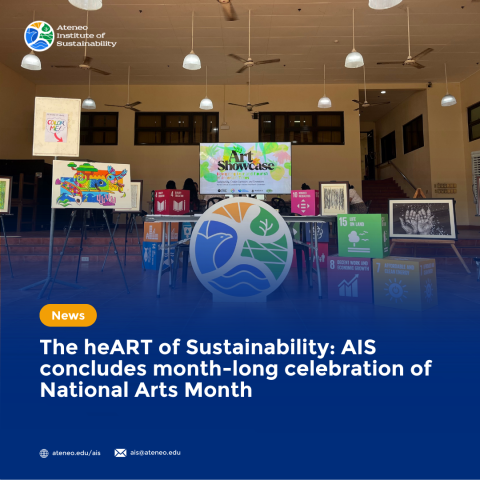
The heART of Sustainability: AIS concludes month-long celebration of National Arts Month
With the desire to make sustainability more accessible and promote its interdisciplinarity, the Ateneo Institute of Sustainability (AIS) hosted a month-long National Arts Month celebration