Bike Share in U.P. Diliman
19 Jul 2019 | Migi Laperal

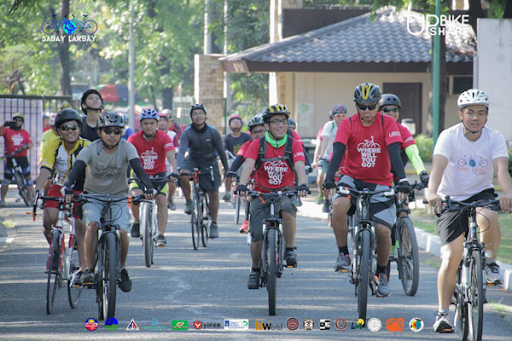
UP Bike Share is a not-for-profit, student-run organization based in the University of the Philippines–Diliman, which advocates for bridging the last mile mobility gap within communities by providing a cheap, intelligent, and convenient bike share program.
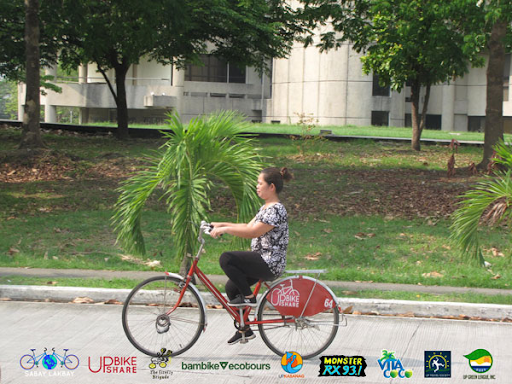
Bike Sharing is not bike rental. Bike Sharing allows a pool of users to share a pool of bikes, thus reducing costs and increasing efficiency and service. Over the course of its 50 year history, bike sharing has developed from free bikes left for any community member to use to wireless, dockless bikes that can be unlocked from a mobile app. UP Bike Share, in particular, aims to be the first 4th-generation bike share system in the country with the inclusion of smart bike tracking, built-in locksand a mobile app.,
UP Bike Share serves university students, faculty, and staff on a monthly or semestral subscription basis; Php50/month and Php150/semester. Being a subscriber allows unlimited use of the bikes 24/7 for trips up to 30 minutes. Based on market research done in UP Diliman prior to launching the initiative, an overwhelming 87% of the 700 survey respondents said they would like to bike in UP, but less than 3% actually did. We see bike share as a bridge to meet the multiple needs of the community. Surprisingly, weather conditions, sweat, and physical exertion were the least of the respondents’ concern; their biggest concern was road safety, and second was the upfront cost and maintenance if they bought their own bikes.
The initiative was launched in August 2015 as a pilot study with 60 dorm residents and 30 bikes. It has since grown to serving over 800 subscribers and 140 bikes over the past 4 years. Bike Sharing as a concept is not new. I came across it in a dusty transportation engineering thesis in the library in August 2014, and got to work building a team of friends and finding a network for support. We talked to industry experts and professors, attended startup pitch competitions, and even represented the Philippines in some regional hackathons like the APEC ASEAN Accelerator Network in Taiwan and YSEALI Startup Weekend in Malaysia both in 2015.
However, none of these events made the project any more real than it was on paper. The first defining milestone for the project was when the core team decided to chip in Php30,000 to purchase and refurbish our first 10 bikes in April 2015. These were Japan Surplus bikes we bought in Antipolo, and painted them a bright Ferrari-like red.
This was our point of no return, and it paid dividends. The network of experts and corporations we spoke to viewed the initiative in a completely different light, and in a matter of months, our humble 10 bikes, turned into a 50 bike fleet thanks to corporate sponsorships. [DMCI Homes and Semirara Mining & Power Corp]
In 2016, the project was given a Php15M grant by the PCIEERD-DOST to scale the project, and provide a system which could easily be launched in any LGU or community.
The vision of UP Bike Share as an organization is to prove that biking is a legitimate form of transportation, not reserved for wealthy weekend warriors or day laborers who have no other option. By making the bikes accessible, convenient, and safe, we hope to make this a reality.
Our community engagement programs include monthly events like bike rentals and lessons, and annual events like First Day Ride, Sabay Lakbay, and Green Light Symposium.
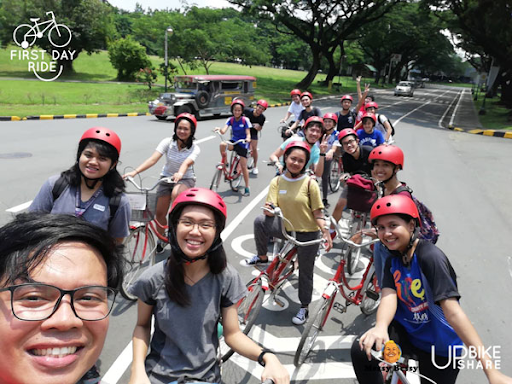
During First Day Ride, we introduce incoming freshmen to see the campus on a bike. The best sentiment we get from them every year is that biking really does force a new perspective; no longer were they in an insulated air-conditioned vehicle with other road users merely in their way. The slower pace of the trip and their exposure to the environment allowed them to notice more things along the way, connecting them with the environment and fellow road users, and care more deeply about their relationship with the built environment.
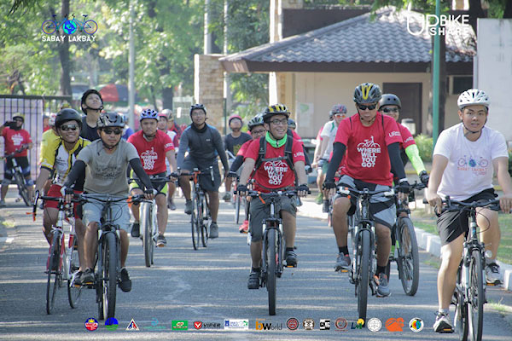
Sabay Lakbay is held to commemorate Earth Day where we bike around QC with stops at Ninoy Aquino Parks and Wildlife and Balara Filters Park to talk about the importance of protecting and supporting some the city’s last public spaces and urban lungs. This year, we had over 200 cyclists join us.
Green Light Symposium is geared towards both high school and college students to promoting an inter-disciplinary approach in problem solving. The worst thing that can happen is for these young people to see traffic as a social reality –a problem too large to realistically solve– and we provide a design thinking framework for approaching solutions. This half-day event also allows them to meet like-minded youth, as well as mobility experts, professors, and civil servants all doing their part to help.
UP Bike Share has benefitted from a very positive reception from UP Admin and students, and surprisingly a neutral reception from the Jeepney association. Initially the jeepneys were afraid that the presence of bike sharing would significantly affect their profits and ridership, but this was not the case.
Bike Sharing is not a solution on its own but an integral part of a holistic mobility program. As has been said by many policy makers, inclusive mobility is about moving people, not moving cars. Biking provides one of the most efficient methods of doing so, at a fraction of the cost. For any bike share network to succeed, it would generally need the following elements:
-
A dense network of stations across a coverage area, with the average spacing 200 – 300 meters away from each other
-
Comfortable city bikes with easily recognizable symbols or specially designed parts and sizes that discourage theft and resale
-
An automated locking system that allows seamless borrowing and return of bikes at stations
-
Wireless tracking, and real-time user information
-
Affordable and competitive pricing structures that encourage short trips on bikes to maximize the number of trips per bike per day
-
Multi-modal stations that connect multiple modes of transportations with one another
Perhaps one of my biggest takeaways from this endeavor is the community that allows such projects to start and flourish. From professors willing to back up starry-eyed students, to university administrators allowing students to experiment, fail, and iterate, to ASEAN networks that widen perspectives, this project would be nowhere without trust and collaboration. It is these values that trickle down and find their way back into the built environment, and its something we hope translates into the interactions of people who come into contact with the project.
For further information on UP Bike Share, see the following articles:
Regidor, A. (2015, August 18). Bike sharing service at UP Diliman. Retrieved July 14, 2019, from https://upd.edu.ph/~updinfo/aug15/articles/Bike%20sharing%20service%20at%20UPD.html
Mojares, E., & Laperal, M. (2016, October 03). These UP Students Started Southeast Asia’s First Smart Bike Sharing System. Retrieved July 14, 2019, from https://www.kalibrr.com/advice/2016/10/up-bike-share-is-taking-the-streets-by-storm
Brizuela, M. B. (2016, August 10). UP bike sharing scheme gets P15-M boost from DOST. Retrieved from https://newsinfo.inquirer.net/804686/up-bike-sharing-scheme-gets-p15-m-boost-from-dost
Lee, R. (2016, February 18). UP Students Introduce a Healthier and Greener Way to Travel. Retrieved July 14, 2019, from https://www.wheninmanila.com/up-bike-share
Amador, B. (2019, April 19). UP Bike Share is a glimpse into a world of efficient alternative transportation. Retrieved July 14, 2019, from http://youngstar.ph/bike-share-glimpse-world-efficient-alternative-transportation/
DMCI Homes partners with student advocacy group UP Bike Share. (2016, May 23). Retrieved July 14, 2019, from https://www.dmcihomes.com/whats-new/news/dmci-homes-partners-with-stude…
FNST. (2019, June 07). FNF joins GPCCI’s Mabuhay Germany to reach new heights! Retrieved July 14, 2019, from https://philippines.fnst.org/content/fnf-joins-gpccis-mabuhay-germany-reach-new-heights
Migi Laperal is an undergraduate civil engineering student in the University of the Philippines – Diliman. He is passionate about transportation and mobility. In his freshman year, he founded UP Bike Share, the first operational bike sharing service in the Philippines. In 2016, they were funded Php15M by the Department of Science and Technology to further develop bike sharing nationwide. He has also presented in front of delegates from APEC, and pitched to companies and government bodies in Taiwan, Malaysia, and America. His article is currently being reviewed for publication at the Journal of Transport Geography‘s Special Issue on “Geographies of Bike Sharing and Emerging Forms of Shared Micro-mobility.”
Recent News
You may also like these articles

Why can’t we eradicate tuberculosis? AIS dissects the TB issue in a multidisciplinary panel
On 24 March 2026, the Ateneo Institute of Sustainability (AIS), through its Sustainable Development Goals (SDGs) Program, hosted a multidisciplinary panel in observance of World
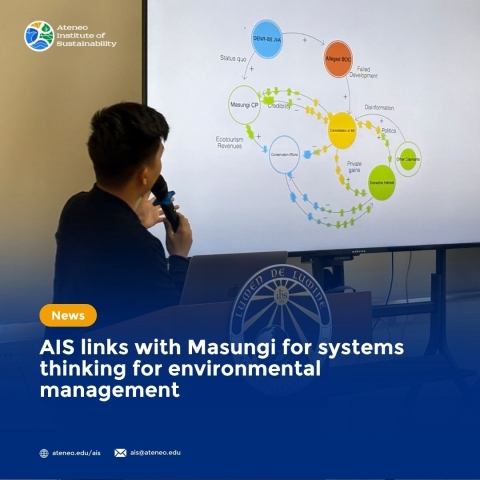
AIS links with Masungi for systems thinking for environmental management
Last 23-24 March 2026, the Ateneo Institute of Sustainability (AIS) , which manages the My Climate Risk – Ateneo de Manila University Regional Hub

Mangroves as shields of history and resilience: Insights from Dr Emma Porio
Mangrove forests have long shaped both the history and survival of coastal communities in the Philippines. According to Dr Emma Porio, Professor Emeritus (Sociology -
Professor Emeritus Dr Emma Porio to deliver keynote address at Regional Dialogue: Schools Climate Action Project
Dr Emma Porio, Professor Emeritus at Ateneo de Manila University's Dr Rosita G Leong School of Social Sciences (RGLSOSS) and Lead Author of UNFCCC-IPCC Climate
Klim@Musika
For most Filipinos, music is inseparable from daily existence. Music playlists accompany Filipinos in their commutes be it through walks, jeepneys, trains, or their private
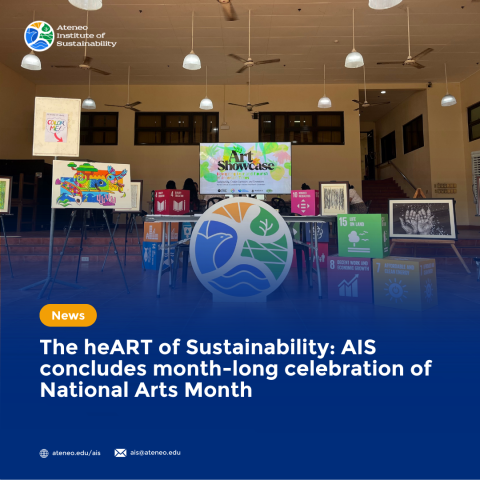
The heART of Sustainability: AIS concludes month-long celebration of National Arts Month
With the desire to make sustainability more accessible and promote its interdisciplinarity, the Ateneo Institute of Sustainability (AIS) hosted a month-long National Arts Month celebration