Paving the road for sustainable mobility in Katipunan
22 Nov 2022



With the expanded resumption of onsite work and classes for SY 2022-2023, the Loyola campus community is again filling the streets and establishments along Katipunan. Foot and vehicular traffic have notably increased, with more cars piling up and exacerbating the congestion along C-5 Katipunan. For commuters attending onsite work and classes, the North EDSA-BGC bus route that passes directly along Katipunan and free rides on the nearby LRT-2 are available as other modes of transportation for traveling.
However, as more people return to the Ateneo, issues on mobility have yet to be sufficiently addressed, putting commuters at a disadvantage. A simple walk along Katipunan reveals a prevailing car-centric culture where sidewalks end up as parking spaces and designated bike lanes are dominated by motorcycles and buses. In some portions, sidewalks that are supposed to accommodate sufficient foot traffic have become too narrow in light of the construction of high-rise residential units. Sustainable mobility, in its part, is conceptualized as the crafting of infrastructure and services for the public’s mobility. This also calls for promoting the socio-economic development of communities and minimizing emissions and adverse environmental impacts. With the prevailing status quo, how can Katipunan become a space for upholding sustainable mobility?
For Riz Supreme Comia, a community teacher and member of Move As One Coalition, the country’s public transportation system is poor and inadequate to move the masses in their daily commute. As a long-time commuter in Katipunan, she continues to bear crowded jeepneys, inconsistent loading and unloading areas, and unreliable trains prone to technical errors. “Pag walang jeep o mga tren, paano na tayong mga commuter? (If there won’t be jeepneys or trains, how about us commuters?)” she said. Even pedestrian infrastructures, which were supposed to ensure the safety of civilians along Katipunan, have been deemed inadequate and inefficient. Across the 3.38-kilometer stretch of C-5 Katipunan from Ateneo to the University of the Philippines, there are only seven footbridges for pedestrian crossing. These are all located near universities and commercial establishments, leaving commuters with only seven chances to cross the road.
These shortcomings in mobility continue beyond existing infrastructures and public transportation in Katipunan. Hans Isaiah Wong, a senior student who has been used to walking along the thoroughfare even before the pandemic, underscored the inconsistencies of the sidewalks initially meant to provide ease for passers-by like him. Wong described Katipunan’s sidewalks as unsafe and unstable in general, with varying elevations for vehicular access to parking areas and improper markings. In addition, Comia also noted how the sidewalks have been hostile and very poor for pedestrians, as even vehicles occupy spaces meant for them. “Sa gabi kakarampot pa yung ilaw, madaling madisgrasya o mapahamak dahil ganito yung kalagayan natin (There aren’t many street lights at night, making us more prone to danger with this kind of situation),” she said. However, Wong lamented if there could still be further actions to address Katipunan’s car-centric characteristics, given that C-5 is considered a major thoroughfare in Metro Manila. "There are more cars than people. But the thing is, where to put the people? You have to still understand there are people living on the other side of Katipunan,” he said.
In 2012, the Ateneo Traffic Group (ATG) published a report that sought to present interventions for addressing the traffic problem and establishing a more efficient mobility system within the Ateneo campus and Katipunan. Underscoring that the Ateneo contributed about 20% of the traffic congestion in Katipunan then, the report highlighted the need to make C-5 Katipunan and nearby Aurora Boulevard more pedestrian-friendly and walkable by consolidating cooperation with different stakeholders in the community. As stated in the ATG, “A walkable Katipunan will not only decrease vehicular need for short-term travel within the area but will also make the LRT station more accessible thus increasing the probability of mass transportation.” It proposed the establishment of more dormitories in Katipunan to reduce the need for driving, improve the existing carpool system at that time, and provision of shuttle services from key areas in Metro Manila traveling to the Ateneo. While some of the group’s proposals have been adopted, such as improved sidewalks, drop-off points, and shuttles inside the campus, the congestion situation in Katipunan has yet to be fully addressed.
To improve mobility in Katipunan, the Move As One Coalition advocates for establishing at-grade pedestrian crossings and pedestrian refuge islands along C-5 Katipunan, instead of letting commuters depend on the limited access to footbridges. AltMobility PH, a member organization of the coalition, has also created a street redesign proposal for Katipunan Avenue that designates sidewalks, parking spaces, and bike and travel lanes. While some these proposals have already been in place this year, the organization is calling for a long-term proposal to establish a bus rapid transit system within Katipunan to address its public transportation problem where median drop-offs and additional lanes will be placed. It also wants to reshape Katipunan’s landscape by providing more green spaces. With this, the organization seeks to make the existing highway more equitable by balancing the needs of commuters and motorists.
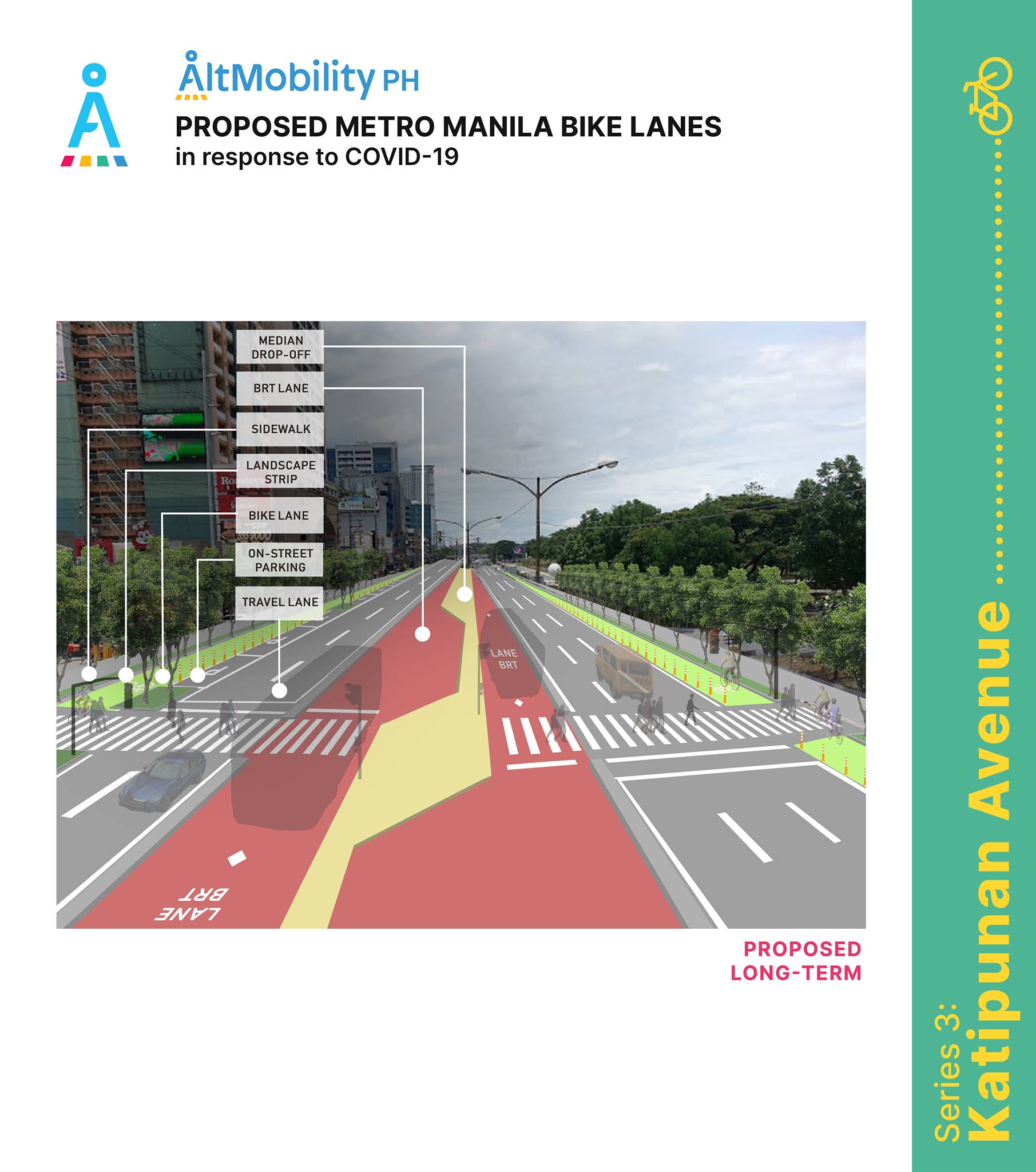
Long term proposal for Katipunan Avenue from AltMobilityPH
With the full implementation of onsite classes, people online have voiced out the need to address the traffic situation in Katipunan by suggesting schemes that could be implemented. Elijah Go Tian, a transport planning engineer, called for a makeover on the designation of lanes along C-5 Katipunan in a thread on Twitter. His proposed layout explores an additional bus lane with a transport shelter and increases the width of sidewalks and bike lanes by significantly reducing the assigned drive lane for motorists passing by (this is what transport planners call a road diet). Furthermore, Tian suggested the establishment of a more people-oriented street network inside Ateneo with wider bike lanes and bike share stations that would connect path walks in different areas around the campus. “The opportunity to create a more people-oriented Katipunan through infrastructure can shift a ton of private vehicular trips to schools and malls to more sustainable and efficient modes of travel,” he said.
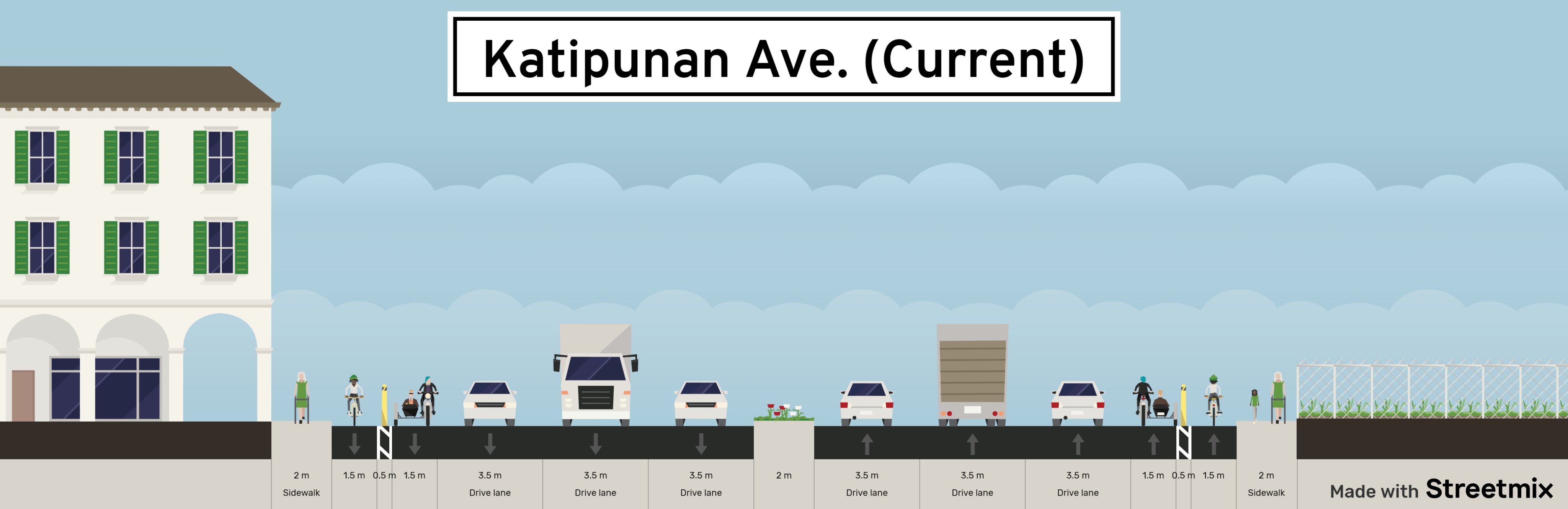
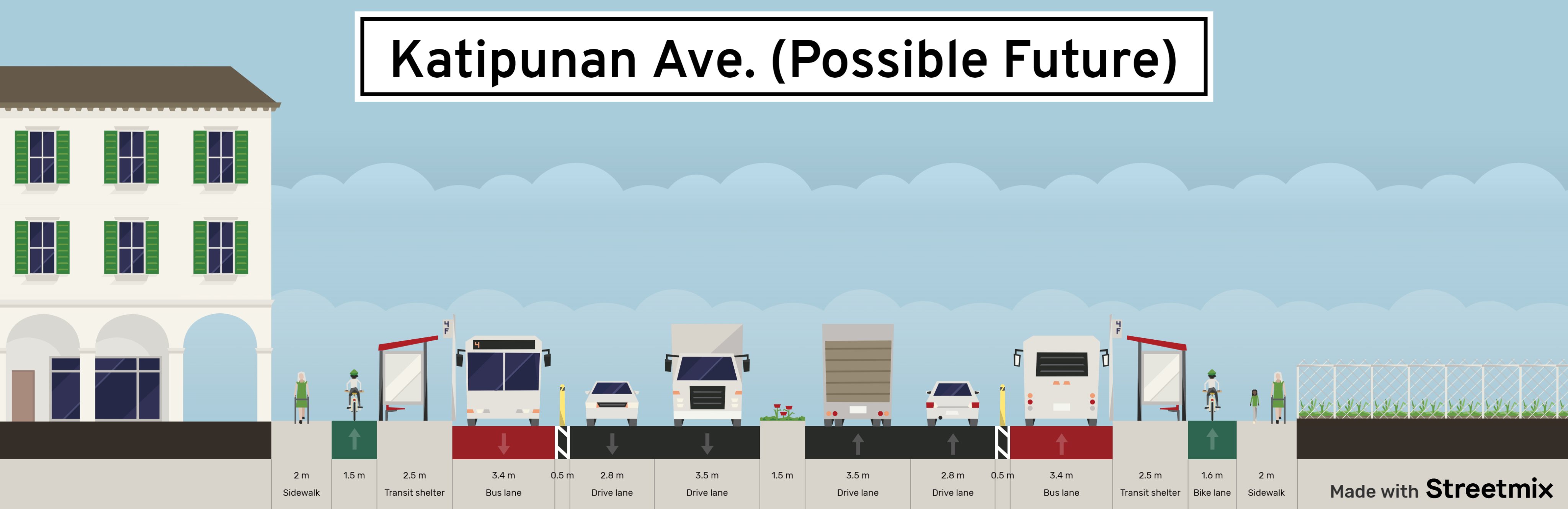
Go Tian’s proposed people-oriented street network exploring a dedicated bus lane and protected bicycle lane which could improve traffic flow and reduce accidents.
Sustainable mobility ensures that people are safely prioritized in public transportation by establishing sufficient pedestrian infrastructures and equitably dividing existing road networks. Given its strategic location and key demographics, Katipunan has excellent potential to become a model for sustainable mobility by striking a balance between moving vehicles and creating a more efficient public transportation system and pathways for commuters. In our way, we are empowered to join organizations such as Move As One Coalition to continue advancing the cause for sustainable mobility and apply mobility practices of walking, cycling, and using public transportation more often in our lives. As Comia pointed out, “If we really want to demand for a people-centric and sustainable mode of mobility all around the country and especially in Katipunan, kailangan magkakasangga tayo at magkakatulong tayo dito (we need to help and collaborate with one another).” Sustainable mobility starts with ourselves, taking small steps in our capacity toward advancing more significant policy improvements and infrastructure developments that will lead the shift of our transport networks from cars to people once again.
This article was written by Lance Arevada (2 AB Communications), a Social Media and Science Communication Intern for the Ateneo Institute of Sustainability.
Recent News
You may also like these articles

Why can’t we eradicate tuberculosis? AIS dissects the TB issue in a multidisciplinary panel
On 24 March 2026, the Ateneo Institute of Sustainability (AIS), through its Sustainable Development Goals (SDGs) Program, hosted a multidisciplinary panel in observance of World
AIS links with Masungi for systems thinking for environmental management
Last 23-24 March 2026, the Ateneo Institute of Sustainability (AIS) , which manages the My Climate Risk – Ateneo de Manila University Regional Hub

Mangroves as shields of history and resilience: Insights from Dr Emma Porio
Mangrove forests have long shaped both the history and survival of coastal communities in the Philippines. According to Dr Emma Porio, Professor Emeritus (Sociology -
Professor Emeritus Dr Emma Porio to deliver keynote address at Regional Dialogue: Schools Climate Action Project
Dr Emma Porio, Professor Emeritus at Ateneo de Manila University's Dr Rosita G Leong School of Social Sciences (RGLSOSS) and Lead Author of UNFCCC-IPCC Climate
Klim@Musika
For most Filipinos, music is inseparable from daily existence. Music playlists accompany Filipinos in their commutes be it through walks, jeepneys, trains, or their private
The heART of Sustainability: AIS concludes month-long celebration of National Arts Month
With the desire to make sustainability more accessible and promote its interdisciplinarity, the Ateneo Institute of Sustainability (AIS) hosted a month-long National Arts Month celebration