How markets change VIA shifts
03 Oct 2023 | Alsol and Pangilinan (Ateneo Economics Association) | Office of Student Activities (College)




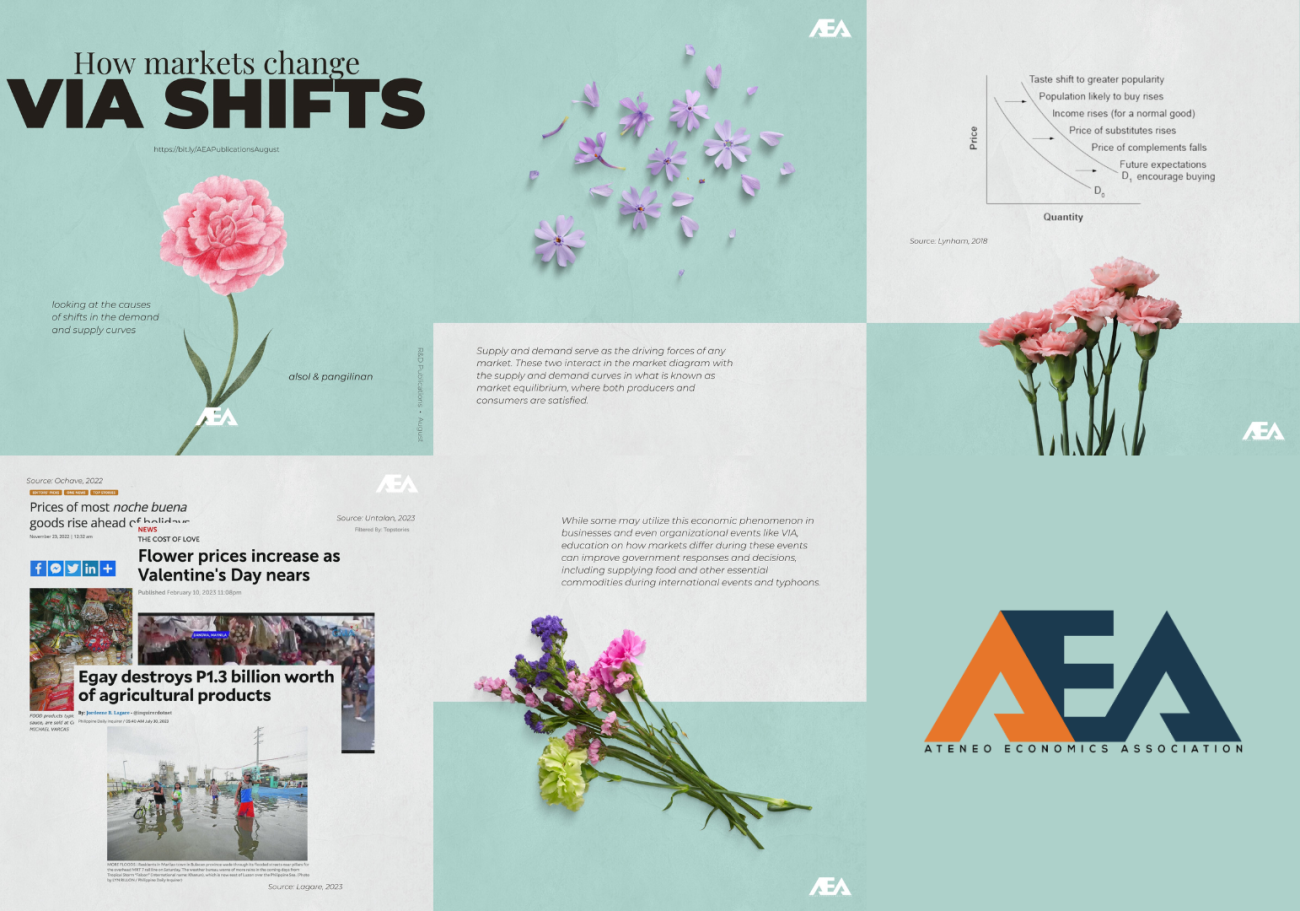
Editor's Note: "Valentine's In August" (VIA) is Ateneo Economics Association's (AEA) annual flagship project that aims to support the flower industry during the lean season. The project purchases an abundance of flowers from local businesses and sells them on campus for people to buy and give to whomever they choose within the school premises. This, in turn, brings satisfaction to the consumers and, more importantly, provides revenue support to a struggling sector. This is a primary initiative not only of the event but also of the organization at large, which is focused on development.
AEA's Research and Development article for this month, originally posted on their Facebook page, explores the shifts in demand and supply curves brought about by special occasions and disasters. As these events affect the quantity demanded and supplied, prices are often influenced, resulting in either lower or higher prices. This research endeavor seeks to provide insight into why AEA conducts this activity in the first place. Annexes and References are provided in the attached file.
While the beginning of the academic year may not be the most eventful time for most students, the Ateneo College community keeps campus lively through its numerous activities and events from its org-rich culture. One of them is hosted by the Ateneo Economics Association entitled Valentine’s in August (VIA) which, as the title suggests, provides Ateneans the opportunity to express their love on campus six months early by selling flowers at lower prices than Valentine’s Day prices. But this does beg the question: how are markets influenced during special occasions and disasters? This article discusses how market forces and consumer behavior intertwine in such events.
For context, supply and demand serve as the driving forces of any market, where supply is determined by producers and demand is represented by consumers. More specifically, supply is the quantity of goods and/or services firms are willing and capable of selling at a particular price. Conversely, demand represents the amount that individuals/households are willing and capable of buying at market prices. These two interact in the market diagram with the supply and demand curves in what is known as market equilibrium, where both producers and consumers are satisfied. While market forces are most immediately affected by movements in price, shifts within said demand and supply curves can also occur. What this means is that changes in factors other than prices can significantly impact the supply and demand dynamics in the market.
The changing tastes of consumers and the expectations of suppliers can significantly affect the production and consumption of goods and services. Changes in consumers’ preferences impact the market through some external (socio-cultural, historical, or seasonal) factors, increasing or decreasing one’s interest in said good. Take for example the recent trend of lato-lato, where the demand for such toys was nowhere near their previous levels due to its sudden popularity. Meanwhile, firms base their expectations on how personal economic conjectures, recent news, or availability of goods could also influence consumers’ current decisions, prompting the demand and supply curves to shift. Take the consumption of gasoline: when the news hit that prices are going to rise in the following weeks, lines formed in gas stations with people wanting to avoid the additional costs brought about by the price hike, thus increasing demand in that instance. But this can go both ways when we consider that suppliers also have their expectations and accordingly adjust how much they can sell with respect to their own conjectures. An illustrative case would be when cinemas raise their prices and accommodate more theaters for a highly anticipated movie.
Furthermore, Lynham (2018) provides a similar insight into the shifts in demand and supply. A shift in demand/supply occurs when a change in an economic factor––other than the price––produces a change in the quantity demanded/supplied. More importantly, on special occasions and disasters wherein consumer and supplier behaviors are affected, the supply and demand of products and services could also change. When this occurs, a new equilibrium will be determined in the market, where a different price can also increase or decrease. Changes in preferences, expectations, population demographics, income, and other products/services are among the many causes of shifts in demand and supply. See the Annex for illustrations.
Moreover, there are observable changes in the market when yearly occasions and natural disasters occur and elicit responses from consumers and producers alike. A typical example of such yearly events is the Christmas season when commodities experience higher demands and prices of raw materials. Last year, the Department of Trade and Industry noted that during the Christmas holidays, many of the common noche buena food products experienced price hikes of between 1% to 10% (Ochave, 2022). Notably, the Department of Agriculture (DA) reported price increases in vegetables because of increased demand during the same period (Allanigue, 2022). Unsurprisingly, flowers during Valentine’s Day also gain huge price increases because of sudden additions in its demand. This year additional prices in bundles of flowers during Valentine’s Day reached up to 1,000 pesos (Untalan, 2023). To add, typhoons and droughts also highly affect the supply and demand of products, specifically agricultural products. Recently, DA recorded that Typhoon Egay brought 1.3 billion pesos in damage to the country’s agricultural sector (Lagare, 2023). This includes the destruction of agricultural products, including 648.3 million pesos worth of corn and 486.8 million pesos of rice. High-value crops, livestock, poultry, and agricultural facilities were also among the affected, burdening about 100,000 local farmers and fisherfolks and decreasing the supply of the said products.
More studies can be conducted to analyze and measure demand and supply shifts. However, it cannot be neglected that there exist events and disasters that drastically influence and change markets. Certainly, a clearer picture can be showcased with further analysis using microeconomics and behavioral economics. While some may utilize this economic phenomenon in businesses and even organizational events like VIA, it is also useful in government planning, law-making, and policy implementation. Education on how markets differ during these events can improve government responses and decisions, including supplying food and other essential commodities during international events and typhoons.
References:
Allanigue, A. (2022, December 14). Expect rise in vegetable prices as Christmas approaches -da. Philippine Information Agency. https://pia.gov.ph/news/2022/12/14/expect-rise-in-vegetable-prices-as-christmas-approaches-da
Lagare, J. B. (2023, July 30). Egay destroys P1.3 billion worth of agricultural products. INQUIRER.net.
https://newsinfo.inquirer.net/1809378/egay-destroys-p1-3b-worth-of-agri-products
Lynham, J. (2018a). 3.2 shifts in demand and supply for goods and services. UH Pressbooks University of Hawaiʻi OER.
https://pressbooks.oer.hawaii.edu/principlesofmicroeconomics/chapter/3-2-shifts-in-dema nd-and-supply-for-goods-and-services/
Lynham, J. (2018b). 3.3 changes in equilibrium price and quantity: The four-step process. UH Pressbooks University of Hawaiʻi OER. https://pressbooks.oer.hawaii.edu/principlesofmicroeconomics/chapter/3-3-changes-in-equilibrium-price-and-quantity-the-four-step-process/
Ochave, R. M. D. (2022, November 23). Prices of most Noche Buena goods rise ahead of Holidays. BusinessWorld.
https://www.bworldonline.com/top-stories/2022/11/23/488847/prices-of-most-noche-bue na-goods-rise-ahead-of-holidays/
Untalan, S. (2023, February 10). Flower prices increase as Valentine’s day nears. GMA News Online. https://www.gmanetwork.com/news/topstories/metro/860417/flower-prices-increase-as-valentine-s-day-nears/story/
AEA R&D Publications
Recent News
You may also like these articles

QS Subject Rankings 2026: Ateneo in top 100 for theology; ranked in 7 subject areas
Ateneo de Manila University is among the top institutions in seven subject areas, and among the top 100 for theological and religious studies, according to

Congratulations to Dominic Craig Carpio (2 AB ECO-H) for placing 2nd in the EDSA Kwarenta Essay Writing Contest
The Department of Economics warmly congratulates Dominic Craig Carpio (2 AB ECO-H) for placing 2nd in the EDSA Kwarenta Essay Writing Contest. This achievement reflects

Ateneo Korean Studies Program Concludes KFL Workshop for Filipino Educators
The Ateneo Korean Studies Program, in partnership with the Global Leadership Development Institute, King Sejong Institute Quezon City 2, and the Dr. Rosita G. Leong

Deanship of the Dr Rosita G Leong School of Social Sciences (Memo # U2526-071)
(Memo # U2526-071) Following the appointment of Dr Czarina A Saloma-Akpedonu as the new Vice President for Higher Education effective 1 June 2026, I have formed a Search Committee for the next Dean of the Dr Rosita G Leong School of Social Sciences (RGLSOSS).
ASoG, through the Ateneo Policy Center, delivers 26 publications in 2025
As the research and public policy unit of the Ateneo School of Government (ASoG), the Ateneo Policy Center (APC) has continued to pursue cutting-edge research

"The Lotus Path” In-Country Field Study to Vietnam culminates with a Forum and Exhibit
On 18 and 19 November 2025, the Ateneo Initiative for Southeast Asian Studies (AISEAS) hosted an exhibit called “The Lotus Path” to conclude the activities