A Call to Purpose
10 Dec 2025 | Fmr BSP Gov Amando M Tetangco Jr
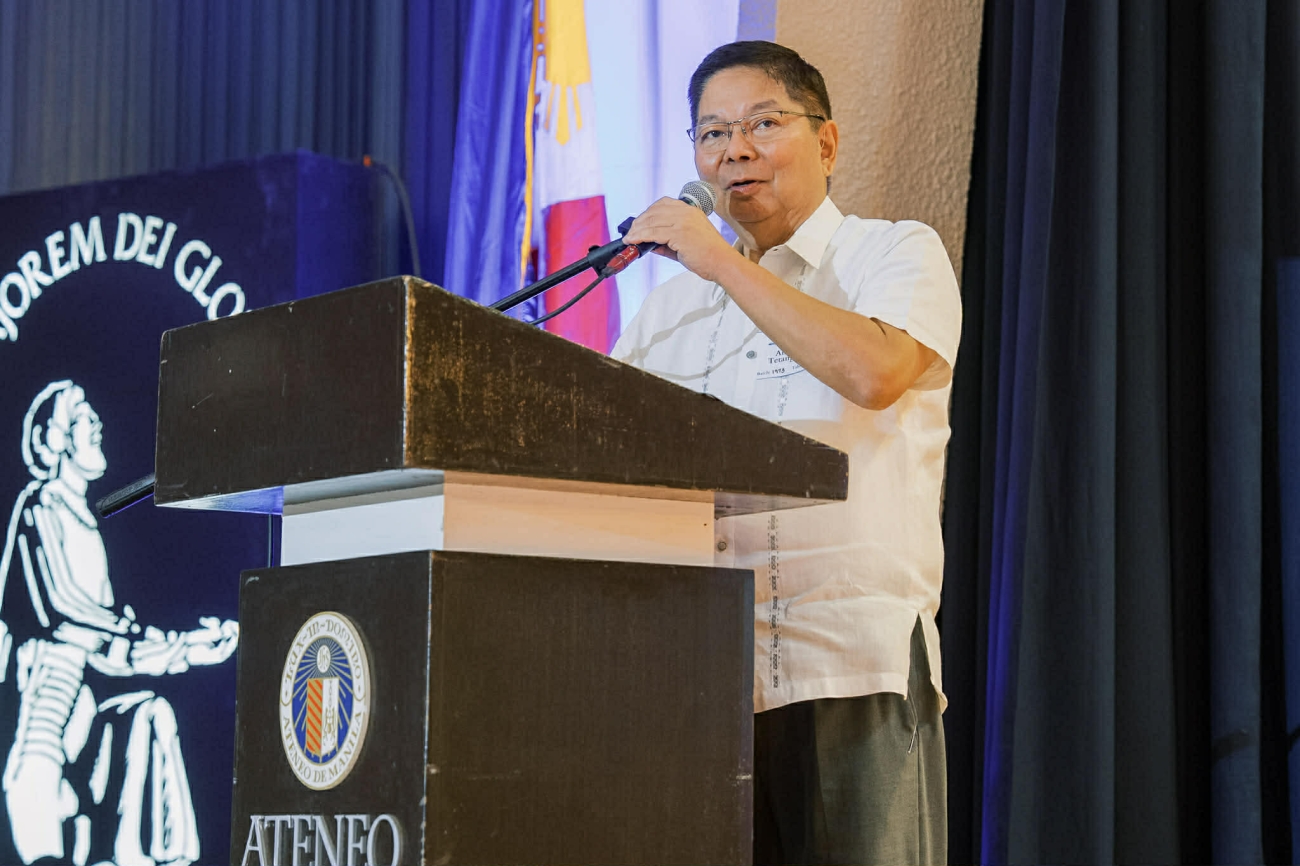
In his keynote address at the Samahan ng mga Atenistang Graduate ng Economics and Management Economics (SAGE) Alumni Homecoming 2025, last 29 November 2025, former Bangko Sentral ng Pilipinas (BSP) Governor Amando M Tetangco Jr spoke about the formative power of Ateneo education and the values of friendship, integrity, and hope. He urged Ateneans to be “steady hands in a restless world,” shaping the nation with principle and purpose.
Good afternoon.
It is great to see everyone here.
As we know, it is always a pleasure to come home to the Ateneo—to see familiar faces, to reconnect with mentors and friends, and to reflect on how far we’ve come since those formative years. This community reminds us that education was never just about knowledge; it was about character. And that, I believe, is what brings us together again today.
Our theme, Rekindling Friendship, Integrity, and Hope, feels especially timely. These three values have carried many of us through demanding seasons—as professionals, as leaders, and as citizens—and they remain essential as our country navigates yet another period of challenge and change.
Friendship — The Foundation of Trust
Friendship, in its truest sense, is not about convenience. It is about shared purpose.
History gives us inspiring examples. The friendship between Nelson Mandela and Archbishop Desmond Tutu went beyond camaraderie—it became a moral partnership that helped heal a divided nation. Their trust in each other gave courage to truth, and truth opened the door to reconciliation.
Likewise, the friendship between Franklin Roosevelt and Winston Churchill showed that even in the darkest hours of global conflict, trust and communication can shape the destiny of nations. Their bond—built on mutual respect and an unspoken understanding of duty—became the backbone of an alliance that defended freedom and rebuilt the post-war world.
They taught us that real friendship in leadership is not sentimental. It is disciplined. It is anchored in purpose and strengthened by the willingness to share burdens as well as victories.
In our own lives, friendship plays a quieter but no less powerful role. It steadies us in moments of difficulty and reminds us that no one leads alone. Over the years, I have seen how genuine professional friendships—built on respect, fairness, and empathy—have kept teams aligned when pressures were high.
Friendship nurtures civility in public life, integrity in competition, and generosity in leadership.
Friendship embodied in the willingness to listen, to collaborate, and to work together despite differences is what binds groups and nations together. It is the soil from which trust grows.
Integrity — The Anchor of Confidence
If friendship builds trust, integrity sustains it.
Integrity is not simply about honesty; it is about moral coherence—living our values even when it is inconvenient. It means doing what is right, not because it is easy, but because it is essential to preserving trust.
During my years at the Bangko Sentral, I saw how markets, investors, and citizens all respond to consistency of principle. Inflation targeting, transparency in policy decisions, and institutional independence were not ends in themselves—they were pursued to uphold integrity in governance and institutions.These reforms showed that good governance can outlast personalities and political cycles.
Today, integrity matters more than ever. At a time when governance issues continue to test public confidence—when questions are being raised about accountability, transparency, and fairness—the call for integrity is not only moral, it is economic. Credibility is our most valuable currency. It underpins investor confidence, strengthens institutions, and sustains trust between government and citizens.
Recent investigations into misuse of public funds and irregularities in infrastructure programs remind us that every act of corruption erodes not only resources, but also public trust. The challenge before us is to restore that trust through transparency, accountability, and the consistent application of the rule of law. And we have to remain vigilant to continually meet that challenge.
As leaders and professionals, we must hold ourselves to the same standard we expect of others. Integrity must be practiced daily—in our decisions, in our stewardship, and in the example we set for those who come after us.
Integrity does not demand perfection; it demands constancy—the discipline to choose the right path, especially when no one is watching, and the courage to uphold truth even when the cost is personal. That is how confidence is rebuilt—not overnight, but act by act, decision by decision, person by person.
Hope — Faith Amid Complexity
Hope, finally, is what allows conviction to endure.
It is not about blind optimism, but about perspective—the ability to see the country’s challenges clearly and still choose to stay engaged. Hope is the discipline of moving forward when the environment is uncertain, and the confidence that persistence, done collectively and with integrity, will yield progress.
Over the decades, I have seen this resilience tested many times—by financial crises, political transitions, and global shocks. Each time, the instinct of many Filipinos has been to work harder, to find solutions, and to rebuild. That is the quiet form of hope that has carried us through.
Today’s environment is complex. The world is adjusting to new technologies, shifting power centers, and changing rules of engagement. Domestically, we continue to face governance challenges and policy transitions that at times test confidence. Yet even amid these headwinds, our institutions, our entrepreneurs, and our workers continue to show commitment and adaptability.
We remain here because we know that the fundamentals of this country—its people, its creativity, and its capacity for renewal—are stronger than the difficulties of the moment.
There is realism in that view, but also conviction: that the Philippines, despite its imperfections, continues to offer promise to those who stay the course.
Hope, in this sense, is not simply emotion—it is stewardship. It is the belief that the best way to shape the future is to keep contributing to it. And that is why, despite the noise and the risks, I remain confident that this nation can still fulfill its potential—provided we lead with integrity, act with prudence, and keep faith in the Filipino.
Looking Ahead
The years ahead will continue to test our adaptability.
Economic shifts, rapid technological change, and social transitions will challenge not only the capacity of our institutions but also the steadiness of our leadership.
To navigate this environment, we will need discipline and agility—discipline to remain guided by principle, and agility to adjust policies and practices as conditions evolve.
Friendship will foster collaboration. Integrity will sustain credibility. And hope will give us the resolve to keep pursuing progress even when the path is uncertain.
If we apply these not only as personal values but as collective standards of conduct, we will help strengthen the institutions we serve and the nation we continue to build.
Conclusion
Friends, as we reconnect today, may we also renew our sense of purpose. Let us remain the steady hands in a restless world—anchored by integrity, strengthened by friendship, and sustained by hope.
The Philippines has never lacked for challenges. But it has also never lacked for people who believe. Let us be among them.
Thank you, and AMDG!
Recent News
You may also like these articles
QS Subject Rankings 2026: Ateneo in top 100 for theology; ranked in 7 subject areas
Ateneo de Manila University is among the top institutions in seven subject areas, and among the top 100 for theological and religious studies, according to
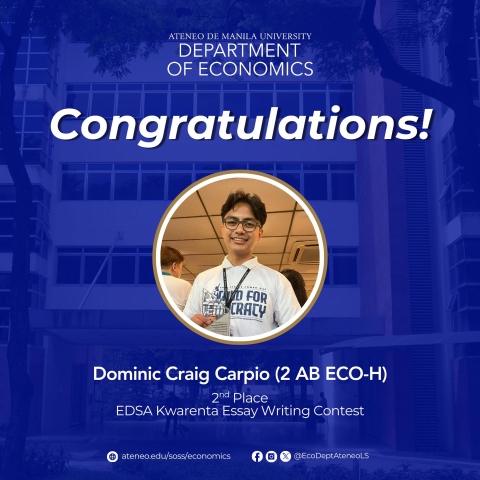
Congratulations to Dominic Craig Carpio (2 AB ECO-H) for placing 2nd in the EDSA Kwarenta Essay Writing Contest
The Department of Economics warmly congratulates Dominic Craig Carpio (2 AB ECO-H) for placing 2nd in the EDSA Kwarenta Essay Writing Contest. This achievement reflects
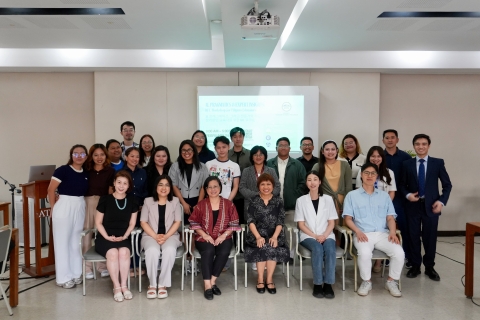
Ateneo Korean Studies Program Concludes KFL Workshop for Filipino Educators
The Ateneo Korean Studies Program, in partnership with the Global Leadership Development Institute, King Sejong Institute Quezon City 2, and the Dr. Rosita G. Leong
Deanship of the Dr Rosita G Leong School of Social Sciences (Memo # U2526-071)
(Memo # U2526-071) Following the appointment of Dr Czarina A Saloma-Akpedonu as the new Vice President for Higher Education effective 1 June 2026, I have formed a Search Committee for the next Dean of the Dr Rosita G Leong School of Social Sciences (RGLSOSS).
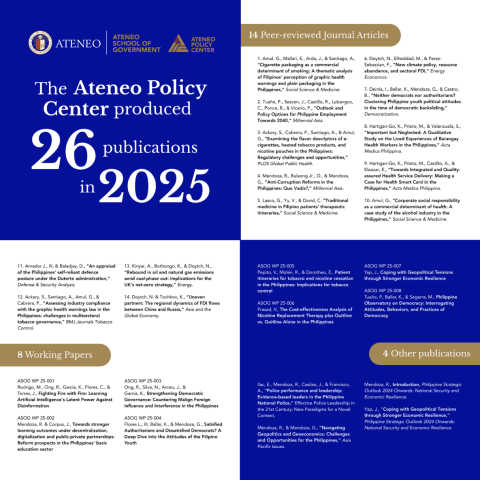
ASoG, through the Ateneo Policy Center, delivers 26 publications in 2025
As the research and public policy unit of the Ateneo School of Government (ASoG), the Ateneo Policy Center (APC) has continued to pursue cutting-edge research
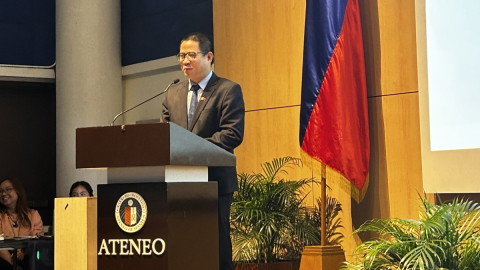
"The Lotus Path” In-Country Field Study to Vietnam culminates with a Forum and Exhibit
On 18 and 19 November 2025, the Ateneo Initiative for Southeast Asian Studies (AISEAS) hosted an exhibit called “The Lotus Path” to conclude the activities