Economics of Pandemics: Dean Ronald Mendoza's remarks on Competition and Inclusive Recovery from COVID-19
16 Nov 2020
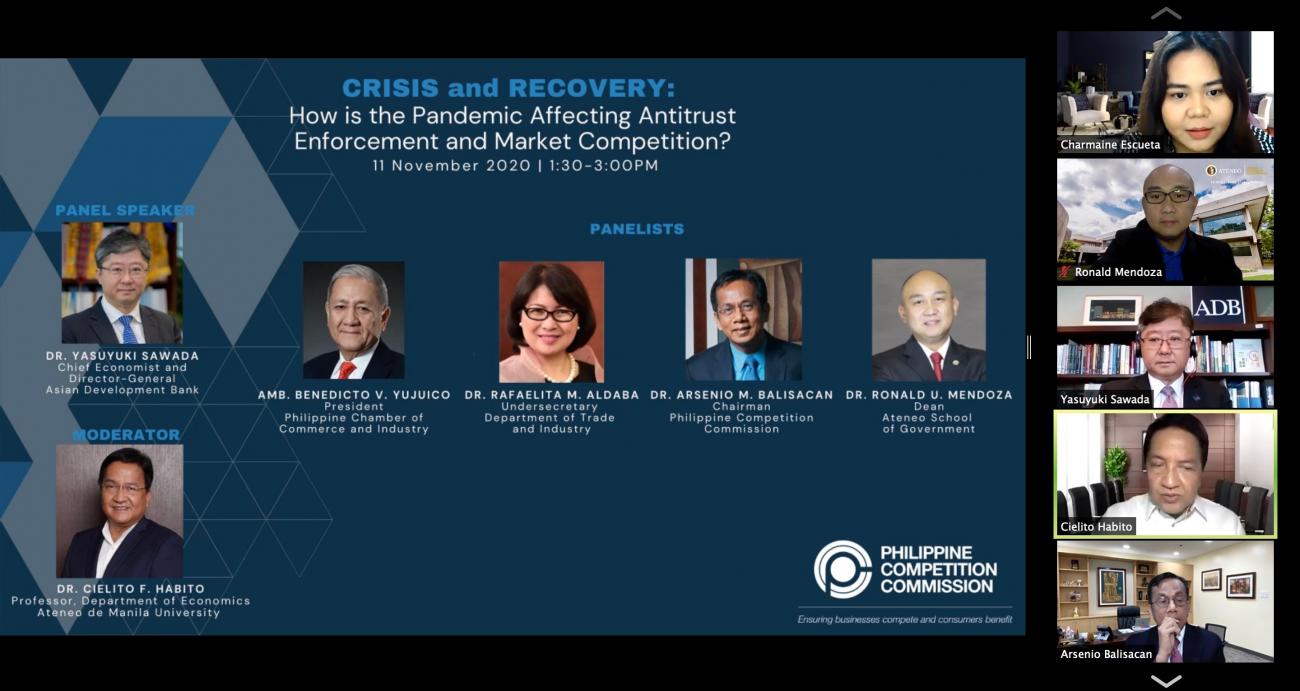
In a panel discussion organized by the Philippine Competition Commission last November 11, 2020, Ateneo School of Government Dean Ronald U. Mendoza discussed how the COVID-19 pandemic is affecting the competition landscape in the Philippines. Below are his remarks:
“Competition and Inclusive Recovery from COVID-19”[1]
Ronald U. Mendoza, PhD
Professor of Economics and Dean, Ateneo School of Government
Ateneo de Manila University
E-mail: rumendoza@ateneo.edu
The questions posed to us this morning are: Will the pandemic potentially change the competition landscape, and if so, in what way? Will the pandemic exacerbate inequality – which may already be worsened by market concentration? And finally, what policies can the Philippines pursue to address these risks?
I’m pleased to share some brief remarks in response.
First of all, we should recognize that the evidence on the unequalizing impact of market concentration is growing, though still heavily focused on industrial countries. Research on US mergers and acquisitions (M&As) in the US found evidence that M&As significantly increase markups on average by around 15-50% (suggesting stronger market power). Meanwhile, these M&As have no statistically significant average effect on productivity (Blonigen and Pierce, 2016).[2] A study of US firms spanning 3 decades also revealed how more concentrated industries invest less (Gutierrez and Philippon, 2016).[3]
More generally, researchers have emphasized how market power is linked to the political economy of reform and regulation of industries. They argue that: “Given the general affluence of shareholders and executives relative to consumers — as well as the power dynamics within large companies — we can expect market power to have significant regressive distributional effects. Monopoly and oligopoly pricing, in general, transfers wealth from the ordinary many to the elite few. […] The prevalence of market power in the economy today was not inevitable. Instead, it is the product of an intellectual and political shift in the 1980s that dramatically reoriented and narrowed the goals of antitrust law” (Khan and Vaheesan, 2016).[4]
In a country like the Philippines, many of these research findings and arguments are quite germane, and COVID-19 may have exacerbated some of the underlying risks. With mobility severely restricted, online marketplaces have expanded, like Shoppee and Lazada, featuring many smaller retailers with the means to thrive online. Meanwhile, other less formal platforms such as Viber and Facebook are also becoming places of commerce, featuring products for sale. In a way, the force of necessity brought about by COVID19 introduced us to these “online malls”. And even if we eventually stamp out this virus with a vaccine, analysts predict that these online consumer and retail adjustments are likely here to stay.
Access to these new online platforms will be key to the survival of many firms, yet not all firms will be able to connect effectively. Policymakers and legislators will need to strike a delicate balance between regulating these expanded economic platforms, while ensuring that they continue to grow and remain inclusive particularly for many smaller firms that are struggling to survive under the pandemic.
Meanwhile, the present disequilibrium could disrupt the market in ways that potentially marginalize many players and consumers. For instance, online logistics platforms suddenly found themselves with strong bargaining power vis-à-vis many smaller retailers or restaurants struggling to keep afloat. As many smaller firms join their logistics platforms, it seems reasonable to expect that these platforms offer competitive pricing. It is critical to ensure adequate competition in this space, while also building stronger inclusion for many as yet less connected firms. Ultimately, strong competition redounds to the benefit of many Filipino consumers who are also right now facing very difficult times.
Emerging research also suggests competition parameters need to be revisited and perhaps enhanced, to take the broader view that appreciates data-sharing. Due to network externalities and advantages, technology platforms growing in size and scope produce value and wealth with access to consumer data. Data was valuable prior to COVID19; but it has become even more so under the “new normal”, as consumers and producers are connecting to data platforms in even greater numbers.
As experts on new technology note: “Data sharing increases gains from trade by improving match quality but gives more market power to the platform relative to the merchants which can reduce entry and consequently consumer welfare” (Kirpalani and Philippon, 2020).[5]
Furthermore, economic slowdowns such as the one the Philippines is going through could trigger firm closures and industry consolidation. Economic planners must find ways to promote more inclusive recovery – and supporting many smaller vulnerable firms could create positive knock on effects on community resilience and facilitate more inclusive recovery. Arguably, supporting firms to fight-on and sustain jobs could be cheaper than allowing mass numbers of them to close and add millions of families to the social protection roster. This support must be provided in ways that enhance competitiveness.
Finally, even as the country tries to recover from crisis, this is a key opportunity to build-back-better and prepare the country for technology shifts that offer both opportunities as well as potential risks of higher inequality. Scholars point to several areas for possible action:
· First, as noted by a growing number of analysts, even prior to COVID-19 technological shifts already started to push the world towards automation, robotics and internet of things (IOT) among other key technologies under the 4th industrial revolution. Manufacturers in industrial countries already started to substitute robotics-enabled manufacturing at home to displace imports from countries with low-cost labor. COVID-19 may intensify this as countries may start thinking of more resilient supply chains, particularly for products critical to health and national security.
· Second, cross-border commerce on “online malls” also now cuts across borders and this could also facilitate trade, but only for those firms that are well connected on these platforms.[6] Regulation for competition and inclusion will be key. Policymakers should consider avoiding the knee-jerk reaction to over-regulate or tax these platforms given the present adjustment period of consumers and firms—it is difficult enough to thrive under the pandemic. On the other hand, as already noted, competition should be strong among these network-based platforms so that they end up offering better value for both consumers and firms.
· Finally, remote work has proven effective for certain sectors and industries, and this could motivate more services offshoring. Certainly for some sectors like education, students the world over may now opt for online courses and degrees abroad, among many services that have become ubiquitous under the “new normal”. These are the new “tradables” under the new normal.
To conclude, increased competition is coming, and much of it is inevitable and can increase welfare. But the country needs to prepare to help people and sectors adapt and compete. Otherwise, vast wealth creation will be accompanied by non-inclusive recovery from COVID-19 and growing inequality.
+AMDG
[1] Remarks at the plenary session on “Crisis and Recovery: How Is the Pandemic Affecting Antitrust Enforcement and Market Competition?” organized by the Philippine Competition Commission and held at the 58thFounding Anniversary of the Philippine Economic Society (PES), 11 November 2020.
[2] https://www.federalreserve.gov/econresdata/feds/2016/files/2016082pap.pdf
[3] http://pages.stern.nyu.edu/~tphilipp/papers/QNIK.pdf
[4] https://papers.ssrn.com/sol3/papers.cfm?abstract_id=2769132
[5] https://www.nber.org/papers/w28023?utm_campaign=ntwh&utm_medium=email&ut...
[6] https://hbr.org/2020/05/will-covid-19-have-a-lasting-impact-on-globaliza...
Recent News
You may also like these articles
QS Subject Rankings 2026: Ateneo in top 100 for theology; ranked in 7 subject areas
Ateneo de Manila University is among the top institutions in seven subject areas, and among the top 100 for theological and religious studies, according to
Congratulations to Dominic Craig Carpio (2 AB ECO-H) for placing 2nd in the EDSA Kwarenta Essay Writing Contest
The Department of Economics warmly congratulates Dominic Craig Carpio (2 AB ECO-H) for placing 2nd in the EDSA Kwarenta Essay Writing Contest. This achievement reflects
Ateneo Korean Studies Program Concludes KFL Workshop for Filipino Educators
The Ateneo Korean Studies Program, in partnership with the Global Leadership Development Institute, King Sejong Institute Quezon City 2, and the Dr. Rosita G. Leong
Deanship of the Dr Rosita G Leong School of Social Sciences (Memo # U2526-071)
(Memo # U2526-071) Following the appointment of Dr Czarina A Saloma-Akpedonu as the new Vice President for Higher Education effective 1 June 2026, I have formed a Search Committee for the next Dean of the Dr Rosita G Leong School of Social Sciences (RGLSOSS).
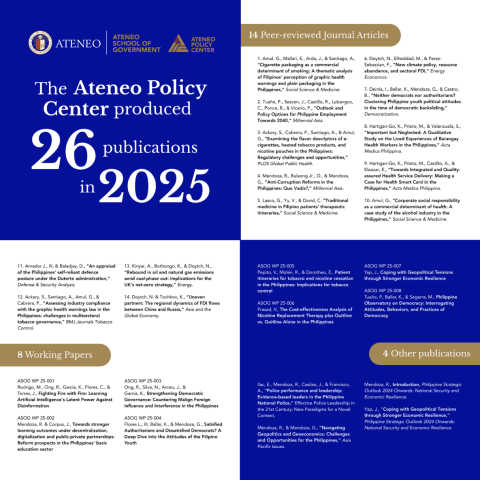
ASoG, through the Ateneo Policy Center, delivers 26 publications in 2025
As the research and public policy unit of the Ateneo School of Government (ASoG), the Ateneo Policy Center (APC) has continued to pursue cutting-edge research
"The Lotus Path” In-Country Field Study to Vietnam culminates with a Forum and Exhibit
On 18 and 19 November 2025, the Ateneo Initiative for Southeast Asian Studies (AISEAS) hosted an exhibit called “The Lotus Path” to conclude the activities