All eyes on COP28: Scientists release statement on fossil fuel phase-out
06 Dec 2023 | Daniel C Ratilla




The My Climate Risk – Ateneo de Manila University (MCR-Ateneo) Regional Hub, in support of the World Climate Research Programme (WCRP), shares a statement crafted by scientists on fossil fuel phaseout pathways.
The global statement, with the title The science is clear: we need net zero carbon dioxide emissions by 2050, was convened by both the WCRP and Future Earth, and was written and is supported by scientists and researchers around the world in response to comments regarding fossil fuel phaseout pathways.
This statement comes in the wake of the controversy-riddled annual conference on climate change, COP28 (the 28th Conference of the Parties), which is being held in Dubai. This year's COP President, Sultan Al Jaber, has come under fire for his remarks, claiming that "there is no science" that supports a phase-out of fossil fuels, and that such a move would "take the world back into caves."a This is in contrast to long-standing scientific consensus that the world must collectively transition away from fossil fuels to avoid catastrophic warming, species extinction, and the worst impacts of the climate crisis. Al Jaber, who is also the chief executive of Abu Dhabi National Oil Company (ADNOC), has since tried to walk back on his comments. Already, more than 100 parties – countries who are signatories to the treaty – support a phase-out of fossil fuels.
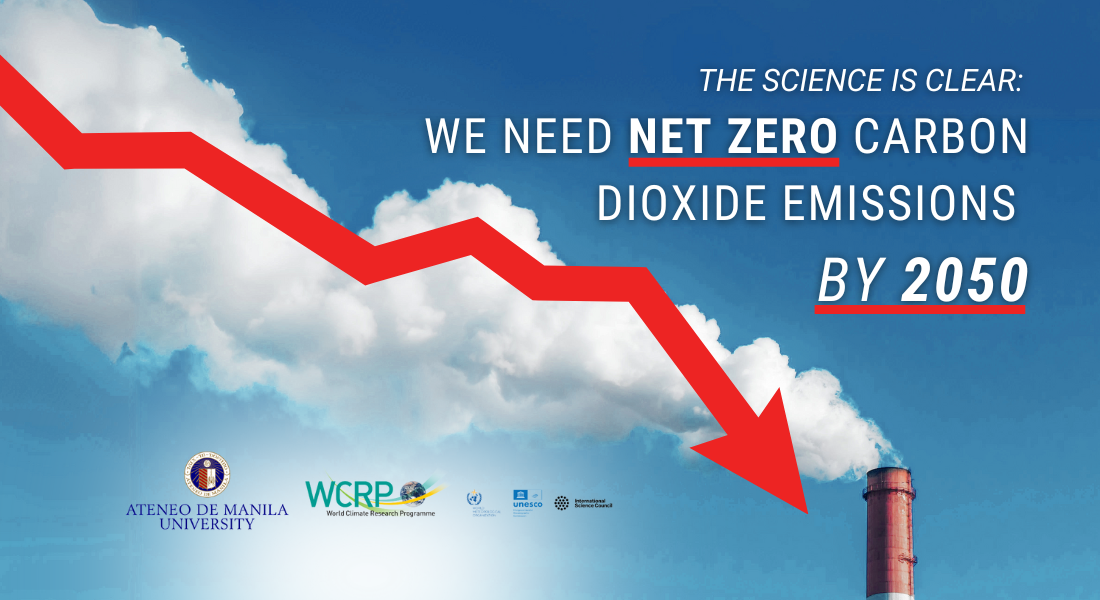
Below is the full text of the statement, with the PDF version accessible here. Scientists and researchers working on climate change may also add their names to the signatories by signing the statement here.
THE SCIENCE IS CLEAR: WE NEED NET ZERO CARBON DIOXIDE EMISSIONS BY 2050
For all intents and purposes, moving towards the phase-out of fossil fuel combustion is necessary to keep the 1.5°C goal of the Paris Agreement within reach. Deploying carbon dioxide removal (CDR) at scale, while being judicious about its limitations and trade-offs, will also be necessary to complement the phase out of fossil fuels, as there will be some residual emissions from hard-to-abate sectors.
As assessed by the IPCC, reaching net zero carbon dioxide emissions by 2050 is required to stand a chance of holding global warming to 1.5°C this century. Net zero means that all anthropogenic carbon dioxide emissions are balanced by anthropogenic carbon dioxide removals. Scenarios consistent with this goal require a complete phase-out of coal by 2050 and rapid phase-down of oil and gas (halved every decade). After 2050 the world needs to rapidly move into net negative emissions, particularly after a number of decades of 1.5°C overshoot.
The most recent assessments of pathways to limit warming at 1.5°C show that by 2050 all unabated use of coal needs to be completely phased-out, while oil and unabated gas need to be phased down by 60-90%.1 To have a 50% chance of holding the global temperature increase to 1.5°C, we can only emit another 275 Gt of carbon dioxide.2 At current emissions rates, we will have used up this budget in just 7 years. Over its lifetime, the existing infrastructure for the extraction and use of fossil fuels would emit more than the world’s remaining carbon budget. New planned infrastructure and exploration for new fossil fuel reserves would exceed this budget many times over.3
All modeling scenarios that limit warming to 1.5°C - with or without a temporary temperature overshoot - rely on carbon dioxide removal (CDR) in order to achieve net zero emissions by 2050 and net negative emissions from 2050 onwards. Current CDR methods amount to about 5% of fossil fuel emissions and rely almost entirely on using nature to enhance carbon storage, but the permanence and scale-up potential of these nature-based CDR methods are uncertain as they are vulnerable to multiple threats including climate change (e.g. due to increases in extremes such as droughts or wildfires). There are also significant trade-offs with food and water security and the protection of biodiversity.
Novel, technology-based, CDR methods currently provide just 0.1% of CDR from the atmosphere4 (this includes direct air capture and storage, bioenergy with carbon capture and storage). Novel CDR is just now moving from pilot experiments into its scaling phase and while theoretically promising there is no evidence yet that these methods can be deployed at the scale needed. Nor do we know whether these CDR methods will be enough to remove even the difficult-to-abate emissions in a timely manner.
Given the certainty about the shrinking carbon budget, and the overwhelming uncertainty about the scalability of CDR, the only certain way to curb global warming and reach net zero is to reduce fossil fuel emissions to the unavoidable minimum level - and concurrently invest in CDR to offset the remaining amount of residual fossil fuel emissions. This residual needs to be kept as low as possible in view of the uncertainties of scale, storage timescale, and trade-offs associated with CDR.
The natural carbon sinks beyond human activity are not included in the net zero equation. The remaining carbon budget already factors in the continued performance of natural land and ocean carbon sinks to remove a significant fraction of anthropogenic emissions (also accounting for their declining efficiency in a warmer world).
The science is clear: there is no room for ambiguity on the required action for achieving net zero carbon dioxide emissions by 2050.
References
1 IPCC, 2023: Climate Change 2023: Synthesis Report. Contribution of Working Groups I, II and III to the Sixth Assessment Report of the Intergovernmental Panel on Climate Change [Core Writing Team, H. Lee and J. Romero (eds.)]. IPCC, Geneva, Switzerland, 184 pp., https://www.ipcc.ch/report/ar6/syr/
IEA. (2021). Net Zero by 2050—A Roadmap for the Global Energy Sector. International Energy Agency. https://www.iea.org/reports/net-zero-by-2050
IEA. (2023). Net Zero Roadmap: A Global Pathway to Keep the 1.5 °C Goal in Reach - A renewed pathway to net zero emissions. International Energy Agency. https://www.iea.org/reports/net-zero-roadmap-a-global-pathway-to-keep-the-15-0c-goal-in-reach
2 Friedlingstein et al, Global Carbon Budget 2023, Earth Syst. Sci. Data, 15, 1–69, 2023
https://doi.org/10.5194/essd-15-1-2023
3 IPCC AR6 Synthesis report (2023), IEA (2021, 2023), and
UNEP (2023). Emissions Gap Report 2023: Broken Record – Temperatures hit new highs, yet world fails to cut emissions (again). Nairobi. https://doi.org/10.59117/20.500.11822/43922
SEI, Climate Analytics, E3G, IISD, and UNEP. (2023). The Production Gap: Phasing down or phasing up? Top fossil fuel producers plan even more extraction despite climate promises. Stockholm Environment Institute, Climate Analytics, E3G, International Institute for Sustainable Development and United Nations Environment Programme. https://doi.org/10.51414/sei2023.050
Additional references on existing fossil fuel infrastructure:
- Tong, et al. (2019). Committed emissions from existing energy infrastructure jeopardize 1.5 °C climate target. Nature, 572, 373–377. https://doi.org/10.1038/s41586-019-1364-3
- Trout, et al. (2022). Existing fossil fuel extraction would phase out world beyond 1.5 °C. Environmental Research Letters, 17(6), 064010. https://doi.org/10.1088/1748-9326/ac6228
Additional references on proposed/potential new fossil fuel infrastructure:
- Kühne, et al. (2022). “Carbon Bombs”—Mapping key fossil fuel projects. Energy Policy, 166, 1–10. https://doi.org/10.1016/j.enpol.2022.112950
- Byers, et al. (2022). AR6 Scenarios Database (1.0) [Data set]. Zenodo. https://doi.org/10.5281/zenodo.5886912
4 Smith. et al. (2023). The State of Carbon Dioxide Removal - 1st Edition. https://www.stateofcdr.org
Writing team:
Pierre Friedlingstein, University of Exeter, UK
Sophie Hebden, Future Earth, Sweden and European Space Agency, UK
Daniel Ospina, Future Earth, Sweden
Julia Pongratz, Ludwig-Maximilians-Universität in Munich, Germany
Johan Rockström, PIK, Germany
Detlef Stammer, Universität Hamburg, Germany
a Sultan Al Jaber's remarks were made at a SHE Changes Climate Event, a live online event on 21 November in the lead-up to COP28. Al Jaber engaged in a heated conversation with Mary Robinson, Chair of The Elders group, former President of Ireland, and a former UN Special Envoy for Climate Change. The full recording of the 8-hour event is available here.
This statement has been covered in the New York Times.
Recent News
You may also like these articles

ASOG’s Tobacco Control initiatives spotlighted in DOH National Technical Working Group for Tobacco Prevention and Control
On March 10 to 12, 2026, the Ateneo School of Government (ASOG), through its research and public policy unit, the Ateneo Policy Center, participated in

Why can’t we eradicate tuberculosis? AIS dissects the TB issue in a multidisciplinary panel
On 24 March 2026, the Ateneo Institute of Sustainability (AIS), through its Sustainable Development Goals (SDGs) Program, hosted a multidisciplinary panel in observance of World
AIS links with Masungi for systems thinking for environmental management
Last 23-24 March 2026, the Ateneo Institute of Sustainability (AIS) , which manages the My Climate Risk – Ateneo de Manila University Regional Hub

BIR and Ateneo sign MOU for academic cooperation and research collaboration
The Bureau of Internal Revenue (BIR) and Ateneo de Manila University recently signed a memorandum of understanding (MOU) for academic cooperation and research collaboration. The

QS Subject Rankings 2026: Ateneo in top 100 for theology; ranked in 7 subject areas
Ateneo de Manila University is among the top institutions in seven subject areas, and among the top 100 for theological and religious studies, according to

ASOG meets with Department of Health—Bureau of International Health Cooperation to strengthen institutional partnership
On 27 February 2026, the Ateneo School of Government (ASOG), through its research and public policy unit, the Ateneo Policy Center, held a courtesy meeting