MCR-Ateneo and CORDEX-SEA collaborate on climate resilience workshop
03 Oct 2025 | By Dhea Amante and Lyzter Deuda




The Climate and Disaster Resilience (CDR) Program of the Ateneo Institute of Sustainability (AIS), representing the My Climate Risk – Ateneo de Manila University Regional Hub (MCR-Ateneo), collaborated with the Coordinated Regional Climate Downscaling Experiment-Southeast Asia, or CORDEX-SEA, last 19 to 21 August. MCR and CORDEX-SEA are both under the World Climate Research Programme (WCRP), with the former being a Lighthouse Activity and the latter a Programme.
The collaboration centered on the organization of a technical and stakeholder workshop for the project titled "Climate hazard Assessment to enhance Resilience against climate Extremes for Southeast Asian megacities' (CARE for SEA megacities), which was held at the BMKG Auditorium in Jakarta, Indonesia. The three-day event gathered researchers, policymakers, and sectoral representatives from across Southeast Asia to exchange insights on how climate information can be better downscaled, shared, and applied at the urban level.
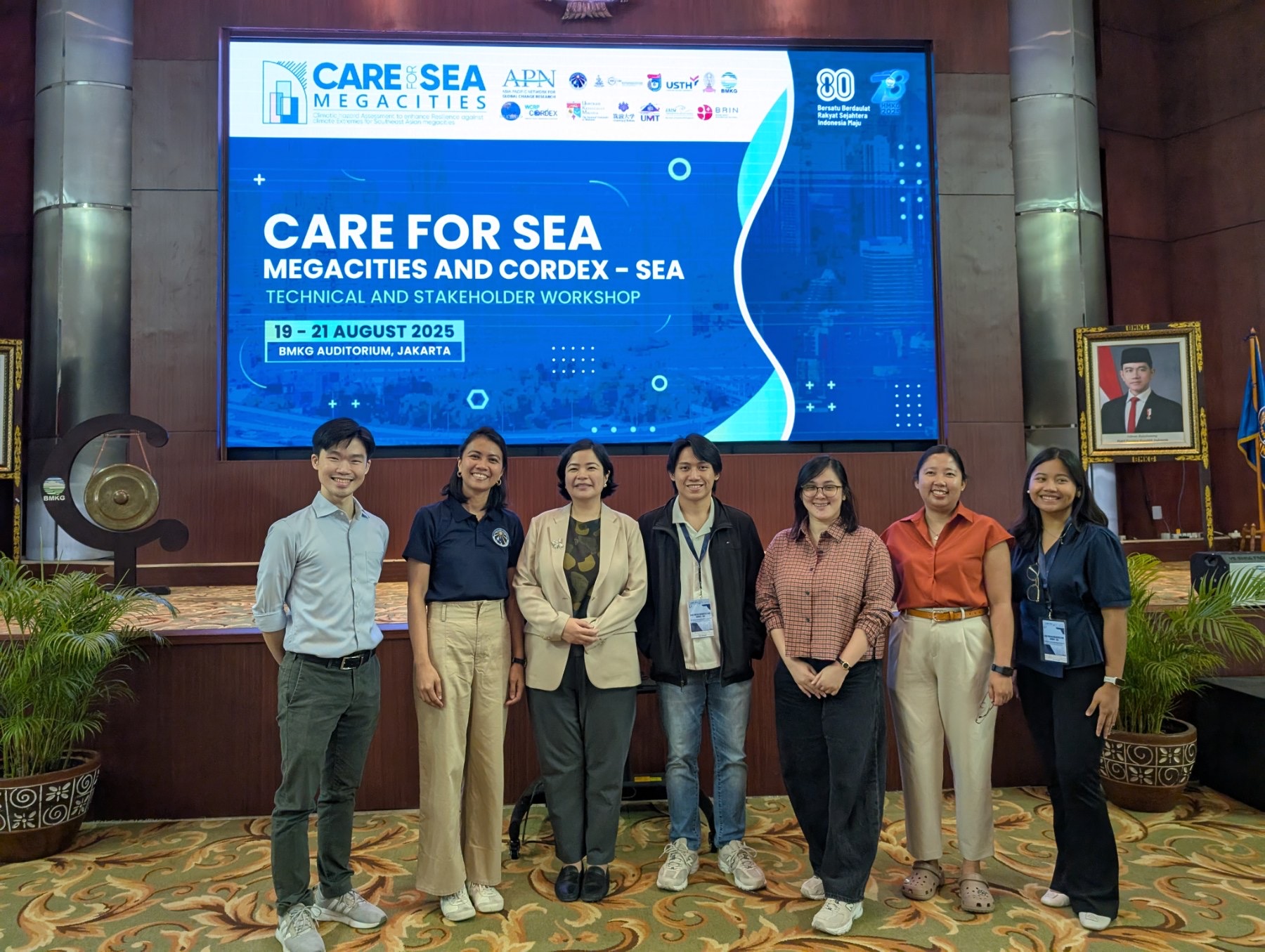
The CARE for SEA megacities project is funded by the Asia-Pacific Network for Global Change Research (APN), and is the latest activity under the Southeast Asia Regional Climate Downscaling / Coordinated Regional Climate Downscaling Experiment Southeast Asia (SEACLID/CORDEX-SEA) collaboration. The project is led by Dr Faye Abigail Cruz, Head of the Regional Climate Systems Laboratory of the Manila Observatory and Collaborator of the MCR-Ateneo Hub, and seeks to generate city-scale climate hazard information for Southeast Asian megacities, an essential resource for strengthening resilience in a globally warmer future.
Over the course of the workshop, participants shared updates on urban climate downscaling activities, highlighting how urbanization and land-use changes are driving higher minimum, average, and maximum temperatures in Southeast Asia’s largest cities. Participants from the Manila Observatory, Mr Enrico Taña, and Ms Jennifer Tibay, also presented their research, in a session moderated by Dr Julie Dado from the Observatory’s Regional Climate Systems Laboratory. Alongside this, progress in CORDEX-SEA’s CMIP6 downscaling efforts was presented, with initial results showing that the region is projected to experience warmer nights during December-February, hotter days during June-August, and wetter wet seasons overall. While regional climate models showed improved performance in some dry-season simulations, challenges such as wet and cold biases remain, emphasizing the importance of using multiple scenarios and correction methods.
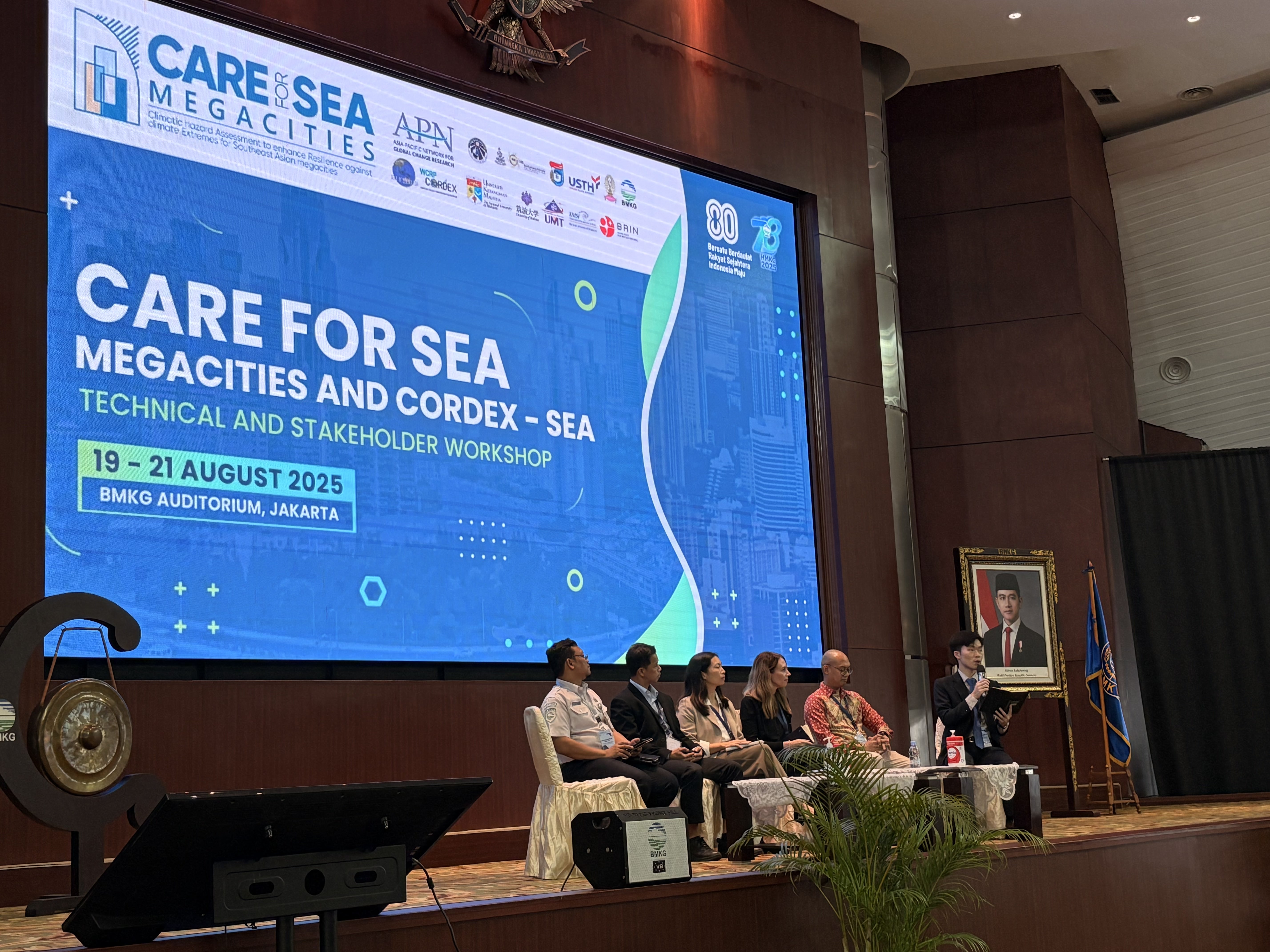
Equally important was the collaborative dialogue between researchers and stakeholders. Mr Daniel C Ratilla, Program Head of CDR and Focal Point of the MCR-Ateneo Hub, moderated the panel discussion on using climate information to support climate action, which brought together experts from the impact sectors of disaster risk reduction, vector-borne diseases, heat health, and water, to share their experiences in applying climate information. Ms Ivy Geraldine D Ferrer, Program Officer for CDR, served as rapporteur for the same session. This was followed by a World Café dialogue, facilitated by Dr Ma. Laurice Jamero, Resilience Coordinator of the Manila Observatory and a Collaborator of the MCR-Ateneo Hub. Dr Jamero also serves as Manager of the Support Unit for the WCRP Academy.
Sessions such as the World Café and poster presentations allowed participants to co-develop ideas for tailored climate products, to make climate information more accessible and impactful. Stakeholders emphasized these dimensions, as climate information must not only be scientifically robust but also practical—delivered through accessible portals, translated into local languages, and relevant or adaptable to different sectoral needs.
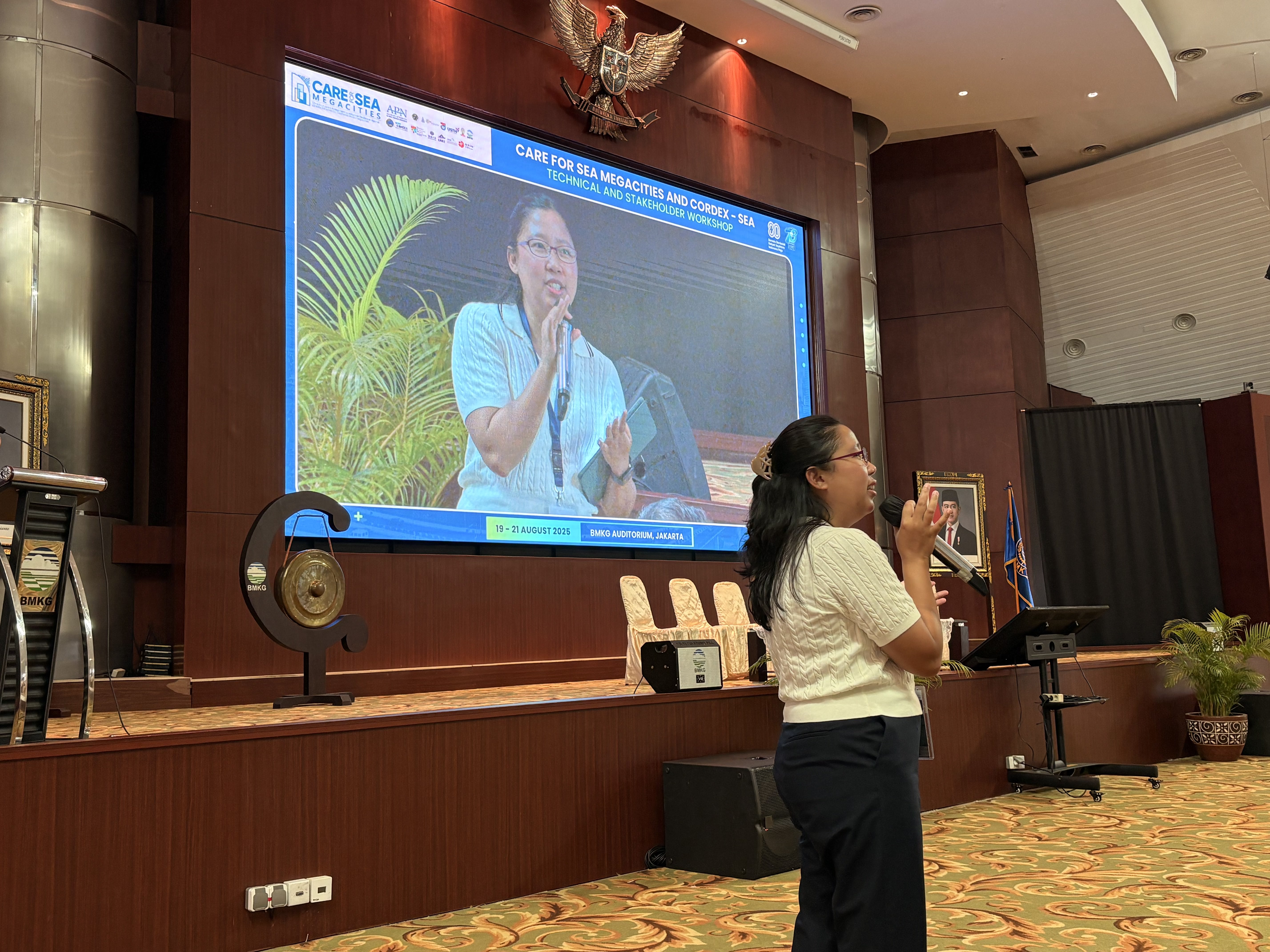
The workshop emphasized the importance of bridging science and practice that requires co-production of knowledge, where scientific expertise and local realities inform each other, and where stakeholders are able to provide inputs into the production of climate information. This approach resonates with the aims of My Climate Risk, to develop and mainstream a bottom-up approach to regional climate risk. This collaboration between MCR and CORDEX-SEA integrates the strengths of both activities of the WCRP, shifting towards a more collaborative approach to producing and delivering climate information. By bridging the worlds of research and practice, researchers and advocates can leverage climate science as a practical tool for building safer, more resilient communities.
Recent News
You may also like these articles
Why can’t we eradicate tuberculosis? AIS dissects the TB issue in a multidisciplinary panel
On 24 March 2026, the Ateneo Institute of Sustainability (AIS), through its Sustainable Development Goals (SDGs) Program, hosted a multidisciplinary panel in observance of World
AIS links with Masungi for systems thinking for environmental management
Last 23-24 March 2026, the Ateneo Institute of Sustainability (AIS) , which manages the My Climate Risk – Ateneo de Manila University Regional Hub
Mangroves as shields of history and resilience: Insights from Dr Emma Porio
Mangrove forests have long shaped both the history and survival of coastal communities in the Philippines. According to Dr Emma Porio, Professor Emeritus (Sociology -
Professor Emeritus Dr Emma Porio to deliver keynote address at Regional Dialogue: Schools Climate Action Project
Dr Emma Porio, Professor Emeritus at Ateneo de Manila University's Dr Rosita G Leong School of Social Sciences (RGLSOSS) and Lead Author of UNFCCC-IPCC Climate
Klim@Musika
For most Filipinos, music is inseparable from daily existence. Music playlists accompany Filipinos in their commutes be it through walks, jeepneys, trains, or their private
The heART of Sustainability: AIS concludes month-long celebration of National Arts Month
With the desire to make sustainability more accessible and promote its interdisciplinarity, the Ateneo Institute of Sustainability (AIS) hosted a month-long National Arts Month celebration