AUN-EEC holds online networking sessions for member institutions
19 Dec 2025


The ASEAN University Network on Ecological Education and Culture (AUN-EEC) organized a series of online networking sessions entitled “I LINK U: The AUN-EEC Mixer” on 24 October, 12 November, and 13 November 2025. The networking sessions came at a milestone moment for AUN-EEC, as they welcomed five new member institutions this year, bringing the total membership to 51.
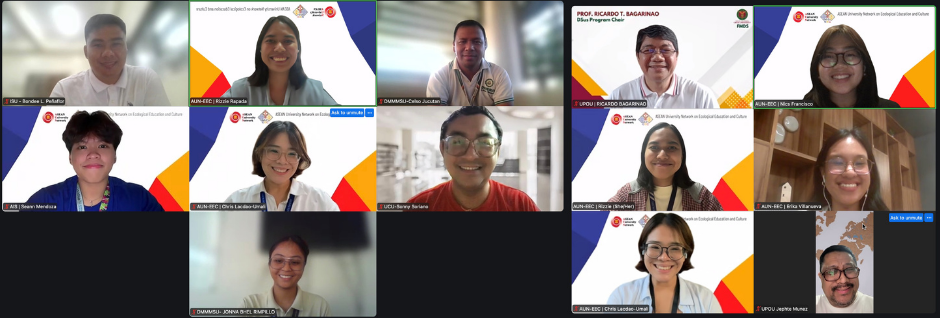
Designed as a space for connection and exchange, the mixer brought together representatives from member institutions to share their respective contexts, experiences, and ongoing initiatives in ecological education and culture, while also exploring opportunities for partnerships and collaborations. Across the three sessions, both academic and student-led institutions, from the Philippines and the ASEAN region were represented. Participants included higher education institutions such as the University of the Philippines Open University (UPOU), Don Mariano Marcos Memorial State University (DMMMSU), and the National University of Singapore (NUS); as well as student organizations such as the Philippine Normal University (PNU) Geografika.
Through small group discussions in breakout rooms, it became apparent that, despite persistent challenges, the work of ecological education and culture is very much alive across the ASEAN region. Participants shared a wide range of sustainability efforts that their institutions are spearheading. These range from awareness campaigns to research, conservation work, and on-the-ground initiatives both within and beyond their campus grounds. Many institutions emphasized adopting a whole-of-society approach, engaging not only their students but also local communities and government units in their sustainability efforts. While approaches and implementation vary across institutions, it is evident that the member institutions are committed to integrating environmental sustainability into their teaching, research, and engagement with the community.
However, commitments, no matter how deeply rooted, are not immune to obstacles. Financial constraints emerged as a major concern for almost all participating institutions. While it may be easy to generate ideas and formulate action points for sustainability initiatives, the extent of the execution and management of such initiatives is largely contingent on the availability of funds and resources. Unfortunately, several institutions, particularly smaller ones, struggle with finding and/or obtaining funding opportunities such as grants and investments. Administrative challenges, both internal and external, were also raised. State universities, for instance, often navigate bureaucratic processes tied with ordinances at the local and national levels. Private institutions likewise encounter internal administrative hurdles or differing systems and culture among partner organizations. Sustaining engagement and broadening participation, especially in the long term are also challenges that institutions continue to grapple with in their initiatives.
Despite these constraints, the sessions were marked by optimism and a strong sense of revolve, especially as participants explored possible opportunities for collaboration. Joint research projects, co-authored publications, and the co-organization of sustainability initiatives are only some of the concrete partnership prospects that were discussed. Participants also exchanged contact information for continuing communication and linkages beyond the three mixer sessions.
Overall, the discussions underscored the value of sustained dialogue and collective action in strengthening ecological education and culture across the ASEAN region.
The networking session was organized by the secretariat of the AUN-EEC, housed at the Ateneo Institute of Sustainability.
Recent News
You may also like these articles
Why can’t we eradicate tuberculosis? AIS dissects the TB issue in a multidisciplinary panel
On 24 March 2026, the Ateneo Institute of Sustainability (AIS), through its Sustainable Development Goals (SDGs) Program, hosted a multidisciplinary panel in observance of World
AIS links with Masungi for systems thinking for environmental management
Last 23-24 March 2026, the Ateneo Institute of Sustainability (AIS) , which manages the My Climate Risk – Ateneo de Manila University Regional Hub
Mangroves as shields of history and resilience: Insights from Dr Emma Porio
Mangrove forests have long shaped both the history and survival of coastal communities in the Philippines. According to Dr Emma Porio, Professor Emeritus (Sociology -
Professor Emeritus Dr Emma Porio to deliver keynote address at Regional Dialogue: Schools Climate Action Project
Dr Emma Porio, Professor Emeritus at Ateneo de Manila University's Dr Rosita G Leong School of Social Sciences (RGLSOSS) and Lead Author of UNFCCC-IPCC Climate
Klim@Musika
For most Filipinos, music is inseparable from daily existence. Music playlists accompany Filipinos in their commutes be it through walks, jeepneys, trains, or their private
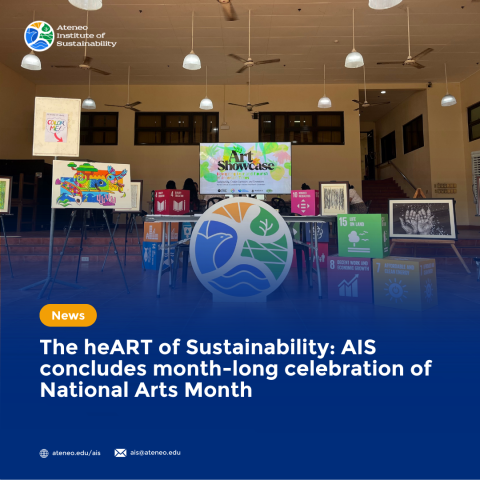
The heART of Sustainability: AIS concludes month-long celebration of National Arts Month
With the desire to make sustainability more accessible and promote its interdisciplinarity, the Ateneo Institute of Sustainability (AIS) hosted a month-long National Arts Month celebration