AUN-EEC and ANU Philippines Institute explore next steps on doing business within boundaries
16 Feb 2026 | by Riza Maree Rapada






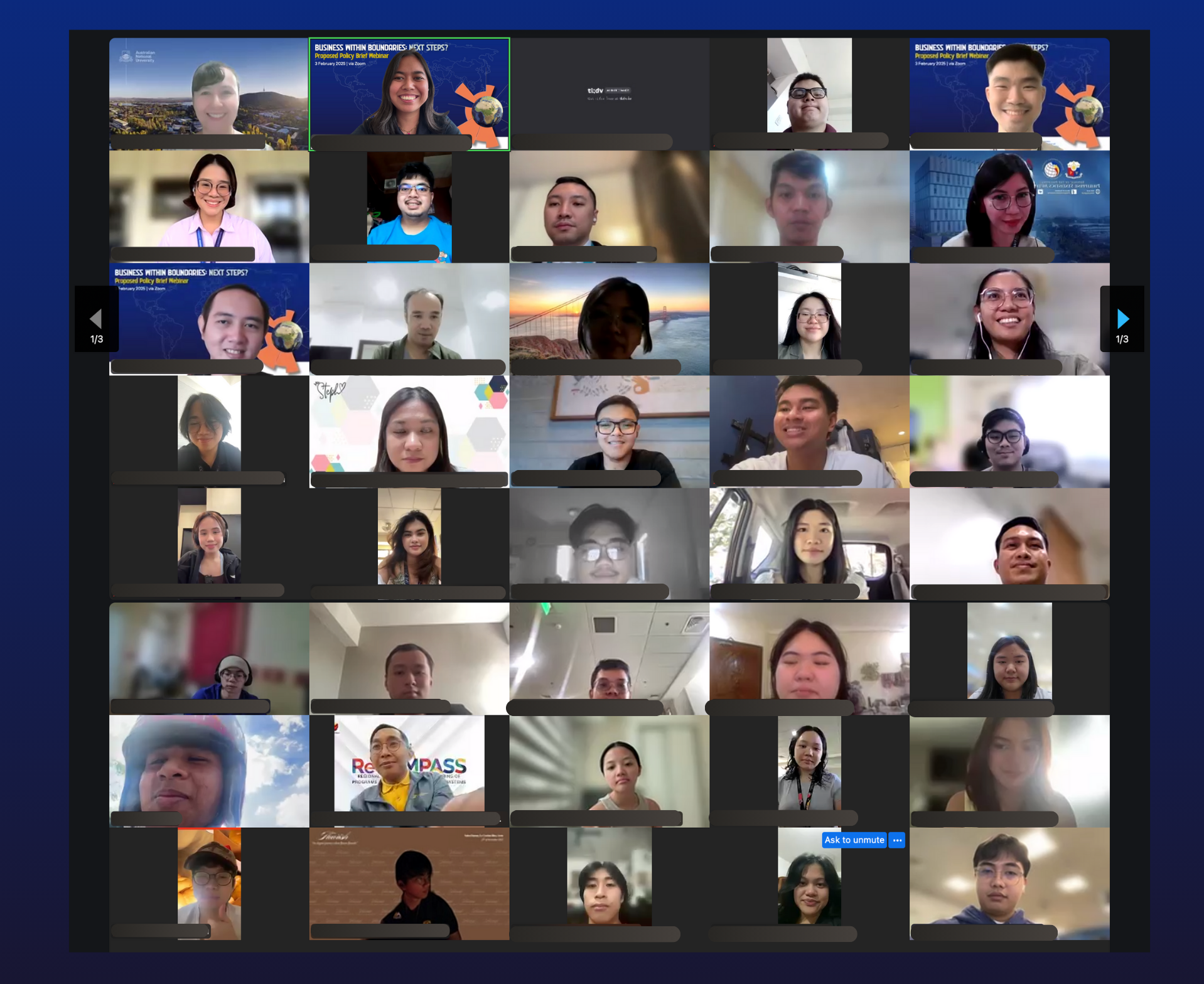
Last 3 February 2026, the ASEAN University Network on Ecological Education and Culture (AUN-EEC) and the Australian National University (ANU) Philippines Institute held a webinar entitled “Business within Boundaries: Next Steps”. The event discussed concrete steps that institutions across different sectors can take to make business operations more sustainable and resilient.
Dr Charlotte Kendra Gotangco Gonzales, Research Fellow at the ANU Philippines Institute and Associate Professor at the Ateneo de Manila University, led the discussion with a presentation of the policy brief developed from the insights and outputs of the multi-stakeholder and systems workshop in November 2025.
According to Dr Gotangco Gonzales, at present, sustainability reporting in the country is still in its early stages. Current efforts are marked by the need to strengthen organizational capacities, address challenges such as greenwashing, and shift toward double materiality. These conditions present opportunities to align sustainability targets with the domains of the planetary boundaries and global agreements, such as the Kunming-Montreal Global Biodiversity Framework. She also emphasized that institutional targets can be refined by incorporating local needs and vulnerabilities.
Dr Gotangco Gonzales then highlighted the Pentahelix Model as a framework for a whole-of-society approach to ecological action. Under this model, each of the five sectors: academe, government, private institutions, NGOs and CSOs, and the media, play distinct but complementary roles. For one, academic institutions can capitalize on their research and outreach functions to work with sectors to establish a common language, standards, and values in sustainability reporting. In addition, the academe and media work in tandem to ensure that accurate information is accessible to different stakeholders. The media, in particular, plays a critical role in promoting transparency and preventing greenwashing.
Within the private sector, she underscored the need for a paradigm shift from focusing solely on financial materiality to also addressing impact materiality. She echoed the potential of establishing an “industrial symbiosis”, a network of private sector representatives in advancing sustainability through a circular economy. There is also growing interest in exploring alternative systems inspired by traditional and indigenous knowledge, as well as including nano-, micro-, small, and medium-sized enterprises that have smaller ecological footprints, but remain significantly vulnerable to disruptions brought by breaches in the planetary boundaries.
On the public sector side, while national governments are responsible for setting policies, local governments are key players in contextualizing and operationalizing these policies. They are also in the best position to convene public-private joint ventures across the different sectors. Meanwhile, NGOs and CSOs act as catalysts, bridging service gaps, advancing advocacy, and connecting stakeholders and communities.
A whole-of-society approach requires collaboration not only across sectors in the Pentahelix Model, but also across generations and across borders. Such a principle is reflected in the policy brief’s recommendations, such as implementing capacity-building programs on the planetary boundaries framework in relation to organizational and community applications. The recommendations also call for the development and testing of metrics and tools that connect local vulnerabilities and targets with global sustainability goals. In addition, consolidating sustainability data across sectors and regions can better inform private sector decision-making and public sector development planning.
Transitioning business operations to stay within planetary boundaries is no easy task, especially amid persistent business-as-usual practices. However, worsening ecological pressures demand a decisive paradigm shift. As Dr. Emmanuel D. Delocado, Executive Director of AUN-EEC and Director of AIS, emphasized in his welcome remarks, “The best time to act was yesterday. The second best time is now.”
The event was funded by the ANU Philippines Institute, with support from the Australian Research Council (ARC) through Discovery Project DP230101280 and the ARC Future Fellowship Program. It was co-organized by the Fenner School of Environment and Society of ANU and the Ateneo Institute of Sustainability.
Recent News
You may also like these articles
Why can’t we eradicate tuberculosis? AIS dissects the TB issue in a multidisciplinary panel
On 24 March 2026, the Ateneo Institute of Sustainability (AIS), through its Sustainable Development Goals (SDGs) Program, hosted a multidisciplinary panel in observance of World
AIS links with Masungi for systems thinking for environmental management
Last 23-24 March 2026, the Ateneo Institute of Sustainability (AIS) , which manages the My Climate Risk – Ateneo de Manila University Regional Hub
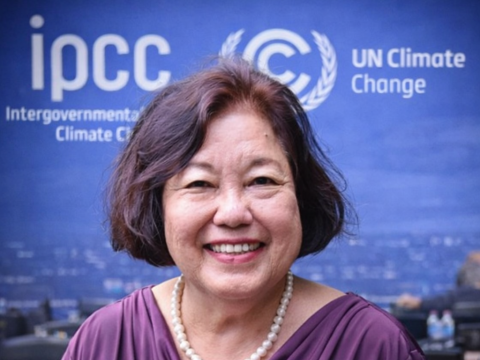
Mangroves as shields of history and resilience: Insights from Dr Emma Porio
Mangrove forests have long shaped both the history and survival of coastal communities in the Philippines. According to Dr Emma Porio, Professor Emeritus (Sociology -
Professor Emeritus Dr Emma Porio to deliver keynote address at Regional Dialogue: Schools Climate Action Project
Dr Emma Porio, Professor Emeritus at Ateneo de Manila University's Dr Rosita G Leong School of Social Sciences (RGLSOSS) and Lead Author of UNFCCC-IPCC Climate
Klim@Musika
For most Filipinos, music is inseparable from daily existence. Music playlists accompany Filipinos in their commutes be it through walks, jeepneys, trains, or their private
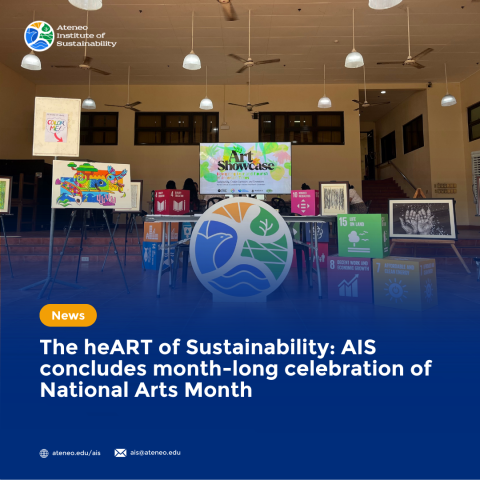
The heART of Sustainability: AIS concludes month-long celebration of National Arts Month
With the desire to make sustainability more accessible and promote its interdisciplinarity, the Ateneo Institute of Sustainability (AIS) hosted a month-long National Arts Month celebration