"Do no harm, do good, do great." (ASMPH Batch 2025 Commencement Speech)
05 Sep 2025

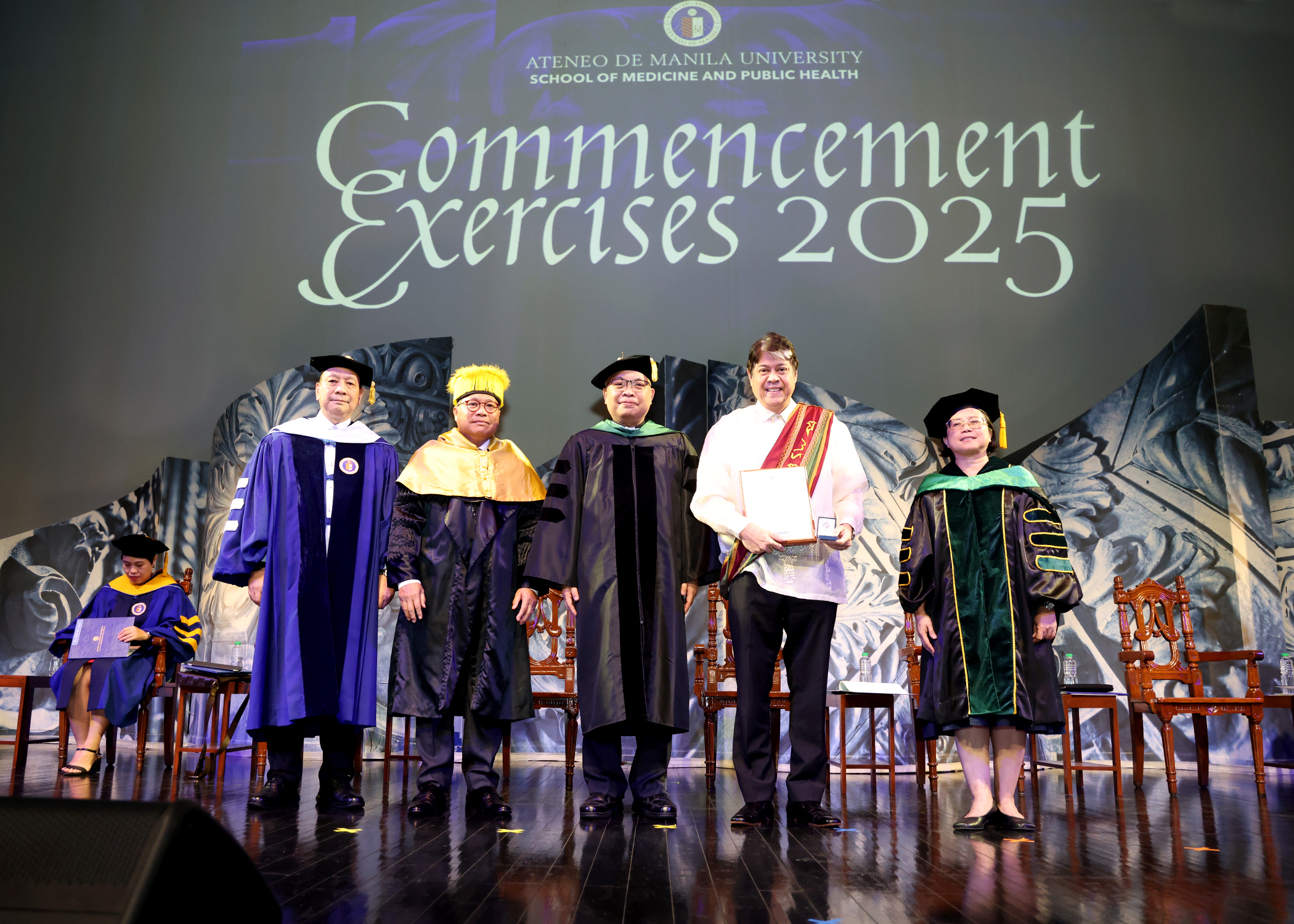
Read the commencement speech of Sen Francis "Kiko" Pangilinan, during the commencement exercises for the Ateneo School of Medicine and Public Health 2025 on 30 August 2025.
Watch the video of his speech here: https://www.facebook.com/share/v/1AXabc2jc9/

Fellow Katipuneros, good afternoon.
I’m happy to be here in Ateneo. Not many are aware that I taught in Ateneo from 1993 to 2000 in the then Department of Management teaching Legal Management.
Maligayang pagtatapos at congratulations to our new medical doctors! Welcome to the so-called real world!
In the real world of the Philippine medical system, you will meet Jino, a seafarer who used to work on board a Norwegian fuel tanker. When he got cancer, he stopped working. The wife sold the car and pawned her jewelry. They are up to their neck in debt. You will see that the middle class is one illness away from poverty.
Families like Jino’s who imagine themselves “safe” are not. Household out-of-pocket spending still covered about 44% of all health expenditures in 2023—a level that exposes the middle class to catastrophic health spending when a prolonged stay in the ICU or cancer or stroke hits. In these situations, I have seen families sell the car, pawn the last piece of jewelry, and finally mortgage the house. This cannot be how a decent society funds survival.
In the real world of the Philippine medical system, you will also meet Ben, the Ilocano tricycle driver with a crushing chest pain who eventually dies even after reaching the hospital, because the hospital doesn’t have a functioning ECG.
You will meet baby Gina, the newborn from the far-flung barangay in Surigao whose life was cut short because the transfusion she needed never came.
You will meet Presy, the lola from Bohol who breathed her last because the health center ran out of epinephrine.
Jino, Ben, baby Gina, and Lola Presy represent the overwhelming majority of Filipinos, for whom the cost of health care is life-threateningly and impoverishingly steep. Nakakamatay. Nakakapulubi.
As you new graduates underwent the OSI (Organ System Integrated) approach to medical education with a Master’s Degree in Public Health, perhaps you may be more than familiar with the statistics: the Philippines has deficit of at least 190,000 physicians, nurses, midwives, and other healthcare workers nationwide, especially in public facilities.
Our public hospitals are crowded. At the Jose Fabella Memorial Hospital in Manila, which has earned the nickname "baby factory," four to five mothers share one bed during busy times. Both patients and medical professionals suffer long waiting times, including bureaucratic delays in insurance reimbursement and support of medical services. Hello, Philhealth. Hello, HMOs.
Many doctors migrate abroad for better opportunities. And the ones who remain suffer the persistent shortages, as well as physical and mental burnout. Health emergencies and epidemiological threats like the COVID-19 pandemic, HIV, and the recent flood-caused leptospirosis spike put extra pressure on our already burdened public health system. Health facility budgets account for less than 1% of the national budget, with only 14.8 billion pesos allocated to hospitals and health centers in 2025—far below the country's growing population and health needs.
And finally, if not most importantly, corruption, politicized budget decisions, and inefficient governance further impede equitable health access. 14.8 billion for hospitals and health centers in 2025.
Dr Jose Rizal, the Ateneo alum and ophthalmologist, saw the social cancer of colonialism that afflicted the Philippines in the late 1800s. It was a cancer marked by corruption, oppression, injustice, cruelty. The social cancer continues to haunt us. For the average Filipino who has to wade through floods after paying and indebting even his grandchildren and great-grandchildren for faulty or poorly designed, if existing, flood-control projects, Humihingi po ako ng paumanhin, nahuli po ako dahil binaha at natrapik po ako.
It is back for the average Filipino who has to suffer indignities in his everyday commute, in his daily pittance of a minimum wage, in the watery soup of instant noodles that he feeds his children. In Rizal's Noli Me Tangere, he wrote of the Philippines’ “cancer so malignant, the least touch irritates it and awakens in it the sharpest pains.” Literally meaning touch me not, his novel created a generation woke to the country’s affliction that cannot be treated painlessly.
Again, I trust your systems approach medical education may help you rightfully diagnose what ills not just the patient, or the public health system, but also the larger society in which we all live. I pray that you will not just heal your patients, but work towards healing what ails our nation.
We have all heard Cardinal Pablo David’s story of the young altar boy in Caloocan who lost his life to leptospirosis while in search for his father who was nabbed and transferred from one precinct to another by the police for allegedly playing small-time gambling Cara Y Cruz in their neighborhood. Sabi nga sa isang post tungkol dito, pag mahirap kulong agad, pag daan-daang bilyon ang ninanakaw, nananalo sa halalan.
Sadly, this is not the only time that the healthcare of our countrymen has been affected by corruption and politics. The zero budget for PhilHealth in 2025 and the unconstitutional transfer of PhilHealth funds—funds that are supposed to cover the healthcare needs of our kababayans. Remember as well the 11-billion-peso Pharmally scam in the midst of the pandemic, where health funds were used to feed the greed of the few, while thousands were dying. That time, the Senate Blue Ribbon Committee recommended the filing of plunder charges over these deals. Later, however, the Ombudsman recommended the downgrading from plunder charges to mere graft cases, bailable by 90 thousand pesos.
Corruption is not a victimless crime. Corruption in health care kills the sick. Every overpriced face shield, every irregular contract, is a bed not bought, a ventilator not delivered, a nurse not hired or paid, a life not saved. Unfortunately, the unconscionable has become normalized. In fact, in the last elections, the unconscionable politicians won.
The call of your profession carries with it immense responsibility: to help the blind see, the lame walk, and those at the brink of death return to life. Without any doubt, to be a doctor is one of the noblest of callings. The life of another rests in your hands. Every patient who enters your care looks to you not only for treatment, but for hope—hope to recover, hope for more time with their families, hope for a chance to live fully once again. You will be their lifeline. Beyond the practice of healing lies the sacred duty to preserve human dignity and life itself.
This afternoon, you graduate not only as physicians but, uniquely, also as managers. It is a rare pairing that speaks to what the Ateneo School of Medicine and Public Health stands for: medicine rooted in science and compassion, management anchored in ethics and systems thinking, and public health animated by faith that does justice. You are, in your alma mater’s own words, “doctors of the future.”
Every commencement is also a thanksgiving. We thank your teachers for demanding both excellence and cura personalis (holistic healing). We thank your parents for the tuition payments, packed baons, and whispered prayers. And, of course, let us thank your classmates — for the shared reviewers, borrowed stethoscopes, and lifetime supply of memories, of camaraderie.
Let us also give thanks to those who came before you—some giants of Filipino medicine: Dr Juan Flavier, the barrio doctor who became Secretary of Health and Senator of the Republic. He proved that public health could both be funny and still be taken seriously. Dr Bobby de la Paz, another doctor to the barrio who treated not just disease but despair—until he lost his life at 29 to a gunman who entered his clinic in Samar. We also celebrate Dr Fe del Mundo, the first Asian and the first woman ever admitted to Harvard Medical School. She founded the first children’s hospital so that no Filipino child need die of something preventable. At a time when women doctors were rare, she shattered ceilings with her intellect and compassion.
So let me make this personal appeal: our country needs you. The Philippines has about one doctor for every 1,250 Filipinos. In rural areas, one doctor may cover entire towns, delivering babies at dawn, treating hypertension at noon, and signing burial certificates by night. In 2022, more than half of all deaths in the Philippines were unattended by a health professional. Imagine: in 14 of 17 regions, Filipinos left this world without seeing a doctor at the end.
The Hippocratic oath orders you to “do no harm.” And if I may add “do good.” Volunteer part-time. One half-day a week in a public clinic. What you lose in Netflix time, you’ll gain in stories richer than any K-drama. Spend a season in the barrios. Ride a banca, a habal-habal, even a carabao to reach patients. When you save a child’s life in a sitio with no signal, you’ll know the true meaning of “unli”—unli gratitude, unli grace. Go full-time in government. Run a district hospital, join PhilHealth, fix procurement so that vaccines for babies are always in stock. As physician-managers, you know that systems don’t heal themselves.
Aside from “do no harm” and “do good”, let me add: do great. I hope that among you, many will be inspired to go further: to pursue advanced studies, engage in research, and tap the wealth of our country’s natural resources. Within our forests, seas, and mountains may lie healing medicines waiting to be discovered, like the anti-cough medicine lagundi, or the the anti-gout tablet derived from ulasimang bato, or more commonly known as pansit-pansitan, or the anti-cholesterol, green siling labuyo. With dedication and innovation, you have the potential to develop medicines that are not only effective but also affordable and accessible to our people. Imagine the impact of transforming the pharmaceutical industry, long dominated by giant multinationals. By harnessing local knowledge and scientific advancement, you can help build a more self-reliant nation—one where quality healthcare and life-saving medicines are within reach of every Filipino. I challenge you: take your Ateneo education, your Ateneo diploma, and bring them where they matter most—in the service of our people, in the service of the least, the lost, and the last.
More than 30 years ago, I was running my daily run here in the Ateneo campus. And as I was running, I came across 2 Jesuit priests who were Indian in ancestry. I understand that it was St Francis Xavier, a Jesuit priest, who went to India to spread the Catholic faith about 500 years ago. I realize at that point as I was running and meeting those priests, I was actually experiencing what St Francis Xavier did 500 years ago. That’s the impact of what individuals can do. 500 years later, you doctors, as you practice your profession, you will affect lives, you will save lives, you will heal the sick. And perhaps 500 years later, what you did, will have an impact, will still have an impact. Do your best, give your all, give your utmost, and 500 years later, the impact will be great!
Congratulations, my dear graduates! This is your one big fight: serve the people. Serve the Philippines.
Magandang hapon sa kanilang lahat at maraming maraming salamat!
Recent News
You may also like these articles
ASOG’s Tobacco Control initiatives spotlighted in DOH National Technical Working Group for Tobacco Prevention and Control
On March 10 to 12, 2026, the Ateneo School of Government (ASOG), through its research and public policy unit, the Ateneo Policy Center, participated in
ASMPH welcomes incoming VPHE, honors the service of VP Marlu Vilches
The Ateneo School of Medicine and Public Health (ASMPH) recently held a transition meeting marking an important leadership shift within the University’s Higher Education cluster
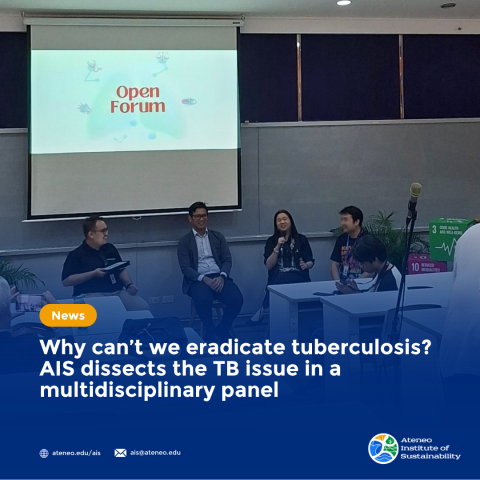
Why can’t we eradicate tuberculosis? AIS dissects the TB issue in a multidisciplinary panel
On 24 March 2026, the Ateneo Institute of Sustainability (AIS), through its Sustainable Development Goals (SDGs) Program, hosted a multidisciplinary panel in observance of World
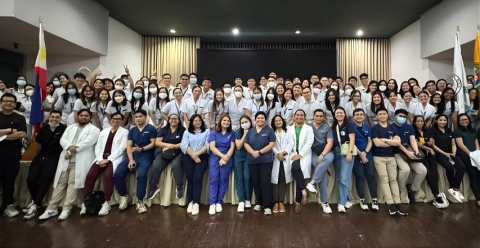
Vertical integration in ASMPH: A shared neurology preceptorial experience
In the Ateneo School of Medicine and Public Health (ASMPH), the commitment to vertical integration continues to grow stronger. This meaningful collaboration brings together YL6
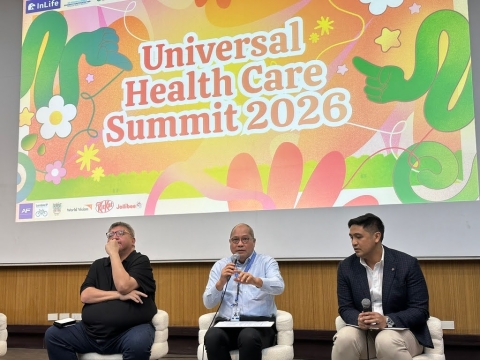
Interweaving disciplines for a healthier future together: Highlights from the UHC Summit 2026
The Rosita G Leong Primary Healthcare Hub (RGL Hub) co-presented the flagship initiative of Project LAAN, the Universal Health Care Summit (UHC Summit), on 14
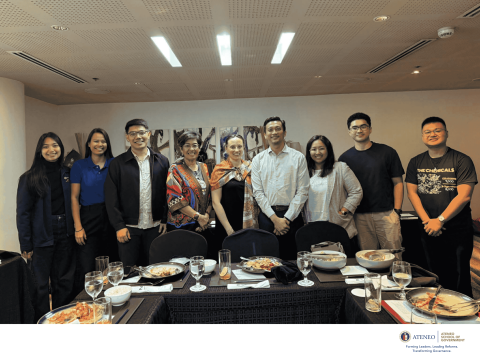
ASOG meets with Department of Health—Bureau of International Health Cooperation to strengthen institutional partnership
On 27 February 2026, the Ateneo School of Government (ASOG), through its research and public policy unit, the Ateneo Policy Center, held a courtesy meeting