MCR-ADMU celebrates Laudato Si’ Week with a Brown Bag Session on “research as care”
27 Jun 2023 | Johanna Camasura and Elian Dominguez



On 23 May 2023, the My Climate Risk – Ateneo de Manila University (MCR-ADMU) Regional Hub, which is hosted by the Ateneo Institute of Sustainability (AIS), organized an event, “MCR Brown Bag Session: ‘Research As Care’”. This event was co-hosted by the Ateneo Research Institute of Science and Engineering (ARISE), and was conducted as part of AIS’ Laudato Si’ Week celebrations, which was particularly meaningful as the institute marks its 10th anniversary this year.
The hybrid event aimed to facilitate discussion among collaborators of the MCR-ADMU Hub from diverse, interdisciplinary backgrounds. This is consistent with the goal of My Climate Risk, a lighthouse activity of the World Climate Research Programme, on developing bottom-up, contextual, and empowering approaches to regional climate risk and pushing these towards the mainstream. This discussion was thus intended to reflect on the paradigm of people-centered climate research and climate research as a form of care, along with existing research methods to this end. The event is also aligned with the Laudato Si’ encyclical on Care for Our Common Home, and Laudato Si’ Goals 1 and 2, or Response to the Cry of the Earth, and Response to the Cry of the Poor, respectively.
The Brown Bag Session featured key speakers Mr Reginald Rex E Barrer of the Ateneo School of Government, Dr May Celine T M Vicente of the Geomatics for Environment and Development Laboratory, Manila Observatory, Dr Emma E Porio of the Department of Sociology and Anthropology, Ateneo de Manila University, and Dr Charlotte Kendra Gotangco Gonzales of the Ateneo Institute of Sustainability.
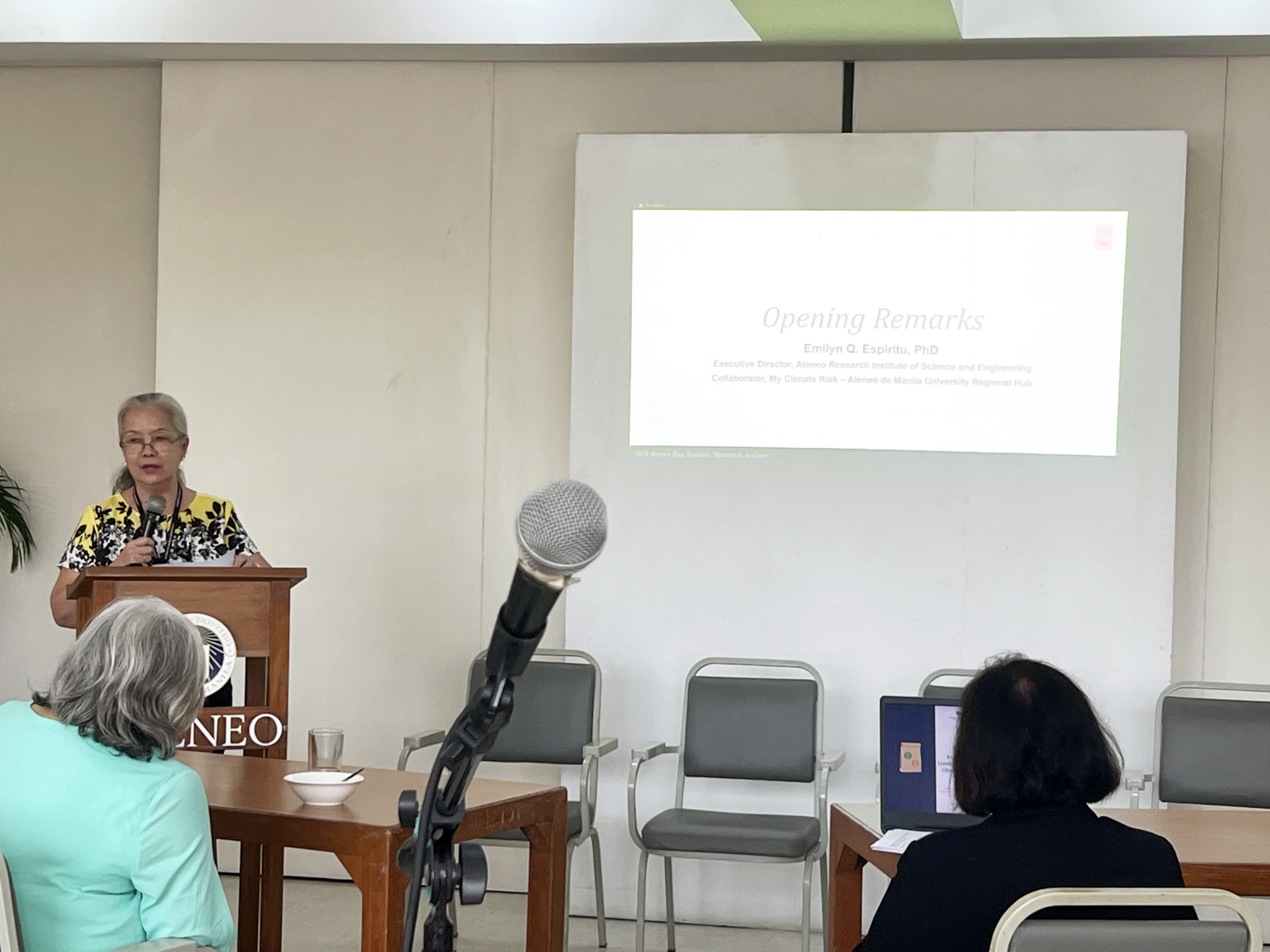
The program began with the Opening Remarks by Dr Emilyn Q Espiritu, Executive Director of ARISE. She explained the idea of “research as care,” touching on what it means for research to be “people-centered” and a form of care. Dr Espiritu also mentioned psychological barriers that deter people from dealing with the climate crisis as a whole: distance, doom, dissonance, denial, and identity. By reframing discussions on climate change, informing others of the opportunities of responding to the crisis, and by being attuned to current realities, present and future challenges, we can address these barriers. These can be achieved, she added, through global collaborations to become responsible stewards of nature. Speaking on behalf of ARISE, Dr Espiritu assured those present that environmental sustainability and disaster response will continue to be part of the research agenda of the School of Science and Engineering, as well as that of the Ateneo de Manila University as a whole.
Each speaker then shared a flash talk, featuring a case study or discussion that touched on the paradigm of “research as care.”
Mr Reginald Rex E Barrer was the first speaker, and he discussed the international perspective while explaining pertinent events in climate governance, which included the Global Stocktake. He also highlighted how 2023 and 2028 were important years in the environmental field; the former marking the halfway point from the start of the Paris Agreement and 2030, and the latter being the year of the next Global Stocktake. Mr Barrer then proceeded to talk about four challenges in climate governance: (1) raising ambition through the operationalization of key climate plans, (2) recognizing the role of science in informing strategies and directions, as this serves as the foundation from which all actions are taken, (3) collaboration with and the capacity of local government counterparts, and (4) sufficient access and meaningful participation of key stakeholders in the implementation of the Paris Agreement.
Additionally, Mr Barrer discussed the linkage among various players in climate governance with a circular diagram, with local governments at the core and international actors at the outermost layer, each influencing the other. Emphasizing the importance of sustainable climate policy from the concentric model, he then stated that such work can be done by enhancing multi-stakeholder participation, resource mobilization, and high-level political engagement, while keeping science at the core of fundamental decisions.
Following this, Dr May Celine T M Vicente introduced her work in geomatics research, which aims to integrate social-environmental themes, emphasizing how spatial analysis work can enable enhanced decision support across sustainable development sectors. She then presented several maps: (1) one showing Palawan’s Environmental Critical Areas Networks (ECANs), which compared the area’s usage every 10 years, and (2) parametric water demand maps, which showed trends for increasing water demand every five years around the urbanized section of Metro Manila. Maps which highlighted various environmental parameters across the National Capital Region were also flashed, covering PM10 concentrations, climate change, rainfall, and temperature anomalies, land use and cover changes, and an informal settlements map, which aimed to integrate the urban poor into the local urban ecosystem. She also emphasized workshops on multiyear poverty maps, which can be brought down to people’s organizations for better integration and negotiations.
Dr Emma E Porio continued with the discussion, highlighting her work with marginalized communities, which involved measuring risk arrangements through surveys and focus group discussions (FGDs). Her take on “research as care” meant empowering, connecting, and including all marginalized groups, children, PWDs, elderly, and the LGBTQIA+, and analyzing their exposure and vulnerability to climate change impacts. Moreover, she discussed two partner communities she had worked with: a group of women affected by Typhoon Ketsana (local name Ondoy) floods, who moved to Valenzuela City and supported themselves by selling fruits and vegetables, and a National Service Training Program (NSTP)-partnered community who used HazardHunterPH for their risk profiling. From these, she highlighted the importance of local knowledge systems and perspectives, and how they should lead to transformative climate adaptation and community resilience.
Citing intersectional, vertical, and horizontal strategies of transformation, Dr Porio also stated fundamental transdisciplinary action research (TDR) principles: (1) co-generation of knowledge with stakeholders, (2) co-creation of capacities with scientists, professionals, and practitioners, and (3) co-ownership with stakeholders. She then concluded by stating that people should always be at the forefront for transformative adaptation – by connecting and including them at all times.
Afterwards, Dr Kendra Gotangco Gonzales discussed person-centered research, where people become active participants in the learning and development process. She cited how these have proven useful in both the school system and the medical field, and how these can be applied in the concept of “research as care.” Fundamentally, she highlighted how the quality and aim of being enabling – or, borrowing from Dr Porio’s flash talk, empowering – should always be at the forefront of person-centered research, to develop solutions for personalized needs.
Dr Gotangco Gonzales then proceeded to discuss what she called the “3 Rs to Rethink Research”: (1) Respecting “expertise”, (2) Recognizing context, and (3) Reimagining and reconfiguring institutions. With the concept of respecting “expertise,” she highlighted that this recognized the existence of expertise everywhere, even in farmers who are typically considered “beneficiaries” in their work. Here, she mentioned a point from a talk by Fr Jose Ramon T Villarin SJ on open science, which is driven by social concerns and done with stakeholders. Next, she stated how recognizing context was also fundamental. Even if other outputs show aggregate impacts and indicators, these must be complemented by finer-scale analysis and more bottom-up approaches. Dr Gotangco Gonzales also highlighted the need for local communities to grapple challenges beyond the physical aspects, especially in terms of climate. However, she also mentioned challenges such as political conflict, policy gaps, and insufficient resources and that it is important to address these in the research process.
Moreover, as part of her research work involving systems dynamics, Dr Gotangco Gonzales described how templates do not fully account for local dynamics, and while differences should not be problematized, these should be recognized and used for their diversity and uniqueness. Lastly, Dr Gotangco Gonzales mentioned reimagining and reconfiguring institutions to support deeper engagement and flexibility. This means developing a cultural shift in the research community itself by revisiting incentives and measures for success. Considering the time and energy needed to build relationships with stakeholders, she posited that the paradigm of “research as care” should also extend to care for the researchers. This involves the larger community joining in solutions development and being aware of the processes and outcomes involved. It also means integrating science into daily encounters, particularly in matters of climate and culture. However, there still needs to be objectivity, while being grounded in culture and community as a whole.
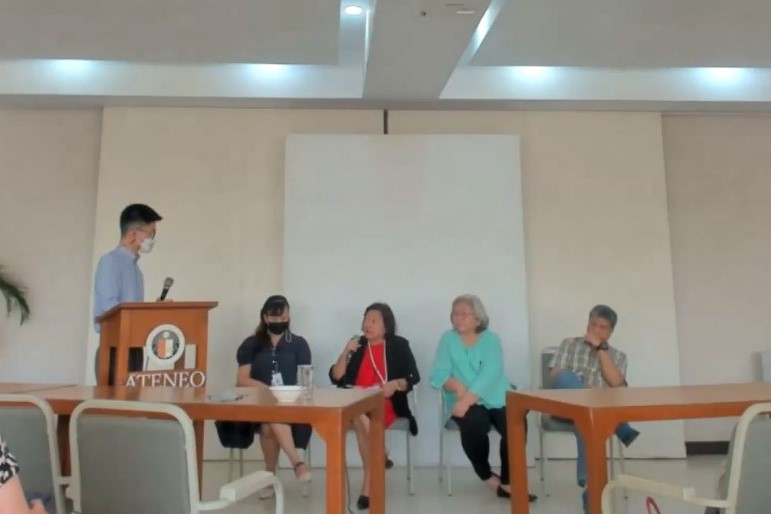
The flash talks were followed by an open forum. This touched on the paradigm of “research as care” in relation to co-production and co-generation, regional scale actions in the context of global stocktaking, balancing the day-to-day struggles of stakeholders when promoting climate research, and actionable steps that the younger generation may take towards climate action. Afterwards, Dr Theodore G Shepherd, Grantham Professor of Climate Science at the University of Reading, UK, and Co-Chair of the Scientific Steering Group of the My Climate Risk lighthouse activity of the World Climate Research Programme, delivered the Closing Remarks.
The session was attended by participants from the Philippines, with international participants from Argentina, South Africa, Switzerland, and the United Kingdom attending online. These participants represented the Hub’s partner institutions who are affiliated with the World Climate Research Programme. The highlights of the event are available in the following page.
Recent News
You may also like these articles
Why can’t we eradicate tuberculosis? AIS dissects the TB issue in a multidisciplinary panel
On 24 March 2026, the Ateneo Institute of Sustainability (AIS), through its Sustainable Development Goals (SDGs) Program, hosted a multidisciplinary panel in observance of World
AIS links with Masungi for systems thinking for environmental management
Last 23-24 March 2026, the Ateneo Institute of Sustainability (AIS) , which manages the My Climate Risk – Ateneo de Manila University Regional Hub
QS Subject Rankings 2026: Ateneo in top 100 for theology; ranked in 7 subject areas
Ateneo de Manila University is among the top institutions in seven subject areas, and among the top 100 for theological and religious studies, according to
Mangroves as shields of history and resilience: Insights from Dr Emma Porio
Mangrove forests have long shaped both the history and survival of coastal communities in the Philippines. According to Dr Emma Porio, Professor Emeritus (Sociology -
Professor Emeritus Dr Emma Porio to deliver keynote address at Regional Dialogue: Schools Climate Action Project
Dr Emma Porio, Professor Emeritus at Ateneo de Manila University's Dr Rosita G Leong School of Social Sciences (RGLSOSS) and Lead Author of UNFCCC-IPCC Climate
Klim@Musika
For most Filipinos, music is inseparable from daily existence. Music playlists accompany Filipinos in their commutes be it through walks, jeepneys, trains, or their private